
ChatGPT Ads vs. Google Ads: What Changes for Performance Marketing
ChatGPT ads vs. Google Ads: context instead of keywords, CPE instead of CPC. The full comparison performance teams should study before the German launch.
How Visible Is Your Business in AI Search?
Find out in 60 seconds. Our free AI Visibility Checker scans ChatGPT, Perplexity, and Google AI Overviews for your brand.
Check Your AI Visibility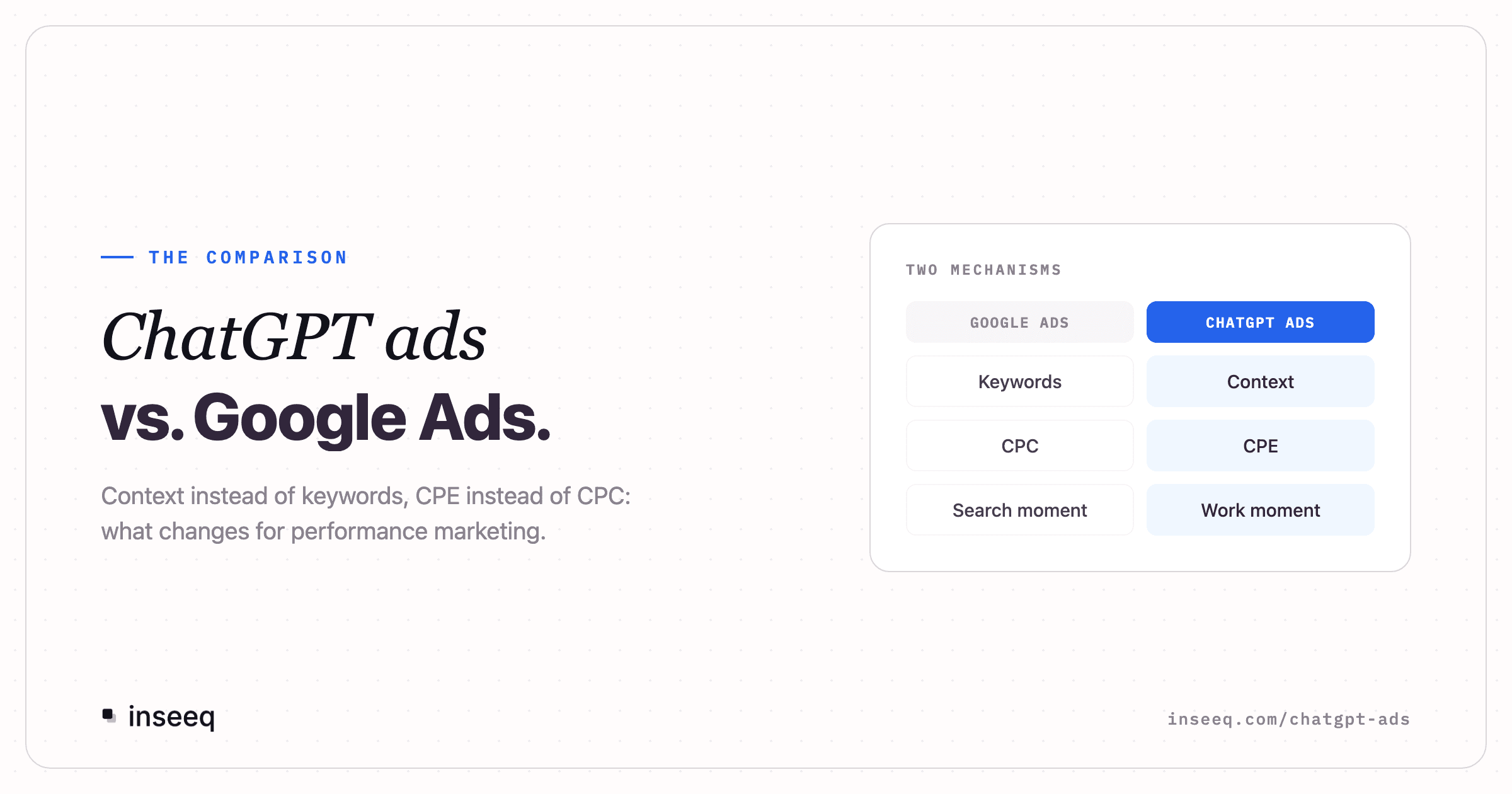
Comparison graphic ChatGPT ads vs. Google Ads: context instead of keywords, CPE instead of CPC, work moment instead of search moment
The head-to-head comparison: ChatGPT ads vs. Google Ads
Your performance team is planning next quarter, and for the first time a new line sits next to Google Ads in the draft: advertising in ChatGPT, officially announced for Germany and expected soon. The questions that follow are the ones every budget discussion produces: Is this the same thing in new packaging? Does it cannibalize search? And who on the team can even run it? A structured look at ChatGPT ads vs Google Ads gives a clear answer: this is not a second Google. It's a different mechanism, and that's precisely its value. Understanding it before the German launch is what turns launch day into execution instead of orientation.
The core differences at a glance:
Google Ads | ChatGPT ads | |
|---|---|---|
Trigger | Search query (a few words) | Conversation context (full history) |
Targeting | Keywords, audiences | Intent categories, context matching |
Billing | CPC / CPM | Cost per engagement (CPE) |
Placement | Above and beside search results | Labeled box below the answer |
Effect on the organic result | None | None (the answer stays untouched) |
Market maturity | Mature, heavily contested | Early, thin competition |
User situation | Looking for an answer | Working on a problem |
Every row of that table has consequences for strategy, team and budget. Some are obvious; others only show up in campaign practice. Here are the three shifts that matter most, followed by the equally important question of what doesn't change at all.
Article status: July 24, 2026. Based on the documented mechanics from live markets.
Shift 1: from keyword to intent
A search query compresses an intent into two to five words. A ChatGPT conversation spells it out. Google sees "CRM comparison mid-market." ChatGPT sees a conversation about a 20-person sales team that wants to switch tools, which integrations are non-negotiable, what made the last tool unusable, and when the decision needs to happen.
For advertisers this changes the basis of campaign planning. With Google you answer: which search terms does my audience type? With ChatGPT: in which conversation situations is my offer the right answer? A keyword tool answers the first question. Your sales calls, support tickets and knowledge of how customers actually talk about their problems answer the second.
The richness of context has a second effect: it removes a different kind of waste. The query "project management tool" can come from a student, an enterprise procurement manager or a two-person startup, and the ad reaches all three. The conversation makes those differences visible, and conversation complexity plus negative targeting lets you exclude the wrong contexts deliberately.
The match works accordingly: instead of keyword lists, advertisers define intent categories that the system matches against the full conversation context, refined by location, device, conversation complexity and negative targeting. The full mechanics are covered in our guide to ChatGPT ad formats and targeting.
The practical consequence for teams: the keyword research routine does not transfer. Translating your Google campaign structure one-to-one into intent categories plans past the system. The better path runs through a standalone intent map from which the campaign structure emerges fresh.
Shift 2: from click price to engagement
Google mostly bills per click; ChatGPT bills per interaction with the ad. The CPE model shifts risk toward the platform: impressions cost nothing, and you pay only when a user expands the ad, works with it, or clicks through to your landing page.
Three consequences follow:
Visibility is free. Every impression without an interaction is unpaid brand presence inside a topically matching conversation. That makes the channel interesting even for brands that get priced out of expensive CPCs on Google.
Relevance becomes the currency. A model that prices interaction rewards ads that hit their context. Generic messaging costs nothing and achieves nothing. The optimization work moves from bid management to the fit between intent, ad and destination page.
Price comparison needs a common denominator. CPC and CPE aren't directly comparable. The workable comparison metric is cost per lead after a few test weeks. Early data from live markets points to engagement prices at the level of mid-funnel search campaigns, and clearly below that in niches. The full cost logic including a worked example is in our analysis of ChatGPT ads cost.
Add the maturity gap. Google Ads is a saturated market with competition priced in. ChatGPT ads are a young market where, per Digiday, the advertiser count recently doubled inside a month. The early price window is real, and it's temporary, in every market that opens.
Shift 3: from search moment to work moment
The subtlest difference is strategically the biggest. Google catches people in the search moment: they have a question and want an answer. ChatGPT catches people in the work moment: they're planning, comparing, drafting, deciding. The user is deeper in the problem, has built more context, and sits closer to execution.
For traffic evaluation that means a visitor from a ChatGPT conversation carries a different history than a visitor from search. They've already thought through their requirements, often together with ChatGPT. Land them on a page that picks up that history and the path to conversion is short. Land them on a generic homepage and the paid engagement was worthless.
The bar for landing pages rises accordingly compared to classic search campaigns. Each intent cluster needs a destination that continues the conversation, loads fast, and offers one precise next step. The same logic extends to measurement: without a dedicated segment for conversational traffic in GA4 and an attribution chain to the lead, the work-moment advantage stays a hypothesis instead of a number.
The overlooked parallel: SEO is to Google what GEO is to ChatGPT
Comparing the ad systems is only half the map. Both worlds have an organic lever next to the paid one, and the relationship is structurally identical:
ChatGPT | ||
|---|---|---|
Paid | Google Ads | ChatGPT ads |
Organic | SEO (rankings) | GEO (citations in answers) |
Interplay | Ad plus top ranking dominates the results page | Ad plus citation in the answer dominates the conversation |
Every experienced team knows that paid and SEO together outperform either alone on Google. The same logic holds in the AI channel, only earlier and stronger: an ad next to an answer that already cites your brand meets built trust. An ad from a brand absent from the answer has to do all the trust-building in two lines. And unlike Google, where organic positions hardened over years, the citations in AI answers are still unclaimed in most categories.
For priorities, that means the organic AI lever is playable today, in every market, with no ad account required. Whether your brand appears in AI answers takes minutes to check with our free AI Visibility Check. Close the gaps you find, and your first campaign launches with organic tailwind.
What stays the same: the performance fundamentals
For all the differences, advertising in ChatGPT is still performance marketing, and the craft largely transfers:
Test logic: bounded budget, defined runtime, clear success criteria, then the scaling decision. Nothing new there.
Measurement discipline: UTM conventions, clean attribution, cost per lead as the cross-channel comparison metric.
Creative testing: multiple ad variants per context, tested systematically against each other.
Landing page quality: load time, clarity, conversion path. The bar is higher, the discipline identical. How we build pages for both traffic types is in our web and conversion work.
The restrictions rhyme too: no gambling, no weapons, no misleading financial products, stricter review for healthcare and financial services. And both systems keep paid and organic strictly apart: a Google ad doesn't improve your ranking, and a ChatGPT ad doesn't change the answer.
Teams with solid Google Ads practice bring more to this channel than the differences suggest. What they need to unlearn is exactly one habit: equating intent with search terms.
Replace or complement? The budget question
The question behind the question is usually: should we shift budget away from Google? The answer, for the foreseeable future: complement, don't replace.
Google remains the largest intent channel in the market, with unmatched reach in the search moment. But a growing share of research is moving into AI assistants, and with it the moments where purchase decisions get prepared. Play only search, and you slowly lose access to that pre-decision phase. Master both mechanisms, and you cover the full stretch from first work moment to final search.
A concrete way to picture the shift: when a user builds their vendor shortlist together with ChatGPT and googles afterwards, the search only decides among the candidates that made the list. Your Google ad still reaches them, but in a moment when the pre-selection already happened. Visibility in the work moment, paid through ads or organic through citations, increasingly decides who's on that list at all.
For budget planning, the concrete answer: an incremental test budget for ChatGPT ads, not a reallocation from working search campaigns. After four to eight test weeks, the cost-per-lead comparison delivers the data for a real allocation decision. Anything earlier is a gut call based on someone else's benchmarks.
How to test ChatGPT ads alongside Google Ads
A clean parallel test follows a simple pattern, and most of it is buildable before you spend:
Build the intent map: your audience's conversation situations, structured by research, comparison, problem solving and implementation. It's the foundation of the campaign structure.
Build landing pages per intent cluster: two to four pages that continue conversations instead of answering queries.
Align measurement: the same cost-per-lead definition as Google, a dedicated GA4 segment for the new channel, clean UTM separation.
Release the test budget: enough for several hundred engagements over four to eight weeks, incremental to search.
Compare after the test: cost per lead, lead quality, and which intent categories performed. Then, and only then, the allocation decision.
Steps 1 through 4 are exactly the preparation we describe in detail in our guide to preparing for ChatGPT ads. Finish them before your launch window and the parallel test starts on day one. Where your market sits in the rollout is tracked in our Germany launch tracker.
Frequently asked questions about the comparison
Are ChatGPT ads an alternative to Google Ads?
More of a complement. Google dominates the search moment; ChatGPT reaches users earlier, during work and decision-making. The channels cover different phases of the same journey, and teams that play both cover the stretch from pre-decision to final comparison.
Should I shift budget from Google to ChatGPT?
Not before your own test. The clean path is an incremental test budget, a cost-per-lead comparison after four to eight weeks, and a data-based allocation decision then. Weakening working search campaigns for an untested channel is a bet without a basis.
What's the biggest difference for performance teams?
Targeting. Keywords give way to intent categories and context matching. The keyword research routine doesn't transfer; the rest of the performance craft, from test logic to measurement discipline, largely does.
Is ChatGPT traffic better than Google search traffic?
It's different: users arrive with more context and often closer to a decision. Whether that becomes better leads depends on whether your landing pages pick up that history. Cross-market data is early; your own test data beats any benchmark.
Do ChatGPT ads influence the assistant's answers?
No. Ads appear as a labeled box below the answer and never change its content, exactly as a Google ad never changes the organic ranking.
Can my Google Ads team run ChatGPT ads?
In most cases yes, with a learning curve on context targeting. The biggest shift is conceptual: conversation situations instead of search terms. Building the intent map together with sales and support helps, because that's where the knowledge of real conversations lives.
What happens to my Google campaigns if ChatGPT ads work?
Ideally they get sharper. Learnings from context targeting, like which situations and phrasings generate engagement, improve search ads and landing pages too. In return, your Google data supplies the first draft of the intent map. The channels compete for budget and learn from each other.
Master both mechanisms before the German launch
The question isn't whether ChatGPT ads beat Google Ads. It's whether your team masters both mechanisms while the customer journey stretches across both. Context targeting, CPE logic and work-moment traffic are learnable, and they're cheapest to learn in a market's early phase, when mistakes cost little and data is worth a lot. The German launch offers a rare setup for that: every German-registered advertiser starts on the same day, and preparation decides who moves through the learning curve first.
We prepare a limited number of companies for that parallel setup, including the test design alongside existing Google campaigns. If you want to run the comparison on your own data from day one of the German market, get the launch briefing. The current status lives in our ChatGPT ads in Germany hub.

Hans-Peter Frank
Co-founder
How Visible Is Your Business in AI Search?
Find out in 60 seconds. Our free AI Visibility Checker scans ChatGPT, Perplexity, and Google AI Overviews for your brand.
Check Your AI Visibility