
ChatGPT Ad Formats, Placement and Targeting Explained
What ads look like in ChatGPT, where they appear, and how targeting works without keywords. Everything advertisers should know before the German launch.
How Visible Is Your Business in AI Search?
Find out in 60 seconds. Our free AI Visibility Checker scans ChatGPT, Perplexity, and Google AI Overviews for your brand.
Check Your AI Visibility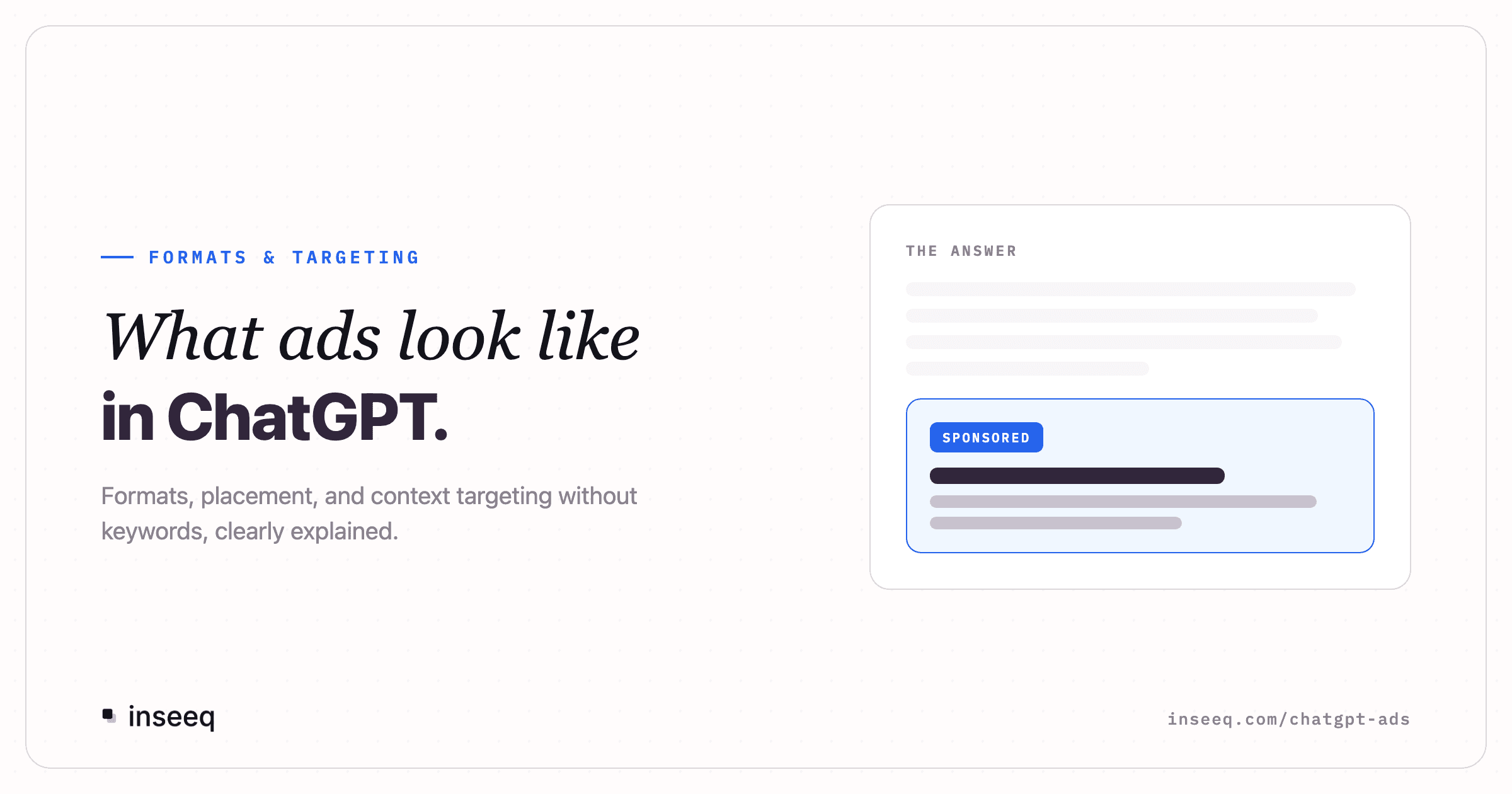
Graphic on ChatGPT ad formats: schematic of an answer with a clearly labeled sponsored ad box below it
Where ads appear in ChatGPT and who sees them
Picture a user who just asked ChatGPT how to digitize the bookkeeping of a 15-person company. They get a thorough answer, and directly beneath it appears a subtly separated, clearly labeled box: an ad from an accounting software vendor. No interruption, no banner, no popup. That's the core idea behind the ChatGPT ad formats, and understanding it explains why this channel plays by different rules than search advertising. It's also the system German advertisers will inherit at launch: the formats and targeting mechanics described here are consistent across every market that has opened, so everything below is directly learnable before Germany goes live.
Before the formats themselves, the ground rules. Ads are shown exclusively to logged-in adult users on the free tier and the low-cost Go subscription. The paid tiers Plus, Team and Enterprise stay completely ad-free. Ads appear below the answer, never inside the text, and they're unmistakably labeled as advertising.
The most important principle: the ad does not influence the answer. ChatGPT doesn't recommend a product in its response because the manufacturer paid. Organic answer and paid ad are strictly separated. For advertisers that means an ad buys visibility in the conversation context, not an endorsement from the model. Confusing the two leads to planning with the wrong expectation.
Article status: July 24, 2026. Based on the publicly documented formats from live markets.
The ChatGPT ad formats in detail
The launch format is deliberately simple. An ad consists of three building blocks:
Headline: short, tied to the conversation context
Description: a few lines connecting the conversation to the offer
Optional rich media: product imagery or visual elements that elevate the unit
Plus the click-through to the landing page as the actual conversion element. Reporting by AdVenture Media from the first months of US campaigns shows the system rewarding ads that read like a natural continuation of the conversation with markedly higher interaction rates than generic messaging.
OpenAI has also announced a second generation of formats: interactive ads. These include product configurators, calculators and embedded demos that run directly inside the ad unit. The ad effectively becomes a mini landing page where a user takes their first steps before ever visiting the advertiser's site.
The early advertiser mix suggests the format carries a wide range of offers: among the self-serve launch campaigns were Best Buy, Lowe's and VistaPrint, spanning electronics retail, home improvement and print services. Both considered purchases and quick buys seem to work, as long as the conversation context fits.
For campaign planning that means strong copy and a good visual concept are enough to start. But if your product can be configured, calculated or demonstrated, think the interactive formats through from the beginning. The companies with concepts ready will be the first to use them.
Targeting without keywords: intent categories and conversation context
The biggest difference from Google Ads isn't in the formats. It's in the targeting. There are no keywords. Instead, advertisers define intent categories: topical and intent spaces where their ad is relevant. The system matches those categories against the full context of the conversation, not against individual search terms.
The difference is fundamental. A search query compresses an intent into two to five words. A ChatGPT conversation spells it out across multiple messages: the starting situation, the constraints, the failed attempts, the budget. The system doesn't see "accounting software comparison." It sees a conversation about a trade business with 15 employees, an accountant who needs specific integrations, and a spreadsheet setup that finally broke.
For advertisers, the central question shifts. It's no longer: which keywords does my audience search? It's: in which conversation situations is my offer the right answer? The first question is answered by a keyword tool. The second is answered by your sales calls, support tickets and the questions prospects ask before they buy.
That preparation is the part of targeting you can build before spending anything, in any market. How to construct an intent map for your category is covered in our guide to preparing for ChatGPT ads.
The targeting options at a glance
Beyond intent categories, the system offers a set of refinement options:
Targeting dimension | What it controls | Comparable to |
|---|---|---|
Intent categories | The conversation contexts where the ad appears | Keyword themes, but context-based |
Location | Geographic scoping | Geo targeting in Google Ads |
Device type | Desktop or mobile | Device targeting |
Conversation complexity | How deep the user is in the topic | Rough funnel-stage logic |
User tenure | How long someone has used ChatGPT | No direct equivalent |
Negative targeting | Contexts where the ad must not appear | Negative keywords |
Dayparting | Days and times | Ad scheduling |
Two of these deserve special attention because search advertising has no equivalent. Conversation complexity allows a rough split between users who are orienting themselves and users deep inside a problem, effectively funnel-stage control at the conversation level. And negative targeting matters more in a context system than in a keyword system: it keeps your ad out of topically adjacent but wrong conversations, like students researching a subject rather than decision makers evaluating a solution.
A worked example: from conversation to matching ad
How context, targeting and format interact is easiest to see in a played-through example. A payroll software vendor wants to reach mid-sized companies.
The conversation: an HR lead describes her situation to ChatGPT. The company is growing from 40 to 70 employees, outsourced payroll is getting expensive, a switch is on the table, but the accountant integration has to survive the migration. She asks for options and criteria.
The targeting: the vendor has booked an intent category around payroll processes, provider switching and HR digitization, scoped to their market and high conversation complexity. Student research and basic definition questions are excluded via negative targeting.
The ad: the headline speaks to the situation, not the product: growing mid-sized companies and payroll with accountant integration. The description names the two criteria that already came up in the conversation. The click leads to a landing page about exactly this switching scenario, not to the homepage.
The difference from a search ad is the precision of the situation. The query "payroll software" reveals almost nothing about context. The conversation reveals almost everything. Ads that use that knowledge read less like advertising and more like a sensible next step, and the billing model rewards exactly that: you pay per interaction, and users interact with relevance. The pricing details live in our analysis of ChatGPT ads cost.
Writing ads for conversations: three rules
The formats are lean, so every sentence carries weight. From the first months of live campaigns, three copy rules separate ignored ads from clicked ones.
Rule 1: Address the situation, not the product. The user is mid-problem. A headline that mirrors the problem gets read. A headline that leads with a company name or slogan gets skipped. The place for self-presentation is the landing page, not the ad.
Rule 2: Respect the conversation's knowledge level. Advertising in high-complexity conversations means no basics. The user just worked through the basics with ChatGPT. The ad has to offer the next step: the comparison, the demo, the concrete tool.
Rule 3: Test variants per intent category. An ad that runs in every context is precise in none. The lean formats make variants cheap. Two or three versions per intent category, differing in tone and entry point, produce a clear picture within weeks of which approach works in which context.
These rules share one requirement: cleanly defined intent categories. Copywriting and targeting aren't separate disciplines in this channel. They're two sides of the same preparation.
Measurement: metrics for a conversational channel
ChatGPT ads ship with classic advertising metrics plus several conversation-specific ones. The key measures:
Engagement rate: share of impressions with active interaction, the core efficiency metric of the CPE model
Clicks to landing page: the classic traffic value
Conversation continuation after ad contact: how often users continue the topic after seeing the ad, an indicator of relevance rather than interruption
Brand mention rate: how often the brand shows up in conversations after ad contact
On your own side, the craft matches every other paid channel: consistent UTM parameters, a dedicated segment for conversational traffic in GA4, and an attribution chain to the lead. Only that chain turns platform metrics into a business statement. A high engagement rate is pleasant, but the question your leadership will ask is: what does a qualified lead from this channel cost compared to Google Ads? How the two channels compare systematically is the subject of ChatGPT ads vs. Google Ads.
One point deserves emphasis: the landing page is part of the measurement chain. Conversational traffic arrives with context. A page that ignores that context and starts from zero loses visitors who were ready to act, and it distorts your evaluation of the whole channel. Fast, topically precise destination pages aren't polish here; they're a prerequisite. How we build them is documented in our web and conversion work.
Restrictions and regulated industries
Not every industry can advertise freely. Excluded categories include gambling, weapons, adult content, illegal products and misleading financial offers. Heavily regulated industries like healthcare and financial services go through stricter review before campaigns run.
The review covers content as well as category: misleading claims and unsupported effect statements fail approval regardless of who submits them. Advertisers in regulated industries should budget the approval process into their launch planning rather than discovering it during it. For the German market specifically, labeling and data-use requirements from GDPR and the Digital Services Act apply on top, plus German advertising law (UWG); the clear ad labeling and the strict separation of answer and ad work in advertisers' favor there, and they're likely part of why the European rollout is arriving market by market. When Germany opens, and which signals narrow the window, is tracked in our ChatGPT ads Germany launch tracker.
Frequently asked questions about formats and targeting
What do ads look like in ChatGPT?
A clearly labeled, visually separated box below the answer, consisting of a headline, a short description and optional imagery. Ads never appear inside the answer and never change its content.
Can an ad influence what ChatGPT recommends?
No. Organic answer and ad are strictly separated. An ad buys visibility in a matching conversation context, not a product recommendation in the answer text. Appearing inside answers requires organic AI visibility, the discipline known as GEO.
How does targeting work without keywords?
Through intent categories: topical intent spaces the system matches against the full conversation context, refined by location, device, conversation complexity, user tenure, negative targeting and dayparting.
Which formats exist at launch?
Text ads with headline, description and optional rich media, plus the click-through to a landing page. Announced beyond that: interactive formats like configurators, calculators and embedded demos inside the ad unit.
Who sees ads and who doesn't?
Logged-in adult users on the free tier and the Go subscription see ads. Plus, Team and Enterprise stay ad-free. That caps the inventory and makes precise targeting more valuable.
Which industries can't advertise?
Excluded: gambling, weapons, adult content and misleading financial products, among others. Healthcare and financial services face stricter review processes and should plan time for approval.
What can I prepare before my market opens?
The intent map: a structured survey of the conversation situations where your audience discusses your category. The sources already exist in your company: sales calls, support tickets and your search data. The map later converts directly into campaign structure and ad variants.
Does Google Ads experience transfer to ChatGPT ads?
Partly. The craft around budget control, test logic and measurement transfers well. The keyword mindset doesn't: contexts aren't search terms, and no keyword list substitutes for understanding conversation situations. Teams that separate the two learn the channel fastest.
Know the formats before Germany opens
The mechanics of ChatGPT ads are quickly explained: lean labeled formats, targeting through conversation contexts, billing per interaction. The real work is understanding your audience's conversation situations, and that work is fully doable before the German launch. Whoever has their intent map, ad variants and landing pages ready when the German window opens starts with an advantage nobody can catch up on later: the first weeks of campaign data in uncontested contexts.
We prepare a limited number of companies for exactly that start: from intent map to ad concepts to landing pages and measurement. If you want to launch with finished campaign concepts, get the launch briefing. The current status of the German market is tracked in our ChatGPT ads in Germany hub.

Hans-Peter Frank
Co-founder
How Visible Is Your Business in AI Search?
Find out in 60 seconds. Our free AI Visibility Checker scans ChatGPT, Perplexity, and Google AI Overviews for your brand.
Check Your AI Visibility