
What Will ChatGPT Ads Cost in Germany? Pricing Model, Benchmarks and Budgets
ChatGPT ads bill per engagement, not per click. How CPE pricing works, early benchmarks from live markets, and how to size a test budget for the German launch.
How Visible Is Your Business in AI Search?
Find out in 60 seconds. Our free AI Visibility Checker scans ChatGPT, Perplexity, and Google AI Overviews for your brand.
Check Your AI Visibility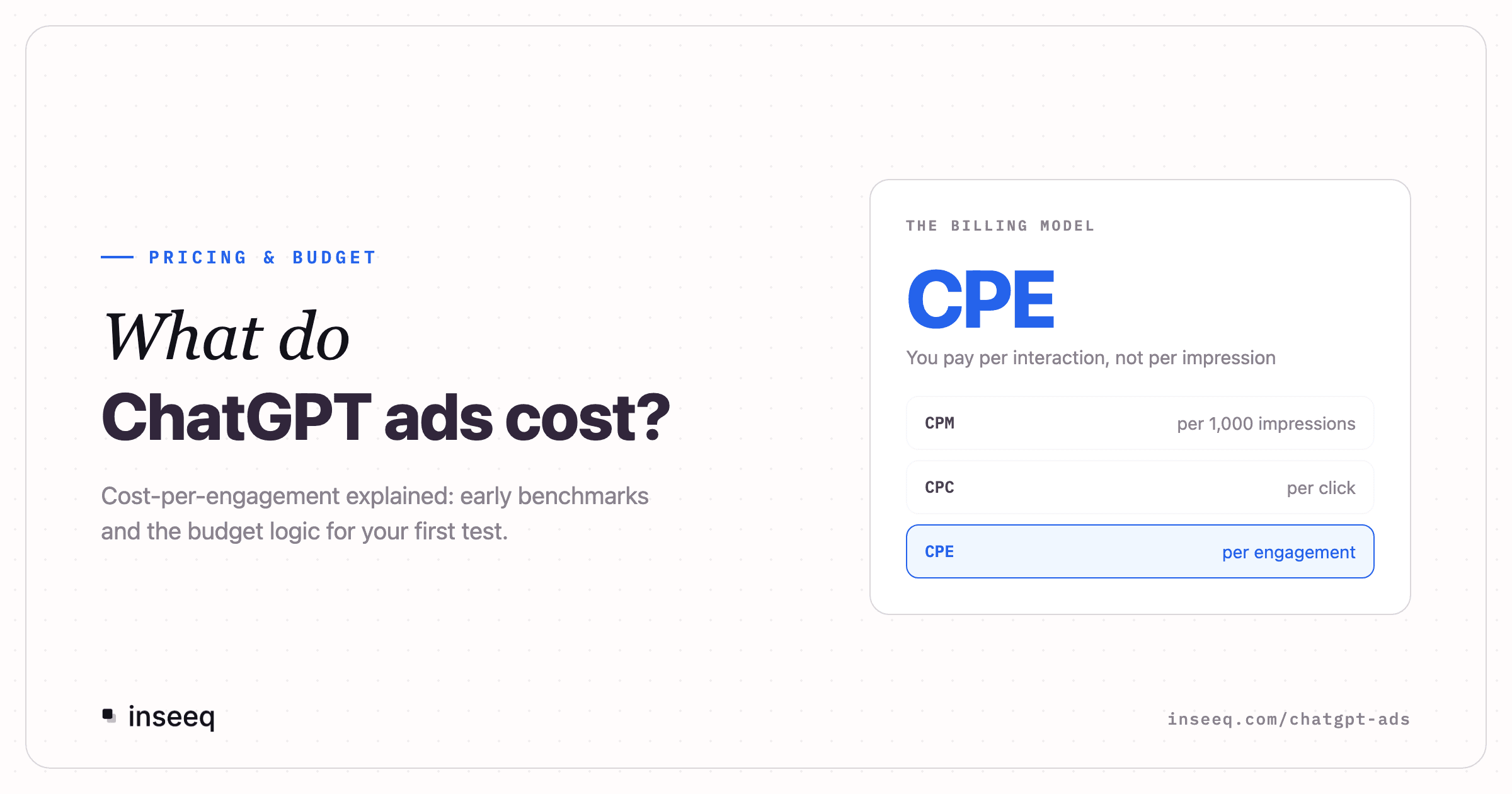
Graphic on ChatGPT ads cost: the cost-per-engagement model (CPE) compared with CPM and CPC, paying per interaction instead of per impression
The pricing model: cost-per-engagement, not cost-per-click
Your media plan for the German market is nearly done when a new line item appears: advertising in ChatGPT, officially announced for Germany and expected to launch soon. The first question from leadership is predictable: what does it cost? The honest answer has two parts. There is no German pricing yet, and no official rate cards exist even in the US. But the pricing model is public, it's consistent across every market that has opened, and it works differently from everything you know from Google or Meta. Which means the cost logic for the German launch is already learnable today.
ChatGPT ads cost follows a cost-per-engagement (CPE) model: you pay when a user interacts with your ad, not when it's shown. Interaction means expanding the ad, using its rich media elements, or clicking through to your landing page. A plain impression costs nothing. US agency AdVenture Media documented the model in detail from the first months of live campaigns.
That one design choice has a remarkable property: visibility is free. Your brand appears directly beneath an answer the user is actively reading, in a conversation about your category, and you're only charged when genuine interest shows up. For well-targeted campaigns that's a structurally cheap setup. For poorly targeted ones it's the opposite of a bargain: you don't lose money, you just don't happen.
In this article we place the CPE model next to CPC and CPM, summarize the benchmarks that exist, run a worked budget example, and cover the part of the bill that media plans tend to forget: landing pages, tracking and the work on conversation intents.
Article status: July 24, 2026. All numbers come from live markets, primarily the US.
CPE vs. CPC vs. CPM: the billing models compared
To place CPE, compare it with the two billing logics that dominate digital advertising:
Model | You pay for | Typical channel | Risk sits with |
|---|---|---|---|
CPM (cost per mille) | 1,000 impressions | Display, social reach | Advertiser |
CPC (cost per click) | Each click | Google Ads, paid social | Shared |
CPE (cost per engagement) | Active interaction with the ad | ChatGPT ads | Platform |
With CPM you carry the full risk: whether anyone cares about the impression is your problem. With CPC you pay for visitors, including misclicks and bounces. With CPE the risk shifts further toward the platform: OpenAI only earns when your ad demonstrably created interest.
The flip side: a model that prices interaction rewards relevance. Generic ads generate no engagement in a conversational context. They cost nothing, and they achieve nothing. The optimization work moves from bid management to the fit between conversation, ad and landing page.
The benchmarks so far
Hard rate cards don't exist, because prices form dynamically through competition for conversation contexts. What exists are consistent reports from early advertisers, and two patterns stand out:
In competitive categories like software, financial products and contested e-commerce, engagement costs land roughly at the level of mid-funnel Google search campaigns.
In niche categories engagement prices run considerably lower, simply because few advertisers compete for the same conversation contexts.
The important context: these prices are a snapshot of a young market. According to Digiday, the advertiser count recently doubled within a single month, and OpenAI keeps expanding to new countries. Prices form through competition, and competition is compounding.
A structural factor adds pressure: inventory is finite. Ads only reach logged-in adult users on the free tier and the Go subscription, while Plus, Team and Enterprise stay ad-free. A capped supply meeting fast-growing demand means rising prices wherever multiple advertisers want the same contexts.
For Germany, the pattern across every market so far points one way: the cheapest engagement prices a market ever offers exist in its first weeks after launch. Since no German-registered company can enter early, everyone's first weeks are the same weeks, and the companies that arrive with finished preparation capture them. When that launch is likely to come, and which signals narrow the window, is tracked in our ChatGPT ads Germany launch tracker.
A worked example for the test phase
Here's what a budget calculation can look like. Every number is an assumption for illustration, not market data. Suppose a B2B software company starts with a €5,000 monthly test budget and pays an average of €2.50 per engagement:
Metric | Assumption | Result |
|---|---|---|
Monthly budget | €5,000 | |
Cost per engagement | €2.50 (assumption) | 2,000 engagements |
Click-through to landing page | 25% of engagements | 500 visitors |
Landing page conversion rate | 4% | 20 leads |
Effective cost per lead | €250 |
The math teaches two lessons. First, the effective cost per lead reacts strongly to the two downstream levers: double the landing page conversion rate from 4 to 8 percent and your cost per lead halves to €125 without the media price moving at all. Second, whether €250 per lead is good or bad depends entirely on your reference value from existing channels. That's why the benchmark belongs in place before the first campaign, not after it.
Sizing a test budget: the three-step logic
Without official pricing, annual planning is fake precision. What works instead is a contained test with a clear decision at the end.
Step 1: A test budget, not a commitment. OpenAI itself courts test budgets in new markets rather than pushing minimum contracts. Plan a bounded amount for four to eight weeks, sized to produce at least several hundred engagements, so you get statistically usable data instead of anecdotes. For most B2B companies that means a mid four-figure amount per month.
Step 2: Set the bar before the first campaign runs. Take your current cost per lead from Google Ads or LinkedIn as the reference. ChatGPT ads don't have to beat it immediately. But after four to eight weeks the direction must be visible, and lead quality has to hold up.
Step 3: Scale, optimize or pause. With test data in hand, the decision is real rather than speculative. The CPE model makes the review comparatively clean, because every euro spent bought a measurable interaction.
This logic only works if the measurement chain exists. Without tracking from ad to lead, step 2 is impossible. The setup work is covered in our guide to preparing for ChatGPT ads.
What really drives your cost: context fit
In Google Ads the auction bid decides. In ChatGPT ads, relevance inside the conversation decides. Targeting runs on intent categories matched against the full conversation context, not on keywords. An ad that hits its context precisely earns more engagement at the same price. An ad that misses it earns nothing.
Which leads to the most important cost rule for this channel: your effective cost per result depends less on the market price than on your preparation. Three factors make the difference:
Precise intent definition: knowing your audience's conversation situations means buying the right contexts instead of broadcasting.
Ads that continue the conversation: headline and copy must speak to the situation, not recite your company description.
Landing pages that pick up where the conversation left off: a user arriving mid-conversation who lands on a generic homepage is a paid engagement with zero value.
All three factors are buildable before you spend anything, in any market. That's the real cost advantage of preparation: it's not early access that makes the channel cheap, it's fit from day one.
The hidden costs: landing pages, tracking, creative
Media budget is only part of the bill. A serious test includes three more items that budget discussions like to skip.
Landing pages. Conversational traffic needs its own destinations, one per intent cluster. Existing SEO landing pages rarely answer a conversation that's already three levels deeper than a search query. Plan for building or adapting two to four pages. How we build fast, converting pages is documented in our web and conversion work.
Tracking and attribution. UTM conventions, GA4 configuration and a dedicated segment for AI traffic are prerequisites, not extras. Without that chain you can't say what a ChatGPT lead actually cost. The effort is small when done before the first campaign and annoyingly expensive when retrofitted.
Ad creative. The formats are text-first and lean; production cost per ad is far below video or display. The real effort sits in researching conversation intents and testing multiple variants per context. The available formats are covered in our overview of ChatGPT ad formats and targeting.
As a rough shape for an eight-week test: media spend ends up at half to two thirds of the total, and the rest is preparation and infrastructure that doesn't recur when you scale.
The unpaid part of the equation: visibility in the conversation
One property of the CPE model deserves its own look, because it appears in no cost calculation: every impression without an interaction is free brand visibility, in an unusually attentive moment. The user is reading an answer to their own question, and your brand sits directly beneath it, in context.
The effect compounds when your brand also shows up organically in AI answers. An ad next to an answer that already cites you meets recognition instead of cold contact. Paid and organic AI visibility aren't separate disciplines; they're two levers on the same moment of the customer journey. How companies build the organic lever is the domain of GEO, covered in our inbound and organic demand work.
For budget planning this means the measured cost per lead systematically understates the channel's value as long as the branding effect of unpaid impressions goes uncounted. That's no reason to skip measurement. It is a reason not to judge the channel on the first cost-per-lead comparison alone.
Frequently asked questions about ChatGPT ads cost
What does a ChatGPT ad actually cost?
There are no official price lists in any market. Prices form dynamically through competition for conversation contexts. Early advertisers report engagement costs comparable to mid-funnel search campaigns, and considerably less in niches where few brands compete for the same conversations.
What counts as an engagement?
An active interaction with the ad unit: expanding the ad, using rich media elements, or clicking through to the landing page. Plain impressions are free. The announced interactive formats, like configurators and embedded demos, will likely widen the range of billable interactions.
Is there a minimum budget?
No official minimum is known. OpenAI works with test budgets in new markets rather than minimum contracts. For statistically usable results, size the budget to produce several hundred engagements; below that, every result stays an anecdote.
Are ChatGPT ads cheaper than Google Ads?
There's no general answer, because the models bill differently. In less contested categories, advertisers report lower engagement prices. The fair comparison runs through cost per lead after a few test weeks, not through price per click versus price per engagement.
Will prices rise as more markets open?
The pattern so far says yes: as advertiser counts grow, competition for attractive conversation contexts grows, and prices with it. The advertiser base recently doubled within a month. Early entrants in each market see the lowest prices, and there's no mechanism in sight that would reverse that dynamic while inventory stays capped to the free and Go tiers.
What costs come on top of media spend?
Landing pages per intent cluster, a tracking setup with GA4 and lead-level attribution, and the research and production of ad variants. These are mostly one-time preparation costs that don't recur at scale.
How fast will I know whether ChatGPT ads pay off?
With clean tracking, four to eight weeks of test runtime produce a usable picture: enough engagements to see patterns across contexts, enough leads for a first cost-per-lead comparison against Google Ads or LinkedIn. Without prepared measurement, add exactly the time the retrofit takes.
Go into the German launch with a calculated budget
The cost question for ChatGPT ads in Germany is mostly a preparation question. The pricing model is known, the test logic is straightforward, and the factors that determine your effective costs sit almost entirely in your own hands: intents, ad fit, landing pages, measurement. Do that homework before the German launch and you buy in the cheapest window the market will ever offer, and you'll know after eight weeks what a lead truly costs. Skip it and you pay the same market price without being able to judge the result.
We prepare a limited number of companies for the German launch, including budget sizing and defined success criteria for the test phase. If you want to start with a calculated plan instead of a guess, get the launch briefing. The current status of the German market lives in our ChatGPT ads in Germany hub.

Hans-Peter Frank
Co-founder
How Visible Is Your Business in AI Search?
Find out in 60 seconds. Our free AI Visibility Checker scans ChatGPT, Perplexity, and Google AI Overviews for your brand.
Check Your AI Visibility