
How to Prepare for ChatGPT Ads in Germany: 4 Steps to Launch-Ready
ChatGPT ads are coming to Germany. These four steps make your company launch-ready: AI visibility, conversation intents, landing pages and measurement.
How Visible Is Your Business in AI Search?
Find out in 60 seconds. Our free AI Visibility Checker scans ChatGPT, Perplexity, and Google AI Overviews for your brand.
Check Your AI Visibility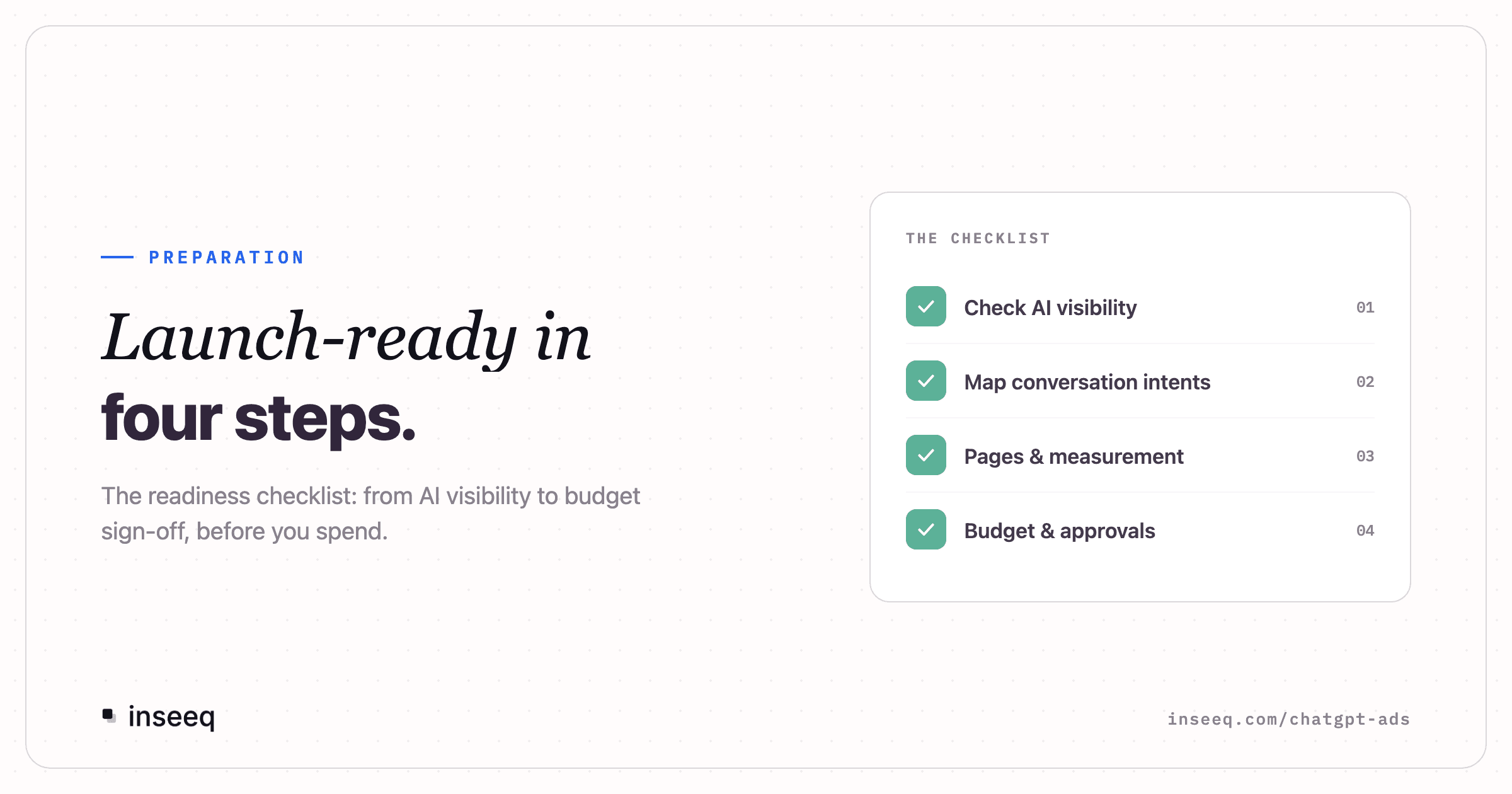
Graphic on preparing for ChatGPT ads: four-step checklist covering AI visibility, conversation intents, landing pages and measurement, budget and approvals
Why readiness beats access
It's a Monday morning in the near future. OpenAI has opened the German market for advertising, the trade press is covering it, and someone in your marketing meeting asks: shouldn't we be in there? From that moment, two clocks run. One measures how fast your company becomes campaign-ready: defining intents, building landing pages, wiring up tracking, releasing budget. The other measures how fast your competitors do the same. How you prepare for ChatGPT ads before the German launch decides which of those clocks works for you.
The reason sits in the channel's mechanics. ChatGPT ads bill per engagement, and prices form through competition for conversation contexts. In the US, the advertiser count doubled within a single month according to Digiday. The cheapest weeks of any market are its first ones, and nobody gets them back.
The German launch adds a rare equalizer: since OpenAI admits advertisers only from markets that are already live, no German-registered company can build domestic campaign experience in advance. Everyone starts the same day. Preparation is the only competitive dimension that's open before launch, which makes it worth more here than in any mature channel. The good news: it's fully plannable. Four steps, in the right order.
Article status: July 24, 2026. The current status of the German market is tracked in our continuously updated hub.
Step 1: Check and build your AI visibility
The first step looks like it has nothing to do with advertising, which is exactly why it gets skipped. ChatGPT ads appear in the context of conversations about your category. The question to answer before any campaign: does your brand appear in those conversations at all?
Two reasons make organic AI visibility the foundation of ad readiness:
Ads and mentions compound. An ad next to an answer that already cites your brand meets recognition. An ad from a brand the answer never mentions has to build trust alone, in two lines of copy.
Visibility work is targeting practice. Working systematically on getting cited in AI answers forces you to learn how your audience talks to AI systems about your category. That knowledge later becomes your intent categories.
The pragmatic entry point: check where you stand. Our free AI Visibility Check shows in minutes whether and how your brand appears in AI answers. The gaps it finds become the work program: content AI systems can cite, structured by the rules of Generative Engine Optimization, from the architecture of existing pages to new content for your category's questions to the signals AI systems read as authority. How companies build that organic lever systematically is our inbound and organic demand work.
Time required: the check takes minutes; building visibility takes weeks to months. Which is why this step comes first, not last.
Step 2: Map conversation intents instead of researching keywords
ChatGPT ad targeting runs on conversation contexts and intent categories, not keyword lists. The decisive preparation is therefore an intent map: a structured survey of the situations in which your audience talks to ChatGPT about your category.
Three sources you already own supply the material:
Sales calls: how do prospects describe their problem before they know your solution? The language of the first five minutes of a discovery call is the language those same people use with ChatGPT.
Support and pre-sales tickets: which questions recur? Every recurring question marks a conversation context where your category gets negotiated.
Existing search data: behind every keyword in your Google Ads and Search Console history sits an intent. Translate the keyword into the spelled-out situation: "switch CRM" becomes the conversation of a sales lead whose team refuses to use the current tool.
Structure the results by conversation situation: research, comparison, problem solving, implementation. For each, note which of your offers is the right answer and what next step genuinely helps the user. Here's what a slice of an intent map can look like for a fictional project management tool:
Conversation situation | Example context | Right next step |
|---|---|---|
Research | Team growing, tasks getting lost in email | Tool selection guide |
Comparison | Two tools shortlisted, criteria unclear | Comparison page with decision matrix |
Problem solving | Current tool ignored by the team | Case study on adoption |
Implementation | Migration planned, effort unclear | Migration checklist plus demo |
This map converts directly into campaign structure on day one: every row is an intent category with its own ad and its own landing page. How the targeting mechanics work in detail is covered in our guide to ChatGPT ad formats and targeting.
Time required: with existing data, a solid first intent map takes one to two weeks.
Step 3: Build landing pages and measurement
Conversational traffic differs from search traffic in one decisive way: the user arrives mid-conversation. They've described their situation, compared options, developed criteria. A generic homepage throws them back to zero, and they leave.
Two work packages follow:
Landing pages per intent cluster. Every important conversation situation from your map needs a destination that picks the situation up: fast loading, precise in its opening, with one clear next step. Two to four pages cover a launch if they cover the right situations. Existing SEO pages can sometimes be adapted, but the bar is different: the page has to continue a conversation, not answer a search query. How we build such pages is documented in our web and conversion work.
Measurement to the lead. Before the first campaign: a consistent UTM convention for the new channel, a dedicated segment for AI and conversational traffic in GA4, and an attribution chain that maps the path from ad to qualified lead. Without that chain you can't say after four weeks what a ChatGPT lead costs, and the test was pointless.
Time required: landing pages and tracking are realistic in two to four weeks, in parallel with step 2.
Step 4: Set budget and internal approvals
The least glamorous step is the most common bottleneck in practice. It's rarely the technology that delays a launch. It's the internal sign-off. Three things belong in place before day one:
A defined test budget for the first four to eight weeks. OpenAI works with test budgets in new markets rather than minimum contracts. For statistically usable results, the budget should produce several hundred engagements; for most B2B companies that's a mid four-figure amount per month. The full sizing logic, including a worked example, is in our analysis of ChatGPT ads cost.
Defined success criteria. Your current cost per lead from Google Ads or LinkedIn as the bar, plus the pre-agreed decision: scale, optimize or pause.
The approval itself. Anyone who knows their company's decision paths knows: between "we should do this" and "it's signed off" lie weeks in many organizations. Those weeks cost nothing before launch and cost market time after it.
A one-page internal document helps: why this channel, what the test costs, how success is measured. It speeds up the approval, disciplines your own planning, and becomes the decision template for scaling after the test. The articles in this cluster supply the arguments, from market development to cost logic.
The readiness checklist at a glance
The four steps with their outputs and realistic time frames:
Step | Output | Time required |
|---|---|---|
1. AI visibility | Status checked, gaps in progress | Check: minutes; building: ongoing |
2. Intent map | Conversation situations structured, campaign structure ready | 1 to 2 weeks |
3. Landing pages & measurement | 2 to 4 destination pages, UTM convention, GA4 segment, attribution | 2 to 4 weeks |
4. Budget & approvals | Test budget, success criteria, internal sign-off | Depends on the company |
Steps 2 and 3 run comfortably in parallel. Starting today means being fully ready in four to six weeks, a time frame that fits the realistic scenarios for the German launch. Which signals narrow the launch window is documented in our ChatGPT ads Germany launch tracker.
Launch day itself: what's left to do
When preparation is done, launch day shrinks to a manageable sequence. Open the account through the available route, whether the self-serve Ads Manager, OpenAI's team, or an ad-tech partner like Criteo or StackAdapt. Transfer the campaign structure from the intent map. Load the ad variants, set budgets, verify tracking parameters, go live.
Teams that prepared this sequence are in the market on day one and collecting data from week one. From there the real work begins, the part that can't be front-loaded: watching which intent categories generate engagement, testing ad variants against each other, sharpening landing pages, and making the scaling decision after four to eight weeks. At that point the difference from your competitors is no longer knowledge. It's a data head start.
The honest part: what you can't prepare
One thing belongs in every serious preparation plan: a clear picture of what preparation can and cannot deliver.
What you can't prepare is German campaign data. Nobody knows Germany's engagement prices, the actual performance of specific intent categories with German audiences, or local conversion patterns. Including anyone who claims otherwise: since OpenAI gates access by company registration, no German-registered provider or agency has run a domestic ChatGPT campaign. Credible partners say that openly and base their value on the transferable disciplines, not on an experience lead that structurally cannot exist.
What you can prepare are exactly those disciplines: the understanding of conversation intents, the quality of the landing pages, the cleanliness of the measurement, the speed of internal decisions. Those decide how fast the first weeks of market data become a working channel. The gap between prepared and unprepared teams doesn't show on day one. It shows in week four, when one side is optimizing on real data and the other is still building tracking.
Frequently asked questions about preparing for ChatGPT ads
When should I start preparing?
Now. The four steps take four to six weeks, and the German launch is officially announced but not dated. OpenAI announced the expansion on July 9, 2026 and is already hiring an ads team in Munich; previous markets moved from announcement to launch within weeks to months. Starting after the launch notice means losing the market's cheapest weeks to your own internal lead time.
What's the single most important step?
The intent map. It feeds targeting, ad copy and landing pages at once, which makes it the step with the most leverage. Without it every campaign is a guess; with it, launch day is execution of a prepared structure.
Do I need new landing pages or will my existing ones do?
The test is the conversation situation: does the page continue the conversation the user arrives from? Existing pages that precisely address a concrete problem situation can be adapted. Generic overview pages and homepages almost never pass that test.
How do GEO and ChatGPT ads relate?
GEO gets your brand cited organically in AI answers. Ads buy visibility next to those answers. Both act on the same moment of the customer journey and reinforce each other: recognized brands earn more ad engagement, and campaign data sharpens your understanding of conversation contexts.
What does preparation cost?
Mostly working time, plus external support for landing pages and tracking if needed. The investment is one-time and keeps its value regardless of when your market opens or when you start spending. Media budget only flows once campaigns run.
Can we do the preparation entirely in-house?
Yes, if the disciplines exist: someone who can structure audience intents, capacity for landing pages, and a clean analytics setup. The most common bottleneck isn't knowledge. It's capacity next to the day-to-day business.
What if we prepare and the German launch takes longer than expected?
Then the preparation works for you anyway. The intent map improves messaging in every channel, the landing pages convert search and social traffic too, and the AI visibility you build acts immediately. No step of this preparation is wasted if the launch date slips.
Ready for the German launch in four to six weeks
Preparing for ChatGPT ads in Germany isn't a megaproject. It's a structured four-to-six-week program: check visibility, map intents, build pages and measurement, release budget. Every step creates value beyond the ad channel, and together they decide whether your company experiences the German launch as a starting gun or as a game of catch-up while the first competitors are already collecting campaign data.
We take a limited number of companies through exactly this program, up to a finished launch setup for day one of the German market. If you want to be on that list, get the launch briefing. The current status lives in our ChatGPT ads in Germany hub.

Hans-Peter Frank
Co-founder
How Visible Is Your Business in AI Search?
Find out in 60 seconds. Our free AI Visibility Checker scans ChatGPT, Perplexity, and Google AI Overviews for your brand.
Check Your AI Visibility