
Why Your WordPress Site Isn't Getting Cited by AI (And How to Fix It)
Most WordPress sites are invisible to AI search engines. Here's exactly why, and the technical and content fixes that get you cited by ChatGPT and Perplexity.
How Visible Is Your Business in AI Search?
Find out in 60 seconds. Our free AI Visibility Checker scans ChatGPT, Perplexity, and Google AI Overviews for your brand.
Check Your AI Visibility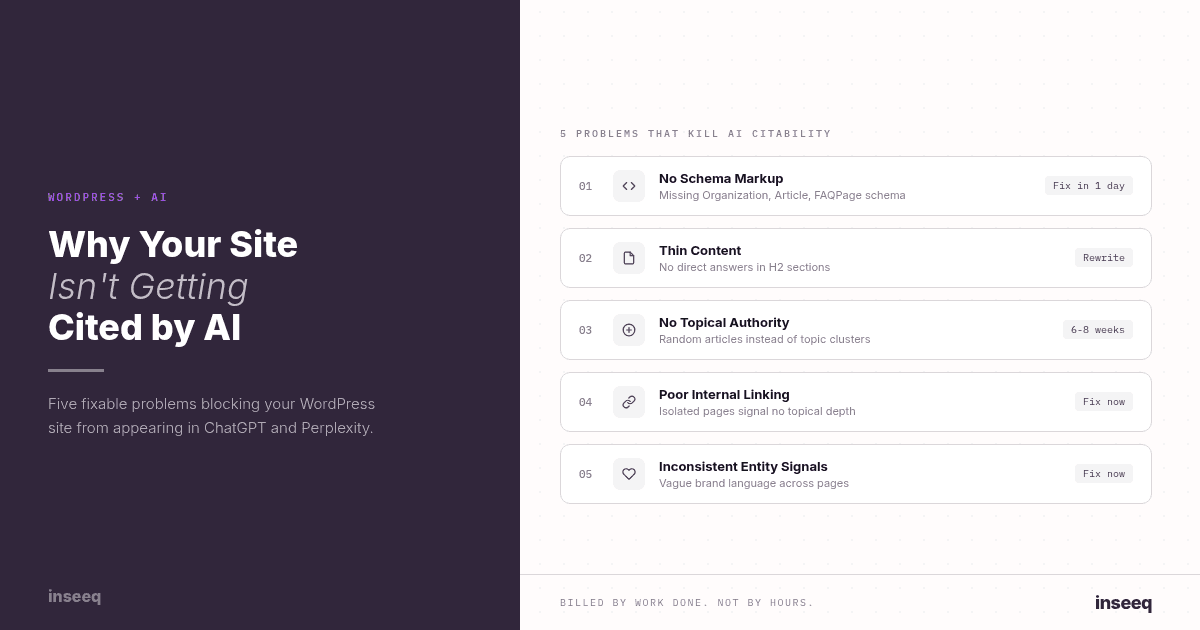
5 reasons why a WordPress site isn't being cited by ChatGPT or Perplexity
Your Site Is Live. ChatGPT Has Never Heard of You.
You type your own company name into ChatGPT. It doesn't know you exist. You try the question your customers actually ask: "what's the best [tool] for [your category]?" And a competitor shows up. You're not even in the answer.
Your WordPress site is live. It loads fast. The design is clean. But ChatGPT has never heard of you, and Perplexity isn't citing you.
This isn't a content quality problem. It's a citability problem. And it's fixable, but you need to understand exactly what's broken first.
How AI Search Engines Actually Discover and Cite Content
AI search engines don't work like Google. Understanding the difference is the first step to fixing your visibility.
Google's PageRank model evaluates pages based on the quality and quantity of links pointing to them. A page climbs the rankings as it earns more authoritative backlinks. The algorithm is backward-looking: it rewards what other sites have already vouched for.
AI search engines (ChatGPT SearchGPT, Perplexity, Google AI Overviews) work on retrieval-augmented generation (RAG). The process looks like this:
A user asks a question
The AI retrieves a set of candidate documents from its index
A reranking layer evaluates those documents for quality, relevance, and authority
The highest-scoring content gets extracted and synthesized into the AI's response
Sources are cited
The signals that drive steps 2-4 are different from Google's signals. Content freshness matters more. Topical authority depth matters more. Structured, extractable content matters more. The ability of AI systems to parse and extract specific answers from your pages matters more.
A page that ranks #1 on Google for a keyword is not guaranteed to be cited by ChatGPT for the same query. Research from 2026 shows ChatGPT overlaps with traditional top-10 Google results only about 14% of the time. It draws from a much broader and differently-weighted pool.
The 5 WordPress Problems That Kill AI Citability
Most WordPress sites have at least three of these issues. Each one reduces the probability that AI engines will cite your content.
1. No Schema Markup
Schema markup is structured data that tells AI engines exactly what your content is: who your organization is, what category your articles belong to, what questions your FAQ sections answer. Without it, AI systems have to guess based on raw text.
The non-negotiables for AI citability:
Organizationschema on your homepage (name, URL, description, contact info)Articleschema on every blog post (author, date published, topic)FAQPageschema on pages with question-and-answer contentBreadcrumbListsitewide
The Yoast SEO or RankMath plugins generate most of this automatically with minimal configuration. There's no valid reason to skip it.
2. Thin Content Without Direct Answers
AI engines cite content that directly answers specific questions. A page that describes your product features at length but never answers "what problem does this solve, for whom, in what situation?" is useless to a retrieval system looking for a clean answer to extract.
Citation-ready content has:
H2 sections that directly answer specific questions (the H2 heading is the question, the first paragraph is the answer)
Concise, extractable statements of fact within each section
FAQ sections where each Q gets a 2-4 sentence answer
3. No Topical Authority
AI engines don't cite individual pages. They cite sources they recognize as authoritative on a topic. A domain with one article about payroll automation is not an authority on payroll automation. A domain with 12 deeply interlinked articles covering every dimension of the topic signals expertise that AI engines can trust.
Most WordPress blogs have a random collection of loosely related articles. That's the opposite of topical authority.
4. Poor Internal Linking
Internal links are how AI crawlers understand the relationship between your content. A blog post that links to three related articles, and those articles link back, creates a network that signals topical depth. An isolated article that links to nothing signals the opposite.
Minimum viable internal linking:
Every article links to at least 2-3 related articles in the same topic cluster
Service pages link to the most relevant content pieces
A logical hierarchy exists: pillar articles link to supporting articles, supporting articles link to pillar articles
5. Inconsistent Entity Signals
AI engines use entity recognition to understand who you are and what category you belong to. If your homepage says "we help businesses grow," your About page says "we're a marketing agency," and your service page says "we offer digital solutions," you've given AI systems three different and vague answers to the same question.
Entity clarity means:
Consistent, specific language about what you do across every page
A clear category statement ("AI-native marketing agency for B2B startups")
Named people with titles and expertise areas
Location information if relevant to your market
The Content Architecture That AI Engines Actually Cite
Beyond fixing the problems above, building AI-citable content requires a deliberate architectural approach.
Topical clusters. Pick the 3-5 topic areas where you want to be cited. For each, publish a pillar article (2,000+ words covering the topic comprehensively) and 6-10 supporting articles targeting specific questions within that topic. All articles interlink tightly.
Direct answer formatting. Structure every major section to answer a specific question. H2 heading = question. First paragraph = direct answer. Rest of section = supporting evidence and context. This mirrors exactly how AI retrieval systems scan content for citation-worthy passages.
Tables and lists for comparison data. AI engines extract and cite structured comparison data frequently. If you have information that can be presented in a table or bulleted list, use that format. It's more extractable than prose.
FAQ sections with schema. A FAQ section at the end of every substantial article, with FAQPage schema markup, directly targets the "People Also Ask" behavior that feeds AI citation systems. Each question should be something your buyers actually type, derived from keyword research or People Also Ask data.
Consistent publishing cadence. Freshness signals matter, especially on Perplexity. A site that publishes 2-5 articles per week sends a different freshness signal than a site that publishes once a month. For competitive AI visibility, cadence is not optional.
The WordPress + GEO Stack inseeq Uses
When inseeq builds WordPress sites for clients, the citation-ready architecture is built in from day one, not retrofitted later.
Theme and page builder: A clean, fast-loading theme (Kadence or GeneratePress) with minimal JavaScript overhead. Page speed is a baseline requirement for AI crawler accessibility.
Schema plugin: RankMath or Yoast SEO Premium for automatic Article, Organization, and BreadcrumbList schema. Custom FAQPage schema blocks used on every article and landing page.
Internal linking: A category and tag taxonomy designed to reflect the topical authority cluster architecture. Every category corresponds to a content cluster. Tags create cross-links between related articles.
Content structure template: Every article follows a consistent structure: concrete scenario opener, H2 sections with direct answer format, comparison tables where applicable, FAQ section with schema, CTA. The template exists so that the citation-ready format is the default, not the exception.
Publishing infrastructure: Editorial calendar synchronized to a 2-5 article per week cadence. Categories pre-configured so every new article is automatically connected to the right cluster.
The result is a WordPress installation where every piece of content that goes live is already positioned for AI citability, not relying on retroactive fixes.
For a complete setup guide: The WordPress Setup Checklist for AI Search Visibility in 2026.
Frequently Asked Questions
How do I get my WordPress site cited by AI? The core requirements: schema markup (Organization, Article, FAQPage), topical authority content clusters, direct-answer H2 structure, consistent internal linking, and a regular publishing cadence. Start with the technical fixes (schema takes a few hours with the right plugin), then focus on building topical authority through consistent content output.
What is WordPress GEO optimization? WordPress GEO optimization is the practice of configuring a WordPress site specifically for AI search citability. It covers schema markup, content architecture, internal linking structure, and publishing cadence: the technical and content layer that makes your WordPress content extractable and citable by AI engines like ChatGPT and Perplexity.
Does WordPress SEO affect AI search? Yes. Strong WordPress SEO (page speed, schema, crawlability, internal linking) directly supports AI citability. Research shows Perplexity cites top-10 Google results 91% of the time, so traditional SEO performance feeds AI visibility. But WordPress SEO alone is not sufficient; topical authority content clusters are also required.
How do I add schema markup to WordPress? Install either RankMath or Yoast SEO Premium. Both generate Organization, Article, and BreadcrumbList schema automatically once configured. For FAQPage schema, both plugins offer FAQ blocks that you add within the article editor. Each Q&A pair is marked up automatically.
How long does it take to rank in AI search? Initial citations can appear within 30 days when the technical setup is complete and content targets underserved questions. Consistent citation share in competitive categories typically builds over 60-90 days. The technical fixes (schema, internal linking) can be implemented in a week; the content layer (topical authority clusters) takes longer.
Is Your WordPress Site AI-Ready?
Most aren't. The good news: the gaps are diagnosable, and most of the fixes are faster than you'd expect.
inseeq's free Growth Audit covers your current AI citation status, your WordPress technical citability, and your topical authority gaps, all in one report. You'll know exactly what's blocking your AI visibility and what to do about it first.
Get your free Growth Audit and find out if your WordPress site is working for AI search or against it.
Check Your AI Visibility
How visible is your brand in AI search engines like ChatGPT, Perplexity, and Google AI Overviews? Find out in 60 seconds with our free tool.
Related Articles
→ How to Optimize Your Website for ChatGPT Search | ChatGPT SEO
→ The Ultimate Guide to AI Content Optimization for Search
→ How We Set Up AI Search Visibility for a B2B Startup in 30 Days

Hans-Peter Frank
Co-founder
How Visible Is Your Business in AI Search?
Find out in 60 seconds. Our free AI Visibility Checker scans ChatGPT, Perplexity, and Google AI Overviews for your brand.
Check Your AI Visibility