
How We Set Up AI Search Visibility for a B2B Startup in 30 Days
A real 30-day case study: how inseeq built AI search visibility from zero for a B2B startup. The exact steps, tools, and results, including 40 qualified leads/month.
How Visible Is Your Business in AI Search?
Find out in 60 seconds. Our free AI Visibility Checker scans ChatGPT, Perplexity, and Google AI Overviews for your brand.
Check Your AI Visibility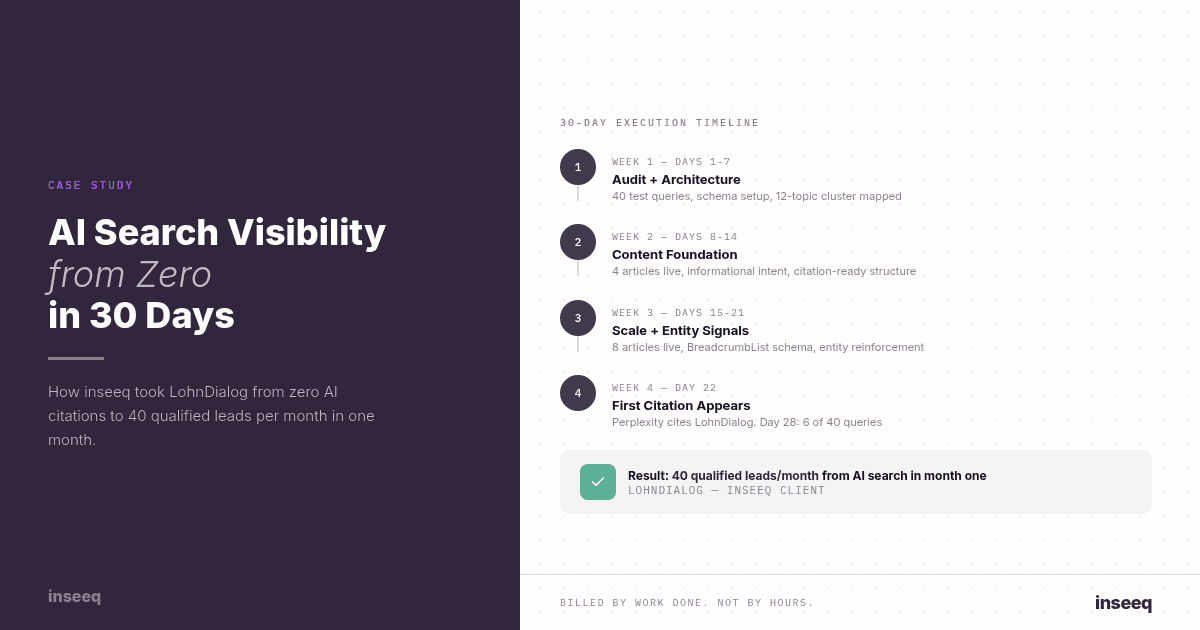
30-day timeline showing how LohnDialog went from zero to 40 qualified leads per month with GEO
Zero AI Visibility, Real Deadline
In January 2026, LohnDialog came to inseeq with a specific problem. When their target customers searched for payroll software recommendations on ChatGPT or Perplexity, a competitor came up. LohnDialog didn't. Not once across 20 different test queries.
Their Google rankings were fine. Their website looked professional. But in the search channel that was growing 165x faster than organic search, they were invisible.
The brief was direct: build AI search visibility fast enough to generate leads within 30 days. No drawn-out retainer proposal. No six-month onboarding timeline. Thirty days, measurable results, or don't bother.
This is what happened.
Week 1: Audit and Architecture
The first seven days were entirely diagnostic and structural. Before writing a single word of content, the team needed to understand exactly why LohnDialog wasn't showing up in AI search responses.
The AI visibility audit covered three platforms: ChatGPT (SearchGPT), Perplexity, and Google AI Overviews. The audit ran 40 test queries across the categories LohnDialog's buyers use when researching payroll software: phrases like "best payroll software for small business Germany," "automated payroll processing SME," and "HR software with payroll integration."
The findings were consistent and clear:
A competitor had published 23 articles in the preceding six months specifically targeting the questions LohnDialog's buyers ask
LohnDialog's content covered their product features but almost nothing their buyers were actively researching
The website had no schema markup, no FAQ structure, and no internal linking connecting their service pages to topic-relevant content
Topical authority was near zero. There was no content cluster signaling expertise in payroll automation to AI engines
The fix list from week one:
Technical fixes (completed in days 2-3):
Organization schema added to homepage
Article schema template configured for all blog posts
FAQ schema setup for key service pages
XML sitemap submitted to all major crawlers
Internal linking structure mapped
Content architecture (days 4-7):
Topical authority cluster designed around "payroll automation for SMEs"
12 target topics mapped, each answering a specific question LohnDialog's buyers ask
Publishing schedule built: two articles per week for six weeks
Keyword research completed for all 12 topics
The WordPress infrastructure was already in place. Week one was about making it citation-ready.
Week 2: Content Foundation
The first four articles published in week two were chosen deliberately. They targeted the questions with the highest research intent: the queries buyers ask at the beginning of their decision process, before they've committed to evaluating specific tools.
Each article was structured for AI extraction:
Clear H2 sections with direct answers to specific questions
Tables for comparison data
FAQ sections with questions derived from People Also Ask research
Internal links connecting each article to relevant service pages and to each other
Source citations linking to third-party research where factual claims were made
The first article was live on day eight. By day twelve, four articles were published.
The keyword strategy for this phase focused on informational intent: questions buyers type when they're learning, not when they're ready to buy. AI engines cite authoritative educational content heavily. The goal was to establish LohnDialog as the source AI engines pull from when answering foundational questions about payroll automation.
Secondary keywords from the research phase were distributed across the content: "payroll automation software," "automated payroll for small business," "HR payroll integration," and "payroll compliance software Germany" each appeared in at least two articles, assigned to specific sections based on topical fit.
Week 3: Citation-Ready Content at Scale
By week three, the publishing cadence was running at full speed. Articles three through eight published during this phase.
The content shifted from pure educational to more specific and comparative. Buyers who'd found the foundational content and were now ready to evaluate options needed articles that answered decision-stage questions: "What's the difference between automated and manual payroll processing?" "What should I look for in payroll software for a 20-person team?" "How much does payroll automation cost for a small business?"
Three technical additions during week three:
BreadcrumbList schema was added site-wide, giving AI crawlers a clear map of content hierarchy within the payroll automation topic cluster.
FAQ schema on service pages was updated to reflect the actual questions appearing in Perplexity and ChatGPT responses for LohnDialog's target queries.
Entity reinforcement was added to the homepage and About page: clear, structured statements of what LohnDialog does, who it's for, and what category it belongs to. AI engines use entity signals to decide whether a brand is a credible source in a given topic area.
The internal linking density had now reached a point where every new article linked to at least two others in the cluster, and the service pages linked to the most relevant content pieces.
Week 4: First Citations and Lead Flow
Day 22. A test query on Perplexity for "payroll automation software for small business Germany" returned a response citing two sources. One of them was LohnDialog.
By day 28, LohnDialog was appearing in responses across six of the 40 test queries, up from zero at the start of the month.
The conversion behavior from AI-cited traffic was different from what the team had seen from Google organic. Research from Semrush confirms what the LohnDialog data showed directly: LLM visitors convert at 4.4x the rate of organic search visitors. When someone finds LohnDialog through a Perplexity recommendation, they arrive having already been told by an AI that this is a credible option. The sales conversation starts at a different point.
By the end of month one, LohnDialog was generating 40 qualified leads per month from AI search visibility. The leads were pre-qualified by the nature of how they arrived: they'd asked an AI assistant a specific question about payroll automation, and the AI named LohnDialog.
What This Means for Your B2B Startup
The LohnDialog case study has three transferable lessons.
Speed is possible. Conventional wisdom says SEO takes six months. AI search citability can begin within 30 days when the content strategy is right and the technical foundation is in place. This is partly because AI search indexes and surfaces new content faster than traditional Google rankings update.
The entry point is your buyers' questions, not your product. LohnDialog wasn't cited because they wrote better product copy. They were cited because they published content answering the specific questions their buyers ask. AI engines surface the best answer to a question, not the best product description.
Technical infrastructure matters before content does. Week one was entirely infrastructure. Publishing content on a site with no schema markup, no internal linking, and no entity signals is like publishing to a folder no AI engine can properly read. The technical work compounds every piece of content that follows.
The same playbook applies to any B2B company in a clearly defined category where buyers research before they buy. Which is most of them.
For a full breakdown of the technical and content approach inseeq uses, see Why Your WordPress Site Isn't Getting Cited by AI (And How to Fix It).
Frequently Asked Questions
How long does AI search optimization take? Initial citations can appear within 30 days when the technical infrastructure is in place and content targets underserved questions in your category. In competitive categories where competitors have already built topical authority, 60-90 days is a more realistic timeline for meaningful citation share.
How do you measure AI search visibility? The most direct method is manual query testing across ChatGPT, Perplexity, and Google AI Overviews using the queries your buyers actually type. Run 20-40 test queries at the start, document which sources are cited, and repeat the test monthly. Third-party tools like Profound and Superlines track AI citation share automatically.
What is AI search optimization for B2B? AI search optimization for B2B is the practice of building content and technical infrastructure that gets your brand cited by AI search engines when B2B buyers ask questions in your category. It differs from traditional SEO in that the goal is AI citation, not Google ranking, though the two reinforce each other.
Can a small company rank in AI search? Yes, and small companies often have an advantage in niche B2B categories where competitors haven't built strong AI visibility yet. The barrier is content volume and quality, not domain size. A focused topical authority strategy in a specific category can produce citations faster than a larger company spreading efforts across too many topics.
How much does AI search optimization cost? It varies significantly by scope. inseeq prices individual articles between 36-60 EUR per piece. A complete GEO setup including technical infrastructure, content strategy, and ongoing publishing typically runs less than a traditional agency retainer for the equivalent workload, because the AI-native model removes a significant portion of the execution overhead.
See What Your AI Visibility Looks Like Today
If you're not being cited by ChatGPT or Perplexity in your category, a competitor is. The gap is measurable, and the fix is faster than most founders expect.
inseeq's free Growth Audit shows you exactly where you stand: which queries cite your competitors instead of you, what technical gaps are hurting your citability, and what a 30-day improvement plan looks like.
Get your free Growth Audit and find out what it would take to get to 40 leads per month from AI search.
Check Your AI Visibility
How visible is your brand in AI search engines like ChatGPT, Perplexity, and Google AI Overviews? Find out in 60 seconds with our free tool.
Related Articles
→ Case Study: How We Achieved 90% LLM Visibility in 6 Months
→ What Is a Generative Engine Optimization Agency and Do You Need One?
→ What is Generative Engine Optimization (GEO)? The Complete 2026 Guide

Hans-Peter Frank
Co-founder
How Visible Is Your Business in AI Search?
Find out in 60 seconds. Our free AI Visibility Checker scans ChatGPT, Perplexity, and Google AI Overviews for your brand.
Check Your AI Visibility