
What Is a Generative Engine Optimization Agency and Do You Need One?
GEO agencies help brands get cited by ChatGPT, Perplexity, and Google AI. Learn what they do, how they differ from SEO agencies, and whether you need one.
How Visible Is Your Business in AI Search?
Find out in 60 seconds. Our free AI Visibility Checker scans ChatGPT, Perplexity, and Google AI Overviews for your brand.
Check Your AI Visibility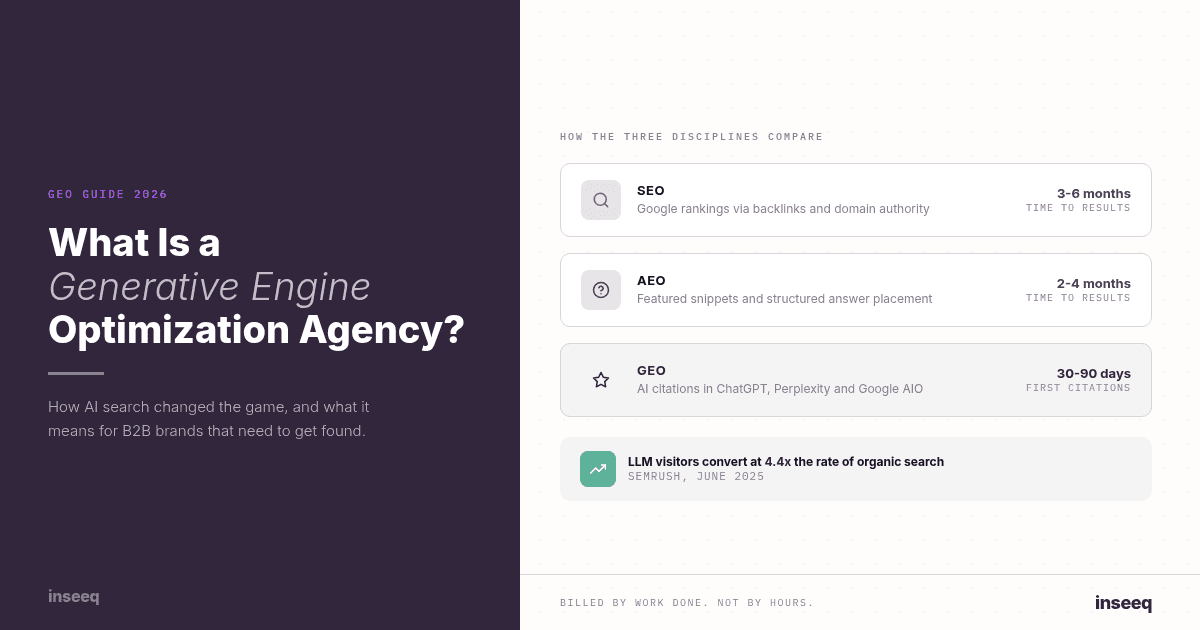
Comparison chart showing GEO vs SEO vs AEO disciplines, timelines, and citation metrics for AI search visibility
The Search Engine You're Not Ranking On
Your company has a Google ranking. Maybe a decent one. You've invested in backlinks, meta titles, and a content calendar. But when a potential customer asks ChatGPT "what's the best marketing agency for B2B startups?" your name doesn't come up.
That's not an SEO problem. That's a GEO problem.
A generative engine optimization agency helps brands become the source that AI search engines cite. Not rank. Cite. The distinction matters because AI search doesn't show a list of ten blue links. It synthesizes an answer, names sources, and moves on. You're either in the answer or you're invisible.
The category is new. The keyword "generative engine optimization agency" had near-zero search volume in early 2025. By early 2026, it was growing at over 1,500% year-over-year. That growth curve tells you exactly where the market is heading.
GEO vs SEO vs AEO: What's Actually Different
These three disciplines often get lumped together. They shouldn't.
SEO (Search Engine Optimization) optimizes for Google and Bing rankings. It works on signals like backlinks, domain authority, keyword density, and page speed. The goal is to appear on page one of a traditional search results page.
AEO (Answer Engine Optimization) is a layer on top of SEO. It structures content to be pulled into featured snippets, voice search answers, and AI-generated summaries. It focuses on clear question-and-answer formatting, schema markup, and entity clarity.
GEO (Generative Engine Optimization) goes further. It specifically targets the citation and recommendation behavior of generative AI systems like ChatGPT, Perplexity, and Google AI Overviews. GEO is about building the kind of topical authority and structured content that AI engines trust enough to cite by name.
SEO | AEO | GEO | |
|---|---|---|---|
Target | Google rankings | Featured snippets, voice | AI citations and recommendations |
Core signal | Backlinks, domain authority | Structured data, entity clarity | Topical authority, content depth |
Success metric | Ranking position | Snippet capture rate | Citation share in AI responses |
Timeline to results | 3-6 months | 2-4 months | 1-3 months for initial citations |
The important nuance: GEO doesn't replace SEO. Research from 2026 shows Perplexity cites top-10 Google rankings 91% of the time. A strong Google presence still feeds AI citability. But it's no longer sufficient on its own.
What a GEO Agency Does (Day to Day)
If you've only worked with traditional SEO agencies, the deliverable set looks different. Here's what a serious generative engine optimization agency actually produces:
AI Visibility Audit The starting point. Mapping your current citation share across ChatGPT, Perplexity, and Google AI Overviews. Identifying which competitors are getting cited in your category and why. Quantifying the gap.
Citation Gap Analysis Comparing your content against what's currently being cited in your target topic areas. Finding the specific questions AI engines are answering where you're absent.
Topical Authority Architecture Building the content cluster structure that signals deep expertise to AI engines. A pillar article supported by 8-12 related pieces, all tightly interlinked. This is the single biggest driver of AI citability.
Citation-Ready Content Production Writing articles and pages that AI engines can actually extract from. Clear H2 structure, direct answers to specific questions, FAQ sections, structured data markup. GEO writing is different from traditional SEO writing.
Technical Optimization Schema markup, structured data, page speed, crawlability. The technical layer that makes content parseable by AI retrieval systems.
Publishing Cadence Management Freshness matters, especially for platforms like Perplexity that weight content recency heavily. A GEO agency maintains a consistent publishing cadence (typically 2-5 articles per week for a competitive B2B category) to stay visible.
Citation Monitoring Tracking your brand mentions and citations across AI platforms over time. Measuring share of voice versus competitors. Adjusting the strategy based on what's working.
What Results Should You Expect?
The honest answer: faster than most founders expect, but not overnight.
AI citations can begin appearing within 30 days of publishing citation-ready content in an underserved topic area. The compound effect kicks in around months two and three, as topical authority builds and AI engines begin recognizing the brand as a reliable source.
The conversion quality is the part that surprises most clients. Research from Semrush (June 2025) found that the average LLM visitor converts at 4.4x the rate of the average organic search visitor. When someone finds you through a ChatGPT recommendation, they arrive pre-sold. The AI already vouched for you.
Concrete examples from inseeq's client work:
project b.: +300% organic traffic in 90 days, driven by systematic GEO content and technical optimization
LohnDialog: 40 qualified leads per month after one month of collaboration, attributable to AI search visibility in their target category
Neither of those results came from a 12-month SEO campaign. They came from building the right content infrastructure quickly and publishing consistently.
How to Choose a Generative Engine Optimization Agency
The category is new enough that a lot of agencies are rebranding old SEO services as GEO. Here's how to tell the difference.
Questions worth asking:
How do you measure AI citation share? What tools or methodology do you use?
Can you show me examples of content you've produced that's currently being cited by AI search engines?
What's your publishing cadence for a typical client? (Below 2 articles per week is a red flag for competitive B2B categories.)
How do you approach topical authority architecture, not just individual article production?
What does your technical GEO stack look like? Schema, structured data, entity optimization.
Red flags:
Agencies that conflate GEO with "AI-powered SEO" (using AI to write content is not GEO)
No clear methodology for measuring AI citations
Vague deliverables with no outcome commitment
Long retainer lock-ins with no money-back option
Hourly billing structures (GEO is outcome-driven, not hours-driven)
What good looks like:
A GEO agency should be able to show you a citation audit before you sign anything. You should know your current AI visibility baseline and your competitor's before committing to a strategy.
How inseeq Approaches GEO
inseeq is an AI-native marketing agency. That means the GEO methodology isn't bolted onto a legacy SEO practice. It's the core of how the work is done.
The model: AI handles 70% of research and content execution. Senior strategists handle the 30% that requires judgment: positioning, competitive differentiation, editorial oversight, quality control. The result is content that moves at the speed AI search rewards, without sacrificing the depth it requires.
The pricing is outcomes-based. Articles are priced between 36-60 EUR per piece, depending on scope. No monthly retainer. No hourly billing. The work is billed by what gets published, not by time spent.
inseeq also offers a money-back guarantee after month one. It's a direct expression of confidence in the results, and a direct challenge to how traditional agencies structure their engagements.
The service covers the full GEO stack: WordPress website builds optimized for AI citability from day one, GEO content strategy and production, technical optimization, and ongoing citation monitoring.
Cross-reference: How We Set Up AI Search Visibility for a B2B Startup in 30 Days — a detailed breakdown of the 30-day process and results.
Frequently Asked Questions
What does a GEO agency do? A generative engine optimization agency helps brands get cited by AI search engines like ChatGPT, Perplexity, and Google AI Overviews. The work typically includes AI visibility audits, topical authority building, citation-ready content production, technical optimization (schema, structured data), and citation monitoring.
Is GEO the same as SEO? No. SEO optimizes for Google rankings. GEO specifically targets AI search citation behavior. The two overlap: strong Google rankings help with AI citability. But GEO requires different content architecture, different technical setup, and different success metrics.
How long does GEO take to show results? Initial AI citations can appear within 30 days for topics where competition is low. In competitive B2B categories, meaningful citation share typically builds over 60-90 days. Conversion from AI-cited traffic is significantly higher than from organic search, so the ROI math often works faster than traditional SEO timelines.
How much does a GEO agency cost? Pricing varies widely. inseeq prices articles between 36-60 EUR per piece. Some agencies charge monthly retainers in the thousands; others offer project-based work. The key is to understand what you're paying for: content production, technical work, monitoring, or strategy. Get clarity on deliverables before signing.
Can I do GEO without an agency? Yes, but the main constraint is publishing cadence. Topical authority requires consistent, high-quality content output, typically 2-5 articles per week for a competitive B2B category. Most founders can't maintain that alongside everything else. The technical layer (schema, structured data, entity optimization) also requires expertise that's easy to get wrong.
Ready to See Where You Stand in AI Search?
Right now, your competitors might be getting recommended by ChatGPT while you're not. The first step is finding out.
inseeq's free Growth Audit maps your current AI visibility across ChatGPT, Perplexity, and Google AI Overviews, identifies your top citation gaps, and shows you exactly what it would take to close them.
Get your free Growth Audit — no commitment, no retainer, just a clear picture of where you stand.
Check Your AI Visibility
How visible is your brand in AI search engines like ChatGPT, Perplexity, and Google AI Overviews? Find out in 60 seconds with our free tool.
Related Articles
→ AI Visibility Agency vs Traditional SEO Agency: What the Data Says
→ How We Set Up AI Search Visibility for a B2B Startup in 30 Days
→ What is Generative Engine Optimization (GEO)? The Complete 2026 Guide

Hans-Peter Frank
Co-founder
How Visible Is Your Business in AI Search?
Find out in 60 seconds. Our free AI Visibility Checker scans ChatGPT, Perplexity, and Google AI Overviews for your brand.
Check Your AI Visibility