
SEO and GEO Tools for 2027: What Actually Helps (and What You Can Skip)
AI is a lever. Visibility depends on whether your topics are relevant. An overview of the SEO and GEO tools that actually help in 2027, and why autopilot promises are a risk.
How Visible Is Your Business in AI Search?
Find out in 60 seconds. Our free AI Visibility Checker scans ChatGPT, Perplexity, and Google AI Overviews for your brand.
Check Your AI Visibility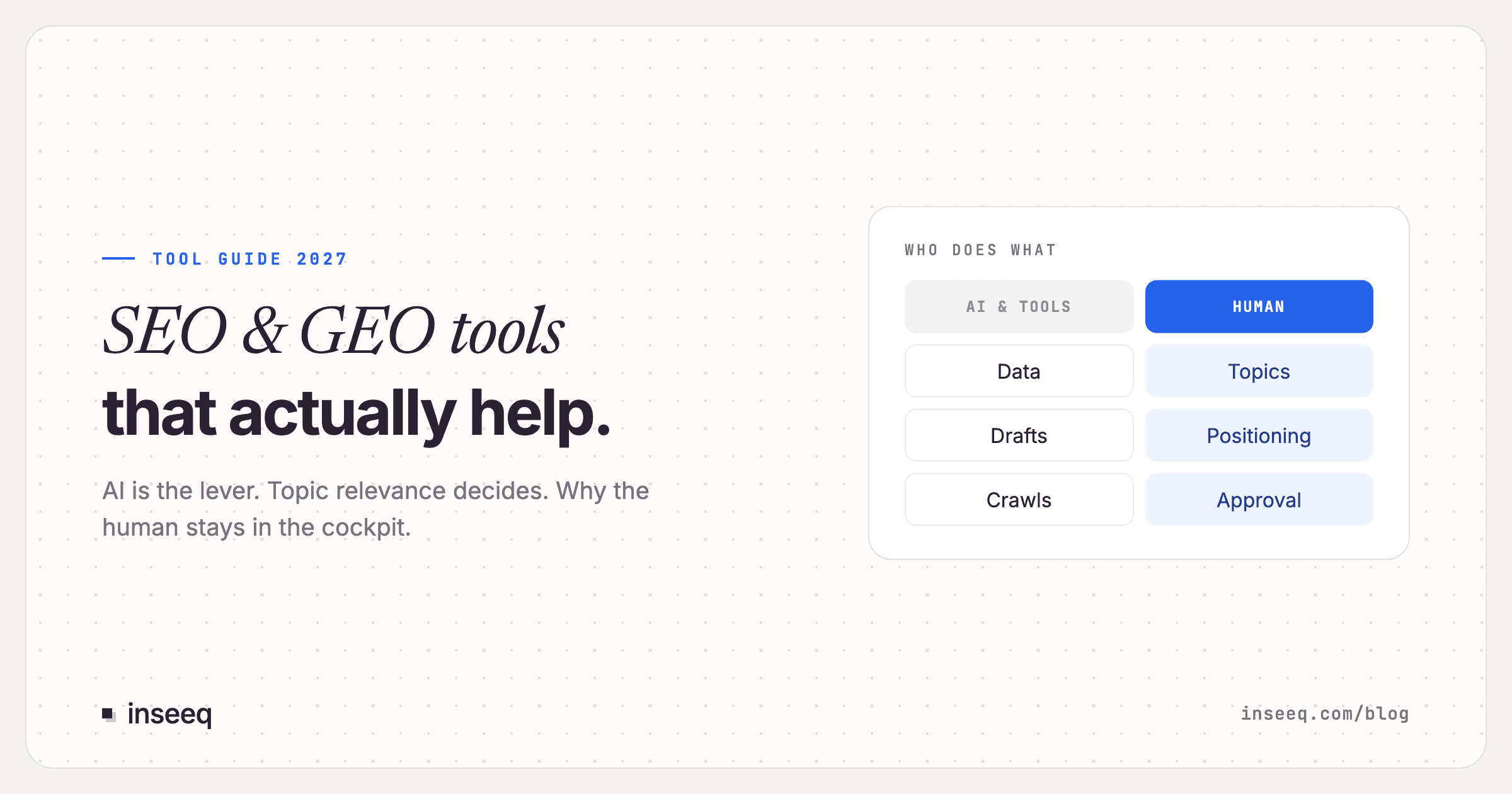
SEO and GEO Tools for 2027: What Actually Helps (and What You Can Skip)
Most teams will need fewer tools in 2027 than they currently pay for. A solid stack is Google Search Console, Bing Webmaster Tools, one research tool such as Semrush, Ahrefs or Sistrix, a crawler, and an AI assistant that works with that data. For AI search, add a tracking tool. What no tool does for you is decide which topics truly matter to your customers. That is where a human stays in the cockpit.
This guide covers which tools help in which role, what they cost, and where their limits are. It also explains why tools that promise SEO "on autopilot" are a risk in 2027 rather than a shortcut. All prices reflect the vendors' own pages in September 2026. Prices can vary by region and billing cycle.
The short answer: which tool stack is enough for 2027?
Role | Recommendation | Cost (as of 09/2026) |
|---|---|---|
First-party Google data | Google Search Console | free |
First-party Bing and Copilot data | Bing Webmaster Tools | free |
Keyword and competitor data | Semrush, Ahrefs or Sistrix (DACH) | from about €95 to €120 per month |
Technical crawl | Screaming Frog or Sitebulb | from about €20 per month |
AI assistant as a lever | Claude or ChatGPT, connected to your SEO data | from about €20 per month |
Visibility in AI answers | one GEO tracking tool | from about $30 per month |
For most companies with one website and a small marketing team, that is enough. We compare the GEO tracking tools in part two of this series: GEO and AIO Tracking Tools for 2027 Compared.
Why topic relevance matters more than any tool
Search is changing fast. According to Ahrefs, the click-through rate of the top-ranking page drops by 58 percent on average when Google shows an AI Overview (300,000 keywords, updated February 2026). If you are missing from the AI answer, you lose reach even with a good ranking.
So the real question is what makes an AI system cite your page. Current data points in one direction.
Topic coverage beats domain strength. In September 2026, Floyi analyzed about 355,000 AI citations across 42 topic areas. Sites ranking for at least half of the topics in an area were cited in 30.8 percent of AI Overviews on average. Sites with under 5 percent coverage reached 0.14 percent. Topic coverage correlated far more strongly with citations (0.51) than Domain Rating did (0.09). The study shows correlation, and does not prove cause.
Fit with the real question counts. Discovered Labs analyzed 2 million AI citations (January 2026) and found the match between prompt and content to be the strongest page-level factor.
Checklist optimization adds little. Seer Interactive analyzed more than 6,000 pages cited first in AI Overviews (May 2026). Schema markup and typical E-E-A-T signals such as author bios did not correlate with those citations. Reddit took 20.4 percent of first-citation slots.
The pattern: AI systems cite sources that answer a specific question completely and credibly. Which questions your customers ask, which topics fit your positioning, and where you hold real expertise are questions no tool answers. That is strategy work. Tools supply the data and speed up execution.
Research and data: Semrush, Ahrefs, Sistrix and others
A research tool shows search volume, competitors, rankings and backlinks. Most teams need only one.
Semrush is the broadest toolbox: keywords, competitors, site audit, rank tracking, and its own AI Visibility Toolkit. The SEO plan starts at about €113 per month on annual billing. Weakness: in independent tests, its traffic estimates for small sites deviate strongly from real analytics data.
Ahrefs has one of the largest backlink indexes and its own AI visibility module, Brand Radar. The full entry plan (Lite) costs €119 per month, and a reduced Starter plan starts at €27. Weakness: usage quotas run out quickly, and AI visibility is a substantial paid add-on.
Sistrix is the standard in Germany, Austria and Switzerland. Its Visibility Index is the metric many DACH agencies and in-house teams report on. Since 2026, every paid plan includes an AI visibility module (free during beta) and an MCP server. Entry: START at €119 per month. Weakness: a smaller backlink index than Ahrefs, and thinner data outside Europe.
SE Ranking is the budget option for freelancers and small agencies, from €109 per month (€87.20 on annual billing). Its keyword database is smaller, especially for niche terms.
DataForSEO is not a dashboard. It is a pay-as-you-go raw data API (start with a $50 deposit). For teams with technical resources or AI workflows, it is often the cheapest data source.
Technical: start with the free essentials
Google Search Console is mandatory. Since June 2026, a dedicated report also shows performance in AI Overviews and AI Mode. That is the only first-party Google data on AI search. Weakness: Search Console hides many rare queries for privacy reasons, and history ends after 16 months.
Bing Webmaster Tools is underrated. Since February 2026 it includes an "AI Performance" report that shows how often Microsoft Copilot cites your pages and which internal search phrases ("grounding queries") Copilot uses to find content. It is free and worth setting up for every site.
Screaming Frog is the standard for technical crawls, with 300+ checks and custom extraction. A licence costs about €245 per year, and the free version crawls up to 500 URLs. Sitebulb is the alternative with prioritized, plain-language hints, from $18 per month. Both are pure crawlers without keyword data.
Content support: useful while you keep the thinking
Tools like Surfer (from €49 per month), Frase (from $49 per month) and Clearscope (from $129 per month) compare your text with ranking pages and suggest terms and structure. That helps you find gaps.
The limit: these scores measure how similar your text is to existing results. A high score makes your text more comparable to the competition. It does not make it better. For AI citations, what counts is what you add: your own data, your own experience, a clear point of view. Use the scores as a gap checklist.
AI assistants: the real lever for 2027
The biggest productivity gain in 2027 comes from one combination: an AI assistant such as Claude or ChatGPT with direct access to your SEO data. The protocol for this is MCP (Model Context Protocol). Ahrefs, Semrush, Sistrix and DataForSEO all offer official MCP servers. Google Search Console has no official server yet, only community-built ones.
With that setup you can ask: "Which pages lost clicks in the last 90 days, and for which queries do competitors now rank higher?" Analysis that used to take an analyst half a day takes minutes.
Be clear about what the assistant does. It collects, compares, summarizes and drafts. It does not know which topics fit your sales motion, which messages convince your customers, or which claims your company can back up. Those decisions stay with you.
The problem with autopilot tools
One category promises more: SEO that "runs itself." Some examples from vendor marketing (as of September 2026):
Outrank: "Grow Organic Traffic on Auto-Pilot" and "30 Articles a month generated and published on auto-pilot"
Search Atlas on OTTO: "Switch OTTO on and your SEO runs itself." (An optional approval mode is available.)
Arvow: "Rank on Google and get cited by AI search, without manual work."
Other vendors deliberately position themselves differently. SEOwind promotes "AI + Humans. Better Together." and Koala builds in a review step before publishing. Automation on its own is fine. It becomes a problem when nobody decides what gets published.
Three reasons argue against full autopilot:
1. Google treats mass-produced content without added value as spam. Its spam policies explicitly list "Using generative AI tools or other similar tools to generate many pages without adding value for users" (policy updated August 2026). At the same time, AI is not banned: "Appropriate use of AI or automation is not against our guidelines." Value to readers is what decides.
2. The consequences are documented. The best-known case is the 2023 "SEO heist." A marketer exported a competitor's sitemap and used an AI tool to generate about 1,800 articles for the software company Causal. After a Google manual action, organic traffic fell from 307,158 to 1,485 visits per month, according to Ahrefs. During the March 2024 core update, Originality.ai also counted 1,446 sites with manual actions, most of which had published AI content at scale according to that analysis.
3. Autopilot content is interchangeable. When a tool derives topics from keyword data and builds text from the current top results, the output is the average of what already exists. AI systems have no reason to cite a copy when the original exists. The data above shows that citations go to whoever answers a question better or differently.
What you can skip in 2027
llms.txt as a GEO lever. The file is meant to give AI systems a summary of your site. Ahrefs analyzed 137,210 domains in May 2026: 97 percent of existing llms.txt files received zero requests. Google has said it does not use llms.txt. The file does no harm, but it does not replace work on content.
Several research tools in parallel. Semrush, Ahrefs and Sistrix overlap heavily. One tool you actually use beats three you only pay for.
Content scores as a KPI. A Surfer or Clearscope score is not a business result. Measure rankings, AI mentions, inquiries and revenue.
The human in the cockpit: who does what
Step | What AI and tools handle | What a human decides |
|---|---|---|
Topic selection | Collect search volume, gaps, questions from forums and AI answers | Which topics fit your offer, audience and sales motion |
Positioning | Summarize competitor content | Which point of view, data and examples you bring |
Draft | Outline, first version, variants | Facts, tone, claims your company can stand behind |
Technical | Crawl, issue lists, prioritization | What gets fixed first and what does not |
Measurement | Combine rankings, AI mentions, traffic | Which metric defines success and what follows from it |
Approval | Checks for links, style, spelling | Every publication |
The bottleneck is almost always in the top-left corner: topic selection. A team that covers the right ten topics in depth wins against a team that publishes a hundred random articles. That holds no matter how much AI is involved.
How to measure your visibility in AI answers
Classic rankings do not show whether ChatGPT, Perplexity or Google AI Overviews mention your brand. A separate tool category covers that, ranging from about $30 per month to enterprise contracts. Which tools exist, what they cost and where they fall short is covered in part two: GEO and AIO Tracking Tools for 2027 Compared. For the basics, see how to measure your AI search visibility.
Frequently asked questions
Do I still need classic SEO tools in 2027 if I focus on GEO?
Yes. AI systems such as Google AI Overviews and ChatGPT Search draw on search indexes. Pages that rank well and are technically sound have a better chance of being cited. GEO builds on SEO.
Which SEO tool is best for the German-speaking market?
For DACH-only work, Sistrix is usually the first choice because of its Visibility Index and German keyword depth. For international markets and backlink analysis, Semrush or Ahrefs are stronger.
Is AI-generated content bad for SEO?
Not in itself. Google evaluates the value of content, not how it was produced. The problem is mass-producing pages that add nothing, which is exactly what autopilot tools make easy.
Can an AI agent take over my SEO completely?
It can take over many tasks: research, analysis, drafts, technical checks. The decision about which topics matter and what gets published should stay with someone who knows your business.
Is an llms.txt file worth it?
Based on current data, hardly. Most files are never requested by AI crawlers, and Google does not use them. Spend the time on content instead.
Want to know how visible your brand is in AI answers? Check your AI visibility now or talk to us about your topic strategy.
Sources (as of 27 Sep 2026)
Google Search Central, spam policies: https://developers.google.com/search/docs/essentials/spam-policies
Google Search Central, guidance on AI-generated content (2023): https://developers.google.com/search/blog/2023/02/google-search-and-ai-content
Google, generative AI performance reports in Search Console (June 2026): https://developers.google.com/search/blog/2026/06/gen-ai-performance-reports
Bing Webmaster Tools, AI Performance report: https://about.ads.microsoft.com/en/blog/post/march-2026/the-ai-performance-dashboard-your-view-into-where-your-brand-appears-across-the-ai-web
Ahrefs, AI Overviews and CTR (2026 update): https://ahrefs.com/blog/ai-overviews-reduce-clicks-update/
Ahrefs, llms.txt study: https://ahrefs.com/blog/llmstxt-study/
Ahrefs, biggest traffic losers (Causal): https://ahrefs.com/blog/biggest-traffic-losers/
Floyi, Topical Authority Report 2026: https://floyi.com/research/topical-authority-report/
Discovered Labs, What drives AI citations: https://discoveredlabs.com/research/what-drives-ai-citations
Seer Interactive, AI Overviews 2026: https://www.seerinteractive.com/insights/what-it-takes-to-rank-in-googles-ai-overviews-in-2026-is-not-what-you-think
Originality.ai, March 2024 update: https://originality.ai/can-google-detect-penalize-ai-content
Pricing: sistrix.com/pricing, semrush.com/pricing, ahrefs.com/pricing, seranking.com/pricing, dataforseo.com/pricing, screamingfrog.co.uk, sitebulb.com/pricing, surferseo.com/pricing, frase.io/pricing, clearscope.io/pricing

Hans-Peter Frank
Co-founder
How Visible Is Your Business in AI Search?
Find out in 60 seconds. Our free AI Visibility Checker scans ChatGPT, Perplexity, and Google AI Overviews for your brand.
Check Your AI Visibility