
What Is Topical Authority and Why AI Search Cares About It More Than Google Did
Topical authority is the signal AI search engines use to decide what to cite. Here's how it works, why it matters more than domain authority, and how to build it.
How Visible Is Your Business in AI Search?
Find out in 60 seconds. Our free AI Visibility Checker scans ChatGPT, Perplexity, and Google AI Overviews for your brand.
Check Your AI Visibility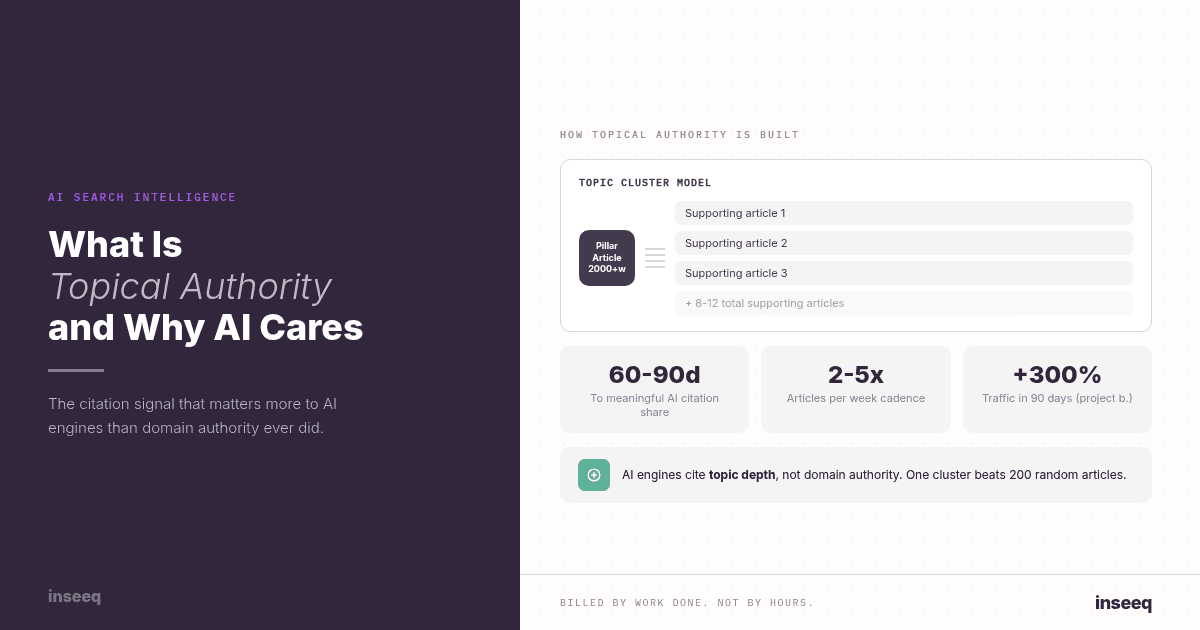
Topic cluster model showing how topical authority is built for AI citation
Domain Authority Is Dead. Topical Authority Is What AI Uses.
For the past decade, domain authority was the SEO metric that mattered most. Build links, raise your DA, outrank competitors. The higher your DA, the more trust search engines placed in your content.
AI search engines work differently. When ChatGPT, Perplexity, or Google AI Overviews decide what to cite in a response, they're not consulting a domain authority score. They're evaluating something else entirely: topical authority. How well does this source cover this specific topic area? Does this domain demonstrate deep, comprehensive expertise in the subject the user is asking about?
The distinction matters because the strategies to build these two metrics are almost completely different. And most B2B companies are still investing in the old metric while wondering why they're not showing up in AI search.
What Topical Authority Actually Means
Topical authority is not the same as "publishing a lot of content." A company that has published 200 blog posts on 50 different topics has not built topical authority on any of those topics. They've built a generalist blog.
Topical authority means recognized, comprehensive expertise in a specific subject area. AI engines infer this through:
Coverage depth. Does this domain have content covering every major dimension of the topic? A domain that has published content on the foundational concepts, the nuanced edge cases, the comparison questions, the how-to questions, and the FAQ questions in a topic area demonstrates coverage depth that a single article or a scattered collection of loosely related posts cannot.
Content interconnection. Are the articles within a topic area connected to each other through internal links? A cluster of 10 tightly interlinked articles sends a stronger topical authority signal than 10 isolated articles on the same subject.
Entity recognition. AI engines build entity graphs: structured representations of who and what exists in the world, and how concepts relate to each other. A domain that appears in the entity graph as a recognized authority on a specific topic has accumulated topical authority that feeds directly into citation probability.
Consistency and recency. A domain that has been publishing on a topic consistently for a year, and continues to do so, signals sustained expertise. A domain that published five articles eighteen months ago and stopped does not.
The practical outcome: when an AI engine retrieves sources for a query about payroll automation, it's more likely to cite a domain that has comprehensively covered every aspect of payroll automation than a domain with a single well-written article on the subject, even if that article is technically better.
How AI Search Engines Evaluate Topical Authority
The mechanism differs slightly across platforms, but the underlying logic is consistent.
Content retrieval layer. When a user query arrives, the AI engine retrieves a pool of candidate documents. Topical authority influences which documents make it into this initial pool. Domains recognized as authoritative on the topic are more likely to have multiple documents retrieved.
Reranking layer. Retrieved documents are scored by a quality model. Signals used in this scoring include content depth, entity recognition, source credibility, and relevance to the specific query. A domain with topical authority scores higher on these dimensions consistently.
Entity graph influence. AI engines trained on the full web have built implicit entity graphs: representations of which sources are most often associated with specific topic areas. A domain that has been consistently cited, linked to, and referenced in the context of a topic area has stronger entity-topic association than a domain that hasn't.
For Google AI Overviews specifically, E-E-A-T (Experience, Expertise, Authoritativeness, Trustworthiness) signals directly operationalize topical authority. Author credentials, external citations, and consistent coverage in a domain all feed into E-E-A-T scoring.
For Perplexity, topical authority interacts with freshness weighting. A domain with topical authority that's also publishing consistently gets the freshness signal boost on top of the authority signal, a compounding advantage.
Building Topical Authority: The Cluster Approach
The content architecture that builds topical authority is the topic cluster model. It works as follows:
1. Pillar article: A comprehensive, 2,000+ word article covering the core topic from every relevant angle. This is the anchor of the cluster. It targets the primary keyword and covers the full scope of the topic. Every other article in the cluster links to this piece.
2. Supporting articles: 8-12 articles each targeting a specific subtopic, question, or angle within the broader topic. Each one covers its specific subject comprehensively (1,500-2,000+ words), and each one links to the pillar article and to 2-3 other supporting articles.
3. Internal linking: The cluster is tightly interlinked. The pillar links to all supporting articles. Each supporting article links to the pillar and to 2-3 related supporting articles. This creates the content network that AI engines read as a signal of topical depth.
4. Cluster-to-service page links: Every article in the cluster links to the relevant service page. The service page links back to the most relevant articles. This connects topical authority to conversion intent.
The publishing sequence matters: start with the pillar article, then publish supporting articles in order from most foundational to most specific. Don't publish 12 niche supporting articles before the pillar exists. The pillar is the topical anchor.
Topical Authority for B2B: What This Looks Like in Practice
A concrete example: a B2B SaaS company offering payroll automation software for SMEs.
Their target topic cluster: payroll automation for small and medium businesses.
Pillar article: "Payroll Automation for SMEs: The Complete Guide"
Supporting articles:
"How to Automate Payroll for a 10-Person Company: A Step-by-Step Guide"
"Payroll Automation vs. Manual Payroll: Costs, Risks, and ROI"
"What Is Payroll Automation Software? Key Features and How It Works"
"How to Choose Payroll Software for a Small Business in Germany"
"Payroll Compliance Automation: What Gets Automated and What Doesn't"
"How Long Does It Take to Set Up Automated Payroll? A Timeline"
"Common Payroll Mistakes That Automation Prevents"
"Integrating Payroll Software with HR Systems: A B2B Guide"
"Payroll Automation for Remote Teams: Specific Challenges and Solutions"
"The True Cost of Manual Payroll: A Calculation Framework"
These 11 pieces, tightly interlinked and published over 6-8 weeks, establish the domain as an authoritative source on payroll automation for SMEs. When an HR manager asks ChatGPT or Perplexity about payroll automation for their 20-person company, the domain now has multiple relevant pieces that the retrieval system can pull from.
This is what project b. achieved: +300% organic traffic in 90 days came from systematic topical authority building across the core topic clusters relevant to their product. The traffic growth wasn't from a single viral article. It was from establishing deep coverage that AI engines and search engines recognized as authoritative.
How inseeq Builds Topical Authority for Clients
inseeq's content strategy process starts with topic cluster design: identifying the 3-5 topic areas where the client's buyers are actively researching, mapping the specific questions within each cluster, and building the pillar/supporting article architecture.
The keyword research phase identifies the specific queries driving the most relevant searches, both for Google rankings and for the questions AI engines encounter most frequently in the client's category. Each keyword maps to a specific article in the cluster.
The publishing infrastructure delivers the cadence required for topical authority: 2-5 articles per week, consistently, over the first 90 days. This isn't a realistic output for most founders to produce themselves while running a company. inseeq's AI-native model, with AI handling 70% of research and execution and senior strategists handling positioning and quality control, is what makes this cadence economically viable.
The inseeq team has built topical authority clusters for clients in B2B SaaS, professional services, and HR technology. The pattern is consistent: domains that commit to the cluster architecture and maintain the publishing cadence see meaningful AI citation share within 60-90 days.
For the full content writing methodology, see How We Set Up AI Search Visibility for a B2B Startup in 30 Days.
Frequently Asked Questions
What is topical authority in SEO? Topical authority is the recognition by search engines and AI systems that a domain is a comprehensive, credible source on a specific subject area. It's built through content clusters: a pillar article covering the topic broadly, supported by 8-12 articles covering specific subtopics, all tightly interlinked. Topical authority differs from domain authority. It's category-specific, not site-wide.
How do you build topical authority? The cluster approach: identify your core topic areas, publish a comprehensive pillar article for each, and follow with 8-12 supporting articles targeting specific questions within the topic. Interlink the cluster tightly. Maintain a consistent publishing cadence, 2-5 articles per week in competitive categories. Avoid diluting focus by covering too many unrelated topics simultaneously.
How long does topical authority take? With a consistent publishing cadence (2-5 articles per week per cluster), meaningful topical authority typically registers with AI engines in 60-90 days. Google recognizes topical authority on a similar timeline but may take longer to reflect it in rankings. The compound effect accelerates over time: early topical authority makes subsequent content in the cluster more likely to get cited immediately.
Does topical authority affect AI search? Yes. Topical authority is arguably the primary citation signal for AI search engines. ChatGPT, Perplexity, and Google AI Overviews all show strong preference for domains that comprehensively cover a topic area over domains with isolated articles. Building topical authority is the single highest-leverage investment a B2B company can make for AI search visibility.
What is the difference between topical authority and domain authority? Domain authority is a site-wide metric measuring overall link equity. It treats the entire domain as a single unit. Topical authority is category-specific. A domain can have high topical authority in "payroll automation" and low topical authority in "marketing automation" simultaneously. AI search engines evaluate topical authority at the category level, not the site level. Domain authority is an SEO metric; topical authority is an AI citation metric.
Map Your Topical Authority Gaps
Most B2B companies have significant topical authority gaps they don't know about. Topic areas their buyers are actively researching where the company has minimal or no content coverage.
inseeq's free Growth Audit maps your current topical authority across your core categories, identifies the specific questions your buyers are asking that you're not answering, and shows you exactly what a cluster architecture for your business would look like.
Book your free Growth Audit and find out where your topical authority gaps are before your competitors fill them.

Hans-Peter Frank
Co-founder
How Visible Is Your Business in AI Search?
Find out in 60 seconds. Our free AI Visibility Checker scans ChatGPT, Perplexity, and Google AI Overviews for your brand.
Check Your AI Visibility