What Is AI Search Visibility (And Why Google Rankings Don't Tell the Whole Story)
AI search visibility measures how often your brand gets cited by ChatGPT, Perplexity, and Google AI. Here's why it matters more than your Google ranking.
How Visible Is Your Business in AI Search?
Find out in 60 seconds. Our free AI Visibility Checker scans ChatGPT, Perplexity, and Google AI Overviews for your brand.
Check Your AI Visibility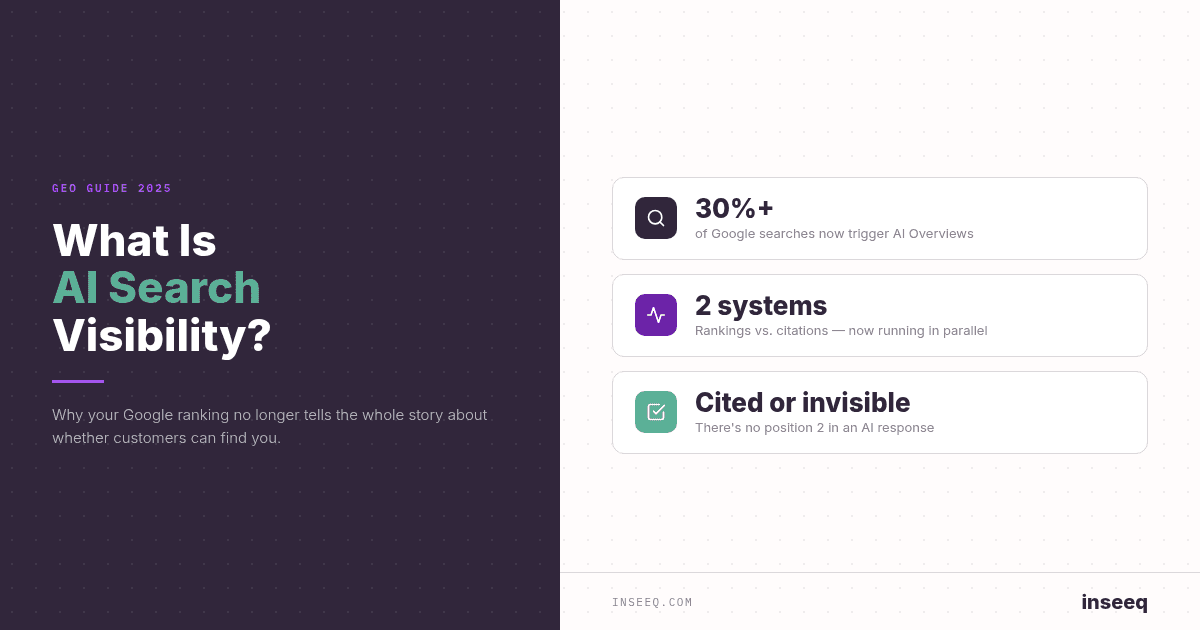
Diagram showing the split between Google rankings and AI citation systems, illustrating what AI search visibility means for brands
The Search Landscape Has Split in Two
A B2B SaaS company ranks #1 on Google for their core category keyword. Organic traffic is solid. The SEO team is happy. Then someone asks ChatGPT: "What's the best tool for [their category]?" The response names three competitors. This company isn't mentioned once.
This isn't a niche edge case. It's the default state for most brands right now.
Search has split into two parallel systems that operate on completely different logic. The first is the familiar ranked-list model: type a query into Google, get ten blue links, click through. The second is the citation model: ask an AI search engine a question, get a synthesized answer with a handful of referenced sources.
Both systems exist simultaneously. Both are capturing real query volume. And critically, performing well in one does not guarantee any presence in the other.
Google AI Overviews, Perplexity, ChatGPT with Search, and Gemini are now answering questions that used to send users to a search results page. For informational and commercial queries, especially in B2B, a growing share of that traffic never reaches a ranked list at all. According to BrightEdge research, AI Overviews alone appear in over 30% of Google searches as of 2025.
The brands appearing in those AI responses didn't get there by ranking. They got there by being structured for citation.
What AI Search Visibility Actually Means
AI search visibility is the measure of how often your brand, product, or content is cited as a source in AI-generated responses across major AI search platforms.
Where traditional SEO tracks rankings (position 1, 2, 3 on a results page), AI search visibility tracks citation frequency: when someone asks a relevant question, does the AI reference you as part of the answer?
The platforms that matter right now:
ChatGPT with Search (OpenAI): used by over 100 million weekly active users as of early 2025, with search integration expanding rapidly
Perplexity: positioned as a direct answer engine; cites sources inline with every response
Google AI Overviews: appears at the top of standard Google searches, synthesizes a direct answer before any ranked results
Gemini: Google's AI assistant, integrated across Search, Workspace, and Android
Each platform pulls from different data sources and applies different weights to decide what to cite. But they share a common logic: they look for content that directly, authoritatively, and clearly answers a specific question.
Measuring AI search visibility means tracking:
Citation frequency: how often your brand appears in AI responses to relevant queries
Query coverage: which questions in your topic space trigger a citation to your content
Response share: what percentage of relevant AI responses include your brand vs. competitors
This is a different measurement framework from SEO entirely. There is no "position 1" in an AI response. You're either cited or you're not.
Why Google Rankings Are No Longer Enough
To understand the gap, it helps to see what each system actually rewards.
Google's PageRank model, at its core, measures link authority. Pages that earn links from authoritative domains rank higher. This rewards brands that have been around long enough, produced content consistently, and earned citations across the web. It's a backwards-looking signal: what has this content already proven?
AI search engines work differently. They're trying to answer a specific question with the most accurate, authoritative, and clearly structured information available at query time. They weight:
Content depth: does the page actually answer the question in full?
Factual specificity: are there concrete claims, data points, examples?
Structural clarity: are the answers findable by an AI parsing the page?
Topical authority: is this source consistently reliable on this subject cluster?
A brand can have excellent Google rankings built on strong backlink profiles and optimized meta data, but if the underlying content is thin, vague, or structured in a way that's hard for an AI to parse, it will be invisible to AI search.
The inverse is also true, and this is the opportunity. A brand with a newer domain and limited backlinks can build significant AI search visibility by producing authoritative, well-structured content that directly answers the questions AI systems are being asked. Content authority, not domain authority, is the currency of AI search.
This isn't an argument that Google rankings stop mattering. They still drive traffic and still correlate with trust signals that feed into some AI search models. The point is simpler: Google performance is a necessary but no longer sufficient condition for search visibility in 2025. Brands that treat them as equivalent are leaving a growing channel completely unaddressed.
What Determines AI Search Visibility
Understanding what the AI systems are actually selecting for makes it possible to build toward visibility deliberately, rather than hoping it follows from SEO work.
Content authority over domain authority
Domain authority is an SEO metric that tracks how many and how powerful the backlinks pointing to a domain are. It's a measure of historical reputation. AI search engines don't ignore domain reputation, but they're more interested in whether a specific piece of content is the most authoritative answer to a specific question. A newer site with a genuinely excellent, in-depth article on a narrow topic can outperform a high-DA site with a superficial treatment of the same subject.
Structural clarity
AI systems parse content at query time to construct an answer. Content that is organized around clear questions and direct answers is easier to cite. This means well-structured H2s that map to real questions, FAQ sections that address common follow-up queries, and direct declarative statements rather than vague, hedged prose.
Compare these two approaches to the same information:
Approach | Example |
|---|---|
Vague | "AI search is becoming increasingly important for brands to consider in their digital strategy." |
Citable | "AI search engines like Perplexity and ChatGPT now answer questions that used to send users to Google. Brands not structured for citation are invisible to this channel." |
The second version answers a specific question directly. An AI can extract and cite it. The first version says nothing extractable.
Topical coverage depth
AI search engines develop a model of which sources are reliable on which topics. A brand that publishes one article about AI search visibility is a weak signal. A brand with a cluster of authoritative, interlinked content on AI visibility, GEO strategy, citation signals, and content authority sends a much stronger signal. Topical depth, not just individual article quality, affects how consistently you appear across the full range of queries in your space.
Factual specificity
Vague claims don't get cited. Specific, verifiable claims do. Include data points, reference external research, name specific tools and platforms, give concrete examples. AI systems favor content that can be extracted and used as a factual anchor in a response.
Freshness for fast-moving topics
In rapidly evolving areas like AI search itself, content freshness matters. Platforms like Perplexity explicitly weight recent sources. Regular content updates and clear publication/revision dates signal to AI systems that your content is current.
How to Check Your AI Search Visibility Right Now
Most brands have no idea where they stand. The default assumption is that if Google is working, everything is fine. That assumption is increasingly wrong.
The quickest manual check: open ChatGPT, Perplexity, and Google AI Overviews and ask the questions your ideal customers ask. Not branded queries, but the category questions. "What's the best tool for [your category]?" "How does [your core problem] work?" "What should I look for when evaluating [your product type]?"
Note how many responses cite your brand. Note who is cited instead.
For a systematic view, inseeq's free AI visibility checker runs this analysis across multiple AI platforms and returns a structured score. It shows where you have citations, where you're absent, and how you compare to competitors in your space. The check takes under two minutes and gives you a baseline to build from.
Knowing your current AI search visibility score is the prerequisite to improving it. You can't optimize a gap you haven't measured.
Frequently Asked Questions
What is AI search visibility? AI search visibility is a measure of how often your brand or content is cited in responses from AI search engines like ChatGPT, Perplexity, Google AI Overviews, and Gemini. It tracks citation frequency across relevant queries in your topic space, unlike traditional SEO which tracks ranked positions on a results page.
Is AI search visibility the same as SEO? No. Traditional SEO optimizes for position in a ranked list of links. AI search visibility optimizes for citation in a synthesized answer. The signals that determine each are different: SEO weights backlinks and on-page factors heavily, while AI search weights content depth, factual specificity, and structural clarity. The two disciplines overlap but are not interchangeable.
Which AI platforms should I optimize for? The four platforms that matter most right now are ChatGPT with Search, Perplexity, Google AI Overviews, and Gemini. They collectively handle the majority of AI-mediated search queries. Each platform has different data source access and citation logic, so a comprehensive AI visibility strategy covers all four rather than optimizing for one.
How do I know if my brand appears in AI search results? The fastest way is to ask the relevant questions manually across ChatGPT, Perplexity, and Google. For a structured baseline, use a dedicated AI visibility checker that tests your brand across multiple platforms and returns a citation score. inseeq offers a free AI visibility check that gives you a starting point in under two minutes.
What is GEO (Generative Engine Optimization)? GEO stands for Generative Engine Optimization. It's the discipline of structuring content and brand presence to appear in AI-generated search responses. Where SEO targets Google's ranked list algorithm, GEO targets the citation logic of AI search engines. GEO involves content depth strategy, structural optimization, topical authority building, and citation signal development.
Does Google ranking affect AI search visibility? Partially. Google AI Overviews draw partly from Google's index, so Google performance has some correlation with AI Overview appearances. But Perplexity, ChatGPT, and other platforms use independent indexes and their own crawling. Strong Google rankings are not a reliable proxy for AI search visibility across the full landscape.
How long does it take to improve AI search visibility? Timelines vary by competitive intensity and starting baseline. Brands with existing content authority in their space can see measurable citation increases within 60 to 90 days with targeted GEO work. Building AI visibility from scratch in a competitive category typically takes three to six months of consistent execution. The critical first step is measuring your baseline, so you know what gap you're closing.
Start With Your Baseline
AI search visibility is no longer a future concern. ChatGPT, Perplexity, and Google AI Overviews are active search channels capturing real query volume today. The brands being cited in those responses are winning visibility that doesn't show up in any Google Analytics dashboard.
The first move is measuring where you stand. inseeq's free AI visibility checker gives you a citation score across the major AI platforms in minutes. No account required. Use it as your baseline, then build from there.

Hans-Peter Frank
Co-founder
How Visible Is Your Business in AI Search?
Find out in 60 seconds. Our free AI Visibility Checker scans ChatGPT, Perplexity, and Google AI Overviews for your brand.
Check Your AI Visibility