
How to Get Cited by ChatGPT, Perplexity, and Google AIO: What's Different for Each
ChatGPT, Perplexity, and Google AIO each cite sources differently. Here's the platform-specific playbook for getting your brand into all three.
How Visible Is Your Business in AI Search?
Find out in 60 seconds. Our free AI Visibility Checker scans ChatGPT, Perplexity, and Google AI Overviews for your brand.
Check Your AI Visibility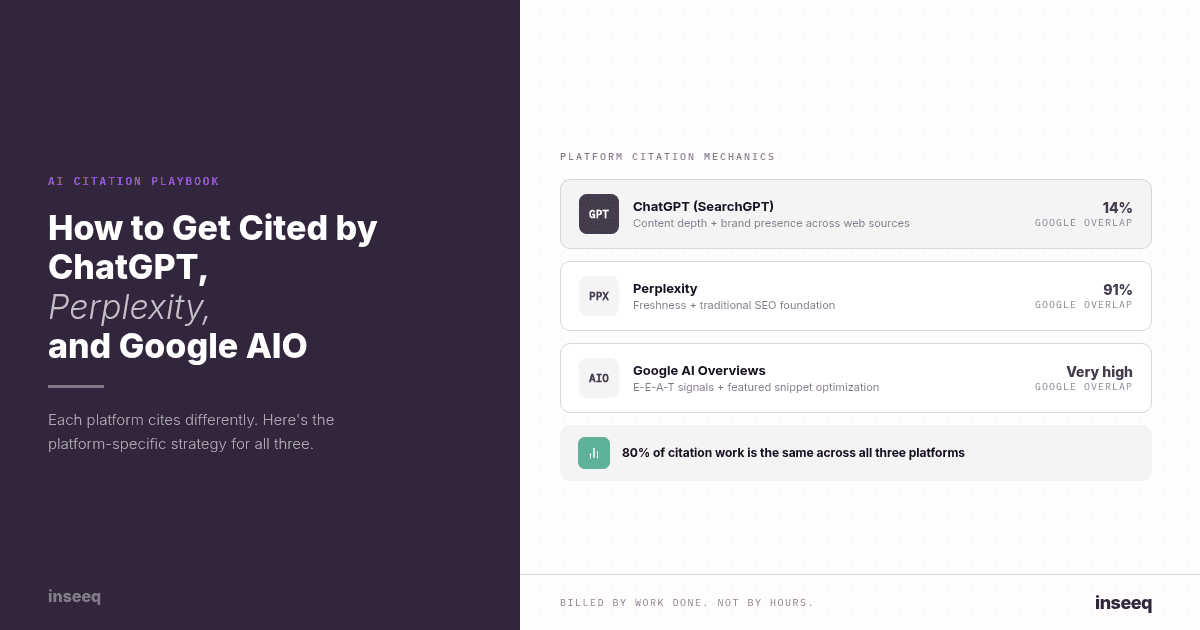
Platform citation mechanics for ChatGPT, Perplexity, and Google AI Overviews compared
Same Brand, Three Different AI Search Results
Run this experiment. Take a B2B company in any competitive category. Ask ChatGPT: "What's the best [category] company for [use case]?" Then ask Perplexity the same question. Then ask Google AI Overviews.
You'll frequently get three different answers: different sources cited, different brands recommended, different levels of confidence in the recommendation.
This isn't a bug. It's how these platforms work. ChatGPT, Perplexity, and Google AI Overviews each operate on different retrieval architectures, different freshness weightings, and different trust signals. A brand that's well-optimized for one isn't automatically visible on the others.
Research published in early 2026 confirmed the divergence: Perplexity has a 14.8x sentiment gap versus ChatGPT for the same brand across the same queries. Same company, radically different editorial treatment. The implication for content strategy is significant.
How ChatGPT Decides What to Cite
ChatGPT operates in two modes that require different optimization approaches.
ChatGPT (training data mode): The base ChatGPT model draws on its training data cutoff. Brands and content that existed and were discussed across the web before the training cutoff get represented in the model's baseline knowledge. Updating your web presence after that cutoff only affects the next training cycle.
SearchGPT (live search mode): When a user enables web search in ChatGPT, the model performs live retrieval similar to a search engine, then synthesizes results. This is where most B2B citations now happen: users asking research questions with web search enabled.
What ChatGPT's live search mode responds to:
Content depth and comprehensiveness on a topic
Clear entity signals (Organization schema, consistent brand naming across the web)
Consistent brand mentions across authoritative third-party sources (reviews, industry publications, partner pages)
Topical authority built through a cluster of related content
The critical difference from Perplexity: ChatGPT's live search has a lower correlation with traditional Google rankings (approximately 14% overlap vs. Perplexity's 91%). It draws from a broader source pool and applies different quality filters. Strong Google rankings help but aren't sufficient.
The ChatGPT citation playbook:
Build brand presence across multiple platforms: LinkedIn, industry publications, partner directories
Publish comprehensive topical authority clusters on your core subjects
Ensure consistent entity language across all web properties
Earn mentions and citations from authoritative third-party sources in your category
How Perplexity Decides What to Cite
Perplexity is a live search engine with a reranking layer. It fetches results in real time, applies a quality filter, and synthesizes an answer from the highest-scoring sources.
Its strongest characteristic: 91% of Perplexity citations come from top-10 Google results. Perplexity's retrieval is heavily correlated with traditional Google rankings.
The additional signals Perplexity weights:
Freshness. Perplexity heavily favors recently published and recently updated content. An article published two weeks ago can outcompete a comprehensive article from 18 months ago on Perplexity, even if the older article has more backlinks. This is why publishing cadence is a primary GEO variable for Perplexity-specific visibility.
Trusted domain signals. Perplexity has a whitelist of domains it treats as higher-quality sources. Publications, established industry sites, and brands that have been consistently cited tend to benefit from stronger trust scoring.
Content structure. Perplexity's reranker responds well to clean, extractable content: H2 sections with direct answers, structured data, FAQ sections.
The Perplexity citation playbook:
Maintain a consistent publishing cadence: 2-5 articles per week keeps you in the freshness window
Build strong traditional SEO as a foundation (Perplexity uses Google rankings as a primary signal)
Structure every article for extraction: direct H2 answers, FAQ sections, source citations
Update existing high-performing articles regularly (updating
dateModifiedhelps signal freshness)
How Google AI Overviews Decide What to Cite
Google AI Overviews (AIO) are the most familiar AI search surface for most B2B marketers. They appear directly in Google search results for a growing share of queries.
AIO citation is heavily tied to Google's existing authority signals:
E-E-A-T (Experience, Expertise, Authoritativeness, Trustworthiness). Google's existing quality framework for ranking is the primary signal for AIO citation. Pages that rank well for traditional search are cited in AIO frequently. Building E-E-A-T means: authored content with expert credentials, external citations and backlinks from authoritative sources, accurate and well-sourced claims.
Featured snippet optimization. Pages that currently hold Google featured snippets are heavily cited in AI Overviews. The formatting that wins featured snippets (direct questions answered in the first 40-60 words, bullet-point lists, tables) is the same formatting that drives AIO citations.
FAQ schema. Google AIO frequently cites FAQ-formatted content. FAQPage schema markup significantly increases the probability of AIO citation.
SERP position correlation. Unlike ChatGPT, Google AIO shows high correlation with top-10 organic rankings. The SEO fundamentals that drive Google rankings also drive AIO visibility, with the additional layer of content structure optimization.
The Google AIO citation playbook:
Target featured snippet position for every target keyword
Build E-E-A-T through authored content, external citations, and quality backlinks
Add FAQPage schema to all relevant content
Structure content with the direct-answer H2 format that wins featured snippets
The Unified Playbook: What Works Across All Three
Platform-specific tactics matter. But 80% of the citation-driving work is the same across ChatGPT, Perplexity, and Google AIO.
Topical authority clusters. All three platforms respond to domains with deep, comprehensive coverage of a topic area. Publishing 12 interlinked articles on payroll automation signals expertise to every AI engine, regardless of the specific retrieval mechanism.
Direct-answer H2 structure. Content organized around specific questions, with direct answers in the first paragraph of each section, is extractable by all three systems. This is the most transferable format for AI citation.
FAQ sections with schema. FAQPage schema is honored by Google AIO, used by Perplexity for structured extraction, and readable by ChatGPT's live search. It's the highest-ROI schema investment for AI citation.
Publishing cadence. Consistent publication at 2-5 articles per week per topic cluster benefits freshness signals on Perplexity, signals domain activity to Google, and expands the content surface area available to ChatGPT's live search.
Source citations. All three platforms respond to well-sourced content. Citing research (with specific data points, study names, and dates) increases the credibility score that each platform's quality filter applies.
ChatGPT | Perplexity | Google AIO | |
|---|---|---|---|
Google ranking correlation | Low (14%) | High (91%) | Very High |
Freshness weighting | Medium | Very High | Medium |
Schema importance | Medium | Medium | High |
Topical authority | High | High | High |
Third-party mentions | High | Medium | High (E-E-A-T) |
What inseeq's GEO Approach Covers
inseeq's GEO methodology is built for cross-platform visibility, not optimized for one AI engine at the expense of others.
The content strategy covers the full spectrum: topical authority cluster design for deep coverage, direct-answer H2 structure for extractability, FAQ sections with schema for featured content placement, and consistent publishing cadence for freshness signals. The technical layer (Organization schema, Article schema, FAQPage schema, BreadcrumbList) is implemented by default in every WordPress build.
The result is citation architecture that compounds across ChatGPT, Perplexity, and Google AIO simultaneously, not a tactic optimized for one platform's current algorithm.
For more on individual platform strategy, see: How to Get Cited by Perplexity AI (And Why Your ChatGPT Strategy Won't Cut It) and Why ChatGPT Never Recommends Your Company (And How to Fix It).
Frequently Asked Questions
How do you get cited by AI search? The universal requirements: topical authority content clusters, direct-answer H2 structure, FAQ sections with FAQPage schema, and consistent publishing cadence. Platform-specific additions: for ChatGPT, build brand presence across third-party sources; for Perplexity, prioritize freshness and traditional SEO; for Google AIO, optimize for featured snippets and E-E-A-T.
Is ChatGPT citation different from Perplexity? Yes, significantly. Perplexity cites top-10 Google results 91% of the time and weights content freshness heavily. ChatGPT has only 14% overlap with top-10 Google results and draws from a broader, more diverse source pool. ChatGPT benefits more from brand presence across multiple web sources; Perplexity responds more to strong Google SEO and consistent publication frequency.
How long does it take to get cited by AI? For Perplexity and Google AIO: 30-60 days with the right technical setup and content strategy, given the high correlation with Google rankings. For ChatGPT live search: similar timeline, but brand presence across multiple web sources (not just your own site) also plays a role. Training-data ChatGPT requires waiting for the next training cycle.
Can any website get cited by ChatGPT? Yes. ChatGPT's live search doesn't have a domain allowlist. It retrieves based on content quality, relevance, and entity signals. A newer domain with well-structured, authoritative content on a specific topic can get cited. Brand recognition and external mentions also help, particularly for ChatGPT's training data model.
Does social media affect AI citations? Indirectly. Social media profiles (especially LinkedIn for B2B) are entity signals that help AI engines build a complete picture of your brand. Social mentions and shares can lead to editorial coverage that becomes citable. Direct social posts are generally not cited by AI search engines in their own right, but the authority signals they create can influence citation probability.
Find Out If You're Being Cited
The first step is running the audit: test the specific queries your buyers use across all three platforms and document what comes up. Most founders find their competitors consistently before the first test query is done.
inseeq's free Growth Audit maps your current citation share across ChatGPT, Perplexity, and Google AI Overviews and shows you exactly what it would take to get cited.
Get your free Growth Audit and find out where you actually stand in AI search.

Hans-Peter Frank
Co-founder
How Visible Is Your Business in AI Search?
Find out in 60 seconds. Our free AI Visibility Checker scans ChatGPT, Perplexity, and Google AI Overviews for your brand.
Check Your AI Visibility