AI Visibility Checker: How to Find Out If ChatGPT, Perplexity, and Google AI Know Your Brand
Use a free AI visibility checker to see if ChatGPT, Perplexity, and Google AI cite your brand — and find out what's blocking you from AI search results.
How Visible Is Your Business in AI Search?
Find out in 60 seconds. Our free AI Visibility Checker scans ChatGPT, Perplexity, and Google AI Overviews for your brand.
Check Your AI Visibility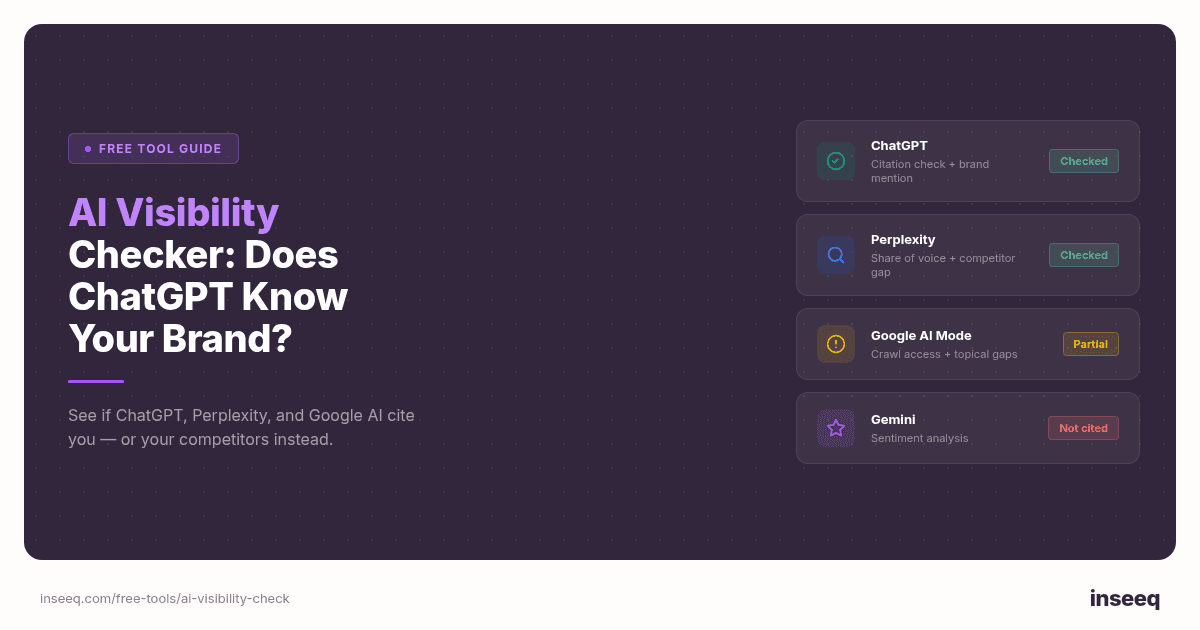
AI visibility checker showing platform-by-platform citation status across ChatGPT, Perplexity, Google AI Mode, and Gemini
What an AI Visibility Checker Actually Does
A founder types their company name into ChatGPT and asks: "What are the best tools in [their category]?" Three competitors appear. Their brand doesn't. They had no idea.
That's the scenario an AI visibility checker is built to catch before it costs you deals.
An AI visibility checker is not a rank tracker. There are no positions to report. What it does is systematically test whether AI platforms can find, parse, and cite your brand when users ask questions in your category. It runs your domain against the actual AI models your buyers are using — and returns a clear answer: visible, partially visible, or invisible.
A well-built checker tests across four dimensions:
Crawl access: Can AI bots (GPTBot, ClaudeBot, PerplexityBot) actually access your site? Many brands accidentally block them in their robots.txt.
Content extractability: Can AI systems pull clean, structured answers from your pages, or is your content formatted in a way that makes it hard to parse?
Citation rate: When AI platforms answer questions in your category, does your domain appear as a cited source?
Brand mentions: Is your brand named in AI responses, even without a direct link?
The platforms that matter most right now: ChatGPT (900M+ weekly users), Perplexity (the most citation-heavy AI search engine), Google AI Mode, and Gemini. A thorough AI visibility check covers all four, because each one uses slightly different signals to decide what to surface.
Most brands who run this check for the first time discover they're invisible on at least two of the four platforms — including ones their buyers use daily.
Why You Can't Trust Your Google Rankings to Tell You This
If your brand ranks on page one of Google, you might assume AI search is taken care of. That assumption is wrong, and the data is stark.
According to Semrush's 2026 AI visibility research, only 2.1% of ChatGPT citations come from pages in Google's top 10. That means for every 100 sources ChatGPT cites, fewer than 3 are brands that Google considers authoritative enough to rank at the top.
The disconnect exists because Google and AI search engines use fundamentally different signals.
Signal | AI Search Engines | |
|---|---|---|
Domain authority | High weight | Low weight |
Backlink profile | High weight | Low weight |
Content depth | Moderate weight | High weight |
Structural clarity | Low weight | High weight |
Direct answer format | Low weight | High weight |
Recency | Moderate weight | High weight |
Google asks: "Which domain has the most authority?" AI search asks: "Which source best answers this specific question, right now?"
The practical result: a competitor with a fraction of your backlink profile, but better-structured content that directly answers buyer questions, can dominate AI citations while your brand is invisible. And you'd have no idea, because your analytics show healthy organic traffic and your rank tracker shows solid positions.
What zero AI visibility looks like in practice: buyers ask ChatGPT which tools to consider in your category, get a confident list of three options, none of which is you, and move into evaluation with your brand entirely out of the picture. The decision is made before anyone visits your site.
This is why checking your AI search visibility is now a distinct discipline from SEO — and why the two metrics need to be tracked separately.
How to Check Your AI Visibility for Free
There are two ways to check: manually, or with a purpose-built tool. Both are worth knowing.
Using inseeq's free AI visibility checker
inseeq's free AI visibility checker runs your domain against the major AI platforms and returns a scored report in under two minutes. No signup required.
What the report shows:
Citation coverage: Which AI platforms are currently citing your domain, and for which types of queries
Competitor gap: Which brands are appearing instead of you in your category, and how frequently
Topical gaps: Which subject areas in your niche are generating AI citations for competitors but not for you
Crawl status: Whether AI bots have access to your site or are being blocked
The output is actionable: you see not just where you're invisible, but the specific gaps that are driving it.
Manual checking as a supplement
For a quick spot-check, open ChatGPT, Perplexity, and Google AI Mode and run these prompt types:
"What are the best [your product category] tools for [your target use case]?"
"Which companies are the leading providers of [your service]?"
"Compare [your brand] vs. [your main competitor]"
"What do experts recommend for [the main problem you solve]?"
For each response, note whether your brand is mentioned, cited with a link, or absent entirely. Record which competitors appear and what's said about them. Five prompts across three platforms takes about 20 minutes and gives you a directional read.
The manual method is useful for spot-checking specific queries. The automated checker is better for systematic baselining and tracking changes over time.
What Your AI Visibility Score Actually Means
An AI visibility score aggregates several underlying metrics. Understanding what's inside the number helps you act on it.
Citation rate is the core metric: how often your domain appears as a cited source when AI platforms answer queries in your category. A citation rate of zero doesn't mean your content is bad. It often means AI crawlers can't access it, or can't extract clean answers from it.
Share of voice measures your citations as a percentage of all citations in your category. If your niche generates 200 AI citations per week and you appear in 4, your share of voice is 2%. Your nearest competitor at 40 appearances has a 20x advantage. Share of voice is the competitive metric that matters most for strategy.
Sentiment captures how AI platforms characterize your brand when they do mention you. "Company X offers competitive pricing but has had mixed reviews for enterprise support" is a citation with built-in reputational risk. Positive, specific, accurate sentiment framing is the goal.
Crawl accessibility is a binary check: are AI bots allowed in your robots.txt? Brands that block GPTBot or ClaudeBot accidentally cut themselves off from citation indexing entirely. It's one of the most common and most fixable causes of zero AI visibility.
What a good score looks like depends on category maturity. In a nascent category with few competitors publishing structured content, even modest citation coverage represents a significant advantage. In a crowded category with well-funded competitors actively running GEO strategies, higher citation rates are needed to hold share.
The red flags to act on immediately:
Zero citations across all platforms: A crawl or content structure problem, fixable within weeks
Citations present but negative sentiment: A reputation or content accuracy issue
High competitor citation rate, zero yours: A content authority gap that requires systematic content investment
Citations for some topics, invisible on others: Topical gaps in your content strategy
The Most Common Reasons Brands Are Invisible to AI Search
When brands discover zero AI visibility, the cause usually falls into one of four categories.
AI crawlers blocked in robots.txt
This is the most common technical cause and the easiest to fix. OpenAI, Anthropic, and Perplexity each send their own crawl bots to index content. If your robots.txt file disallows GPTBot, ClaudeBot, or PerplexityBot, those platforms cannot index your content — and therefore cannot cite it. Check your robots.txt at yourdomain.com/robots.txt. If any of those bots are listed under Disallow, remove the rule and allow crawling.
Thin or unstructured content authority
Domain authority (SEO's backlink-based metric) has limited value for AI citation. What AI systems respond to is content authority: does this page comprehensively answer a specific question in a way that can be extracted and cited?
A page that says "We offer best-in-class solutions for enterprise teams" is useless to an AI model. A page that says "Here are the five most common causes of X problem, with data from [source], and specific steps to address each" gives an AI model something it can actually use.
No schema markup or structured data
Schema markup (FAQ schema, HowTo schema, Product schema) gives AI systems machine-readable signals about what a page contains and what questions it answers. Brands without schema are harder to parse, and harder-to-parse content gets cited less.
Content that's too old or too vague
Approximately 90% of AI-cited pages were published in the last three years, according to Semrush's analysis. Content from 2019 or 2020 — even if technically accurate — is less likely to surface in AI responses than fresher, more specific material covering the same topic. Recency is a signal AI systems weight more heavily than traditional search.
How to Fix Low AI Visibility (After You've Checked)
Once your AI visibility checker report identifies the gaps, the fixes fall into three categories.
Structural fixes: make your content extractable
The single highest-leverage change for most brands is restructuring existing content to be directly answerable. This means:
Rewrite H2 headings to mirror the exact questions buyers ask ("What is X?" "How does Y work?" "Which Z is best for [use case]?")
Answer the question in the first sentence of each section, not after two paragraphs of context
Add tables for any comparison or reference data — AI systems extract structured data efficiently
Break long paragraphs into shorter, topically focused blocks
Add FAQ sections with genuine PAA-derived questions and direct answers
None of this requires new content. It requires restructuring what you already have.
Freshness: updating beats creating
If your most authoritative content is more than two years old, refreshing it with current data, updated statistics, and new examples will improve AI citation rates faster than writing an entirely new article from scratch. AI systems weight recency, so a 2024 article updated in 2026 with new sections outperforms a 2022 article that's technically still accurate.
The priority order: update your highest-traffic existing pages first, since they already have some authority signal. New articles targeting net-new topics come second.
Distribution: earn mentions where AI systems look
AI models don't just index your site. They build their understanding of your brand from across the web. Third-party mentions on industry publications, Reddit threads, LinkedIn posts, and review platforms all contribute to how AI characterizes your brand — independent of what's on your own domain.
Getting your brand accurately discussed in places AI systems frequently crawl: contribute to Reddit discussions in your niche, publish guest articles on industry-relevant publications, build a presence on LinkedIn with consistent topical authority content. These external mentions compound over time and shape the AI narrative about your brand.
For a systematic approach to auditing and closing AI visibility gaps, inseeq's AI search visibility service combines content production, structural optimization, and distribution into a single managed workflow. The typical result: measurable AI citation improvement within the first 90 days. Clients like project b. saw +300% organic traffic in that window, driven in part by AI search citation gains alongside traditional SEO.
For a broader view of what the measurement process looks like, see What Is AI Search Visibility — And How Do You Measure It?.
Frequently Asked Questions
What is an AI visibility checker? An AI visibility checker is a tool that tests whether your brand is cited, mentioned, or recognized by AI-powered platforms like ChatGPT, Perplexity, Google AI Mode, and Gemini. Unlike a rank tracker, it doesn't report keyword positions — it reports actual brand presence in AI-generated answers, along with crawl access status, competitor gap analysis, and topical coverage.
Is there a free AI visibility checker? Yes. inseeq offers a free AI visibility checker that returns a scored report in under two minutes — no signup required. It covers citation coverage across major AI platforms, competitor comparison, and content gap identification.
Why is my brand invisible in AI search results? The most common causes are: AI crawlers blocked in your robots.txt, content that isn't structured for extractability (no clear headings, no direct answers, no FAQ sections), missing schema markup, and content that's too old or too generic for AI systems to consider authoritative. An AI visibility checker diagnoses which of these applies to your site.
How is an AI visibility checker different from an SEO tool? SEO tools measure keyword rankings in Google's index. An AI visibility checker measures brand presence in AI-generated answers. The two metrics use different signals and often don't correlate. A brand can rank on page one of Google and be completely invisible to ChatGPT — and vice versa.
Which AI platforms should an AI visibility checker cover? At minimum: ChatGPT, Perplexity, and Google AI Mode. These three represent the majority of AI-driven discovery for B2B buyers. If your market skews enterprise or European, also include Gemini and Google AI Overviews. Different platforms use different indexing signals, so multi-platform coverage gives a more accurate picture than checking just one.
How often should I check my AI visibility? Monthly is a good baseline for most B2B brands. If you're actively running an AI search optimization strategy — publishing new content, updating existing pages, or building third-party mentions — check every two weeks to track the impact of those changes. Use a consistent set of test prompts so results are comparable over time.
Can my AI visibility score improve after making changes? Yes, and typically faster than traditional SEO. Structural content changes (rewriting headings, adding FAQ sections, fixing crawl access) can show up in AI citations within weeks, since AI models update their indexes more frequently than Google's ranking algorithm cycles. Brands that implement structural fixes and fresh content often see measurable AI citation improvement within 60 to 90 days.
Check Your Score Now
You're not going to find out your AI search visibility is broken from a Google Analytics report. The signal doesn't show up there — it shows up in lost deals you never knew were happening, in buyers who chose a competitor they found through ChatGPT, in a narrative about your category that doesn't include your name.
Run inseeq's free AI visibility check now. It takes two minutes, requires no signup, and tells you exactly where you stand — citation coverage, competitor gap, crawl status, and topical blind spots.
If the results show gaps, that's fixable. But you need to know first.

Hans-Peter Frank
Co-founder
How Visible Is Your Business in AI Search?
Find out in 60 seconds. Our free AI Visibility Checker scans ChatGPT, Perplexity, and Google AI Overviews for your brand.
Check Your AI Visibility