
AI Visibility Audit: What to Check and How to Fix What's Broken
A step-by-step AI visibility audit covering citations, content structure, technical signals, and off-page mentions. Run the free checker to get your baseline.
How Visible Is Your Business in AI Search?
Find out in 60 seconds. Our free AI Visibility Checker scans ChatGPT, Perplexity, and Google AI Overviews for your brand.
Check Your AI Visibility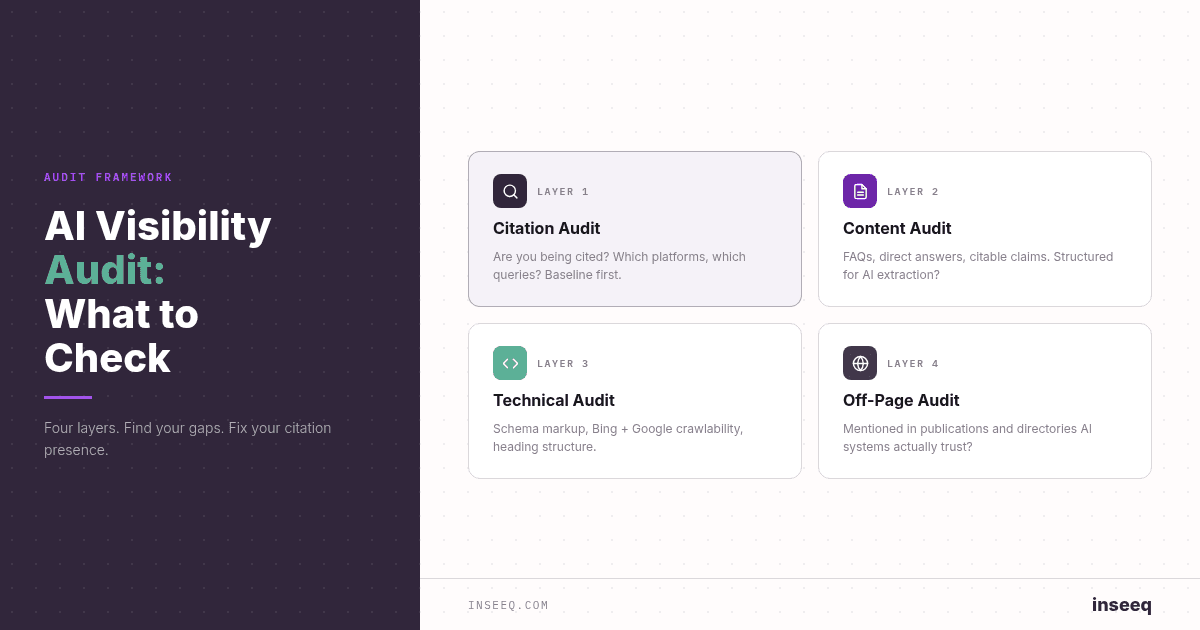
Four-layer AI visibility audit framework: citation audit, content audit, technical audit, and off-page audit
What an AI Visibility Audit Actually Covers
An AI visibility audit is not a technical SEO audit with a new label. Most SEO audits focus on crawlability, page speed, backlink profiles, and ranking positions. An AI visibility audit focuses on something different: whether your brand is being cited by AI search engines when users ask relevant questions, and what's preventing that from happening if it isn't.
The two audit types share some technical foundations, but the questions they're trying to answer are different. An SEO audit asks: why am I not ranking? An AI visibility audit asks: why am I not being cited?
A thorough AI visibility audit covers four layers:
Citation audit: where you currently stand across AI platforms
Content audit: whether your content is structured to be citable
Technical audit: whether AI crawlers can find and process your pages
Off-page audit: whether you're mentioned in sources AI systems trust
Most brands that run this audit for the first time find the same thing: strong citation gaps they had no awareness of, structural content issues that are straightforward to fix, and off-page footprints significantly smaller than their competitors. The audit makes the gap visible and creates a prioritized fix list.
Layer 1: Citation Audit
The citation audit answers the most fundamental question: when someone asks a relevant question on ChatGPT, Perplexity, or Google AI Overviews, does your brand appear?
What to measure
Three metrics matter:
Citation frequency: how many times your brand is cited across a defined query set relevant to your category
Query coverage: which questions trigger a citation to your brand and which don't
Platform breakdown: are you cited on all four major platforms (ChatGPT, Perplexity, Google AI Overviews, Gemini) or only some?
How to run a manual citation check
Select 20 to 30 queries that represent the questions your target customers ask. Include category questions ("what's the best [tool type] for [use case]"), problem questions ("how do I solve [specific problem]"), and comparison questions ("what's the difference between [option A] and [option B]").
Run each query on ChatGPT, Perplexity, and Google. Record whether your brand is cited, who is cited instead, and how specific the citation is (named in passing vs. prominently featured). This gives you a raw citation map.
Using a tool vs. manual checking
Manual checking is practical for initial discovery but doesn't scale. Running 30 queries across three platforms manually is feasible for a one-time baseline. Ongoing monitoring across a larger query set requires tooling.
inseeq's free AI visibility checker runs a systematic analysis across ChatGPT, Perplexity, Google AI Overviews, and Gemini and returns a structured citation score. It's the fastest way to get a baseline and identifies where the gaps are by platform. Run it before doing any of the other audit layers — the citation data tells you which gaps to prioritize.
Layer 2: Content Audit
The content audit examines whether your existing content meets the structural requirements for AI citation. Most brands with citation gaps have content that's well-written for human readers but poorly structured for AI extraction.
Are you answering the right questions?
Map the queries from your citation audit against your existing content. For every query where you have no citation, identify whether you have any content that addresses that question at all. Gaps here are immediate priorities for new content production.
For queries where you exist but aren't cited, the issue is usually structure or specificity, not absence.
Is your content structured for AI parsing?
AI search engines parse content to extract answers. The structural requirements for this differ from requirements for human reading. Check each key article against these criteria:
Does every H2 section open with a direct answer to the implicit question in that heading?
Are key claims stated as clear, specific, extractable sentences rather than buried in narrative context?
Do headings map to real questions, or are they topic labels?
Is the reading structure logical: question introduced by heading, answered in first sentence, supported in subsequent sentences?
Content that fails these checks may rank fine in Google but fail to get extracted by AI systems.
Topical coverage gaps
Identify the full set of questions people ask in your topic space. You can build this list from People Also Ask data, keyword research tools, and manual AI queries. Map your existing content against this question set. Topics where you have no coverage are citation gaps. Topics where you have content but it's thin or vague are improvement priorities.
FAQ sections: present or missing?
Check every substantive article for a FAQ section. FAQ sections are high-citation-probability content because the question-and-answer format maps directly to how AI systems construct responses. Articles without FAQ sections are missing one of the easiest structural improvements available.
Specificity check
Review your ten highest-traffic articles and assess how many specific, verifiable, citable claims they contain. Look for concrete numbers, data points with sources, named examples, specific tools and platforms. Vague, hedged content is rarely cited. Specific content with attributable facts is.
A rough benchmark: a 2,000-word article optimized for AI citation should contain at least eight to ten specific, sourced claims that an AI could extract and use in a response.
Layer 3: Technical Audit
The technical audit verifies that AI crawlers can find, access, and process your pages. Even excellent content can't be cited if it's not indexed.
Crawlability check
Verify that your key pages are indexed by both Google and Bing. Google indexing matters for Google AI Overviews and Gemini. Bing indexing matters for ChatGPT with Search. Use Google Search Console for Google index status and Bing Webmaster Tools for Bing. Pages missing from either index cannot be cited by the corresponding AI platforms.
Common crawlability failures: pages blocked by robots.txt, orphaned pages with no internal links, pages returning non-200 status codes, JavaScript-rendered content that crawlers can't process.
Schema markup check
Check whether your key pages have implemented the schema types most relevant for AI citation:
Schema type | Benefit | Priority |
|---|---|---|
FAQ schema | Makes Q&A pairs directly extractable | High |
Article schema | Signals publication date and authorship | High |
HowTo schema | Structures step-by-step content for AI parsing | Medium |
Organization schema | Establishes entity identity in Knowledge Graph | Medium |
Use Google's Rich Results Test to check what schema is currently implemented. Missing FAQ schema on pages with FAQ sections is the most common quick win in this audit layer.
Page speed
Slow pages are less likely to be fully crawled and processed. Use Google PageSpeed Insights to check Core Web Vitals for your key pages. A target of under three seconds for Time to First Contentful Paint is a reasonable baseline. Pages significantly below this threshold should be flagged for technical optimization.
Heading structure check
Review the heading structure of your key articles. Every page should have a single H1 (the title), H2s that map to real questions or clear topic statements, and H3s that break those sections into specific aspects. Heading structures that use H2s as decorative labels rather than meaningful navigation reduce AI parsability.
Layer 4: Off-Page Mentions Audit
AI search engines don't only draw from your own site. They draw from the broader web, with significant weight given to authoritative third-party sources. The off-page audit assesses how visible your brand is in sources that AI systems trust.
Publication coverage
Run searches on ChatGPT and Perplexity that are likely to surface your category. Note which third-party publications are cited in those responses. These are the publications that carry weight in AI search for your space. Now check: are you mentioned in any of those publications?
The target list typically includes major industry publications, research reports, analyst coverage, and authoritative blogs. For B2B SaaS, common high-weight sources include G2, Capterra, TechCrunch, Product Hunt, and relevant vertical publications.
Directory and tool roundup coverage
Search for "[your category] tools" and "[your category] software" across AI platforms. Note the roundup articles and directories that appear as sources. Check whether your brand is listed in each. Missing from the key roundups in your category is a high-priority off-page gap.
Competitor footprint comparison
For each off-page source you've identified, check whether your main competitors are mentioned there. Competitors with significantly more off-page mentions in authoritative sources have a structural advantage in AI citation frequency. Closing that gap requires a targeted placement strategy, not just content production.
How to Prioritize Fixes
An AI visibility audit typically surfaces more fixes than can be addressed simultaneously. Prioritize by impact and speed of implementation.
Quick wins (weeks 1-4)
These fixes improve AI citation potential for existing content without requiring new articles:
Add FAQ schema to all pages that have FAQ sections
Add Article schema to all blog posts and articles
Restructure H2 openings in your top ten articles to lead with direct answers
Add FAQ sections to any high-traffic article that's missing one
Fix crawlability issues for pages not indexed by Bing or Google
Medium-term work (months 1-3)
These require content creation and structural changes:
Fill the highest-priority content gaps identified in the topical coverage check
Build out a complete topic cluster around your core category
Refresh existing articles with specific, sourced data points to improve citability
Improve internal linking to strengthen topical cluster signals
Longer-term investment (months 3+)
These require sustained outreach and relationship building:
Secure placements in the authoritative publications that appear in AI responses for your category
Get listed in relevant tool directories and roundup articles
Build original research or data assets that other publications will cite
What to track over time
Once you've made initial fixes, run the citation audit again at 30, 60, and 90 days. Track citation frequency across your defined query set and platform breakdown. The goal is a measurable upward trend in citation frequency as the content and structural improvements compound.
Frequently Asked Questions
What is an AI visibility audit? An AI visibility audit is a structured assessment of how visible your brand is in AI-generated search responses from platforms like ChatGPT, Perplexity, Google AI Overviews, and Gemini. It covers four layers: citation measurement (how often you're cited now), content structure (whether your content is optimized for AI extraction), technical signals (whether AI crawlers can access your pages), and off-page mentions (whether you're referenced in sources AI systems trust).
How is an AI visibility audit different from an SEO audit? An SEO audit focuses on ranking positions in Google's search results page and the signals that affect them (backlinks, on-page factors, technical health). An AI visibility audit focuses on citation frequency in AI-generated responses, which depends on different signals: content depth and structure, factual specificity, topical authority, and presence in third-party sources AI systems weight heavily. The two audits share some technical foundations but answer different strategic questions.
How often should I run an AI visibility audit? A full audit quarterly is a reasonable cadence for most B2B brands. The citation layer — checking your baseline score across platforms — should be tracked monthly once you've started implementing fixes, so you can see whether the work is moving the metrics. The content and technical layers only need revisiting when you've made significant changes or added new content.
What's the fastest way to improve AI visibility? The highest-leverage quick wins are structural: adding FAQ schema to existing pages with FAQ sections, restructuring H2 section openings to lead with direct answers, and adding FAQ sections to high-traffic articles that don't have them. These changes can be made to existing content without producing anything new, and they improve AI parsability across your entire content library immediately.
Do I need a paid tool to audit my AI visibility? The citation audit layer can be run manually for free, though it's time-consuming at scale. inseeq offers a free AI visibility checker that automates the citation scan across major AI platforms and returns a structured score. The content, technical, and off-page audit layers can all be done manually with standard tools (Google Search Console, Bing Webmaster Tools, Google's Rich Results Test).
Which AI platforms should I check in an audit? The four platforms that matter most by query volume are ChatGPT with Search, Perplexity, Google AI Overviews, and Gemini. Each uses different data sources and citation logic, so checking only one platform gives an incomplete picture. A complete audit covers all four.
What does a good AI visibility score look like? There's no universal benchmark — it depends on your category, competition, and how long you've been executing GEO. The useful comparison is against your own baseline over time (are citation rates improving?) and against competitors (are you cited as often as the key players in your category?). Starting from zero citations in a defined query set and reaching 30 to 50% citation frequency within a competitive cluster in six months is a realistic target for a focused GEO execution.
Run the Audit Now
The fastest way to start is with the citation layer. Everything else in this audit depends on knowing your current citation baseline — where you stand, which platforms are citing you, and where the gaps are.
inseeq's free AI visibility checker gives you that baseline in minutes. No account required. Use the results as the input for the content, technical, and off-page audit layers that follow.
For more on the mechanics behind AI search citation, read What Is AI Search Visibility, GEO vs SEO, and How to Get Your Brand Cited by ChatGPT, Perplexity, and Google AI.

Hans-Peter Frank
Co-founder
How Visible Is Your Business in AI Search?
Find out in 60 seconds. Our free AI Visibility Checker scans ChatGPT, Perplexity, and Google AI Overviews for your brand.
Check Your AI Visibility