
GEO vs SEO: What's Different and What Actually Matters for Your Brand
GEO and SEO are not the same discipline. Here's what changes with Generative Engine Optimization, what carries over, and what to prioritize first.
How Visible Is Your Business in AI Search?
Find out in 60 seconds. Our free AI Visibility Checker scans ChatGPT, Perplexity, and Google AI Overviews for your brand.
Check Your AI Visibility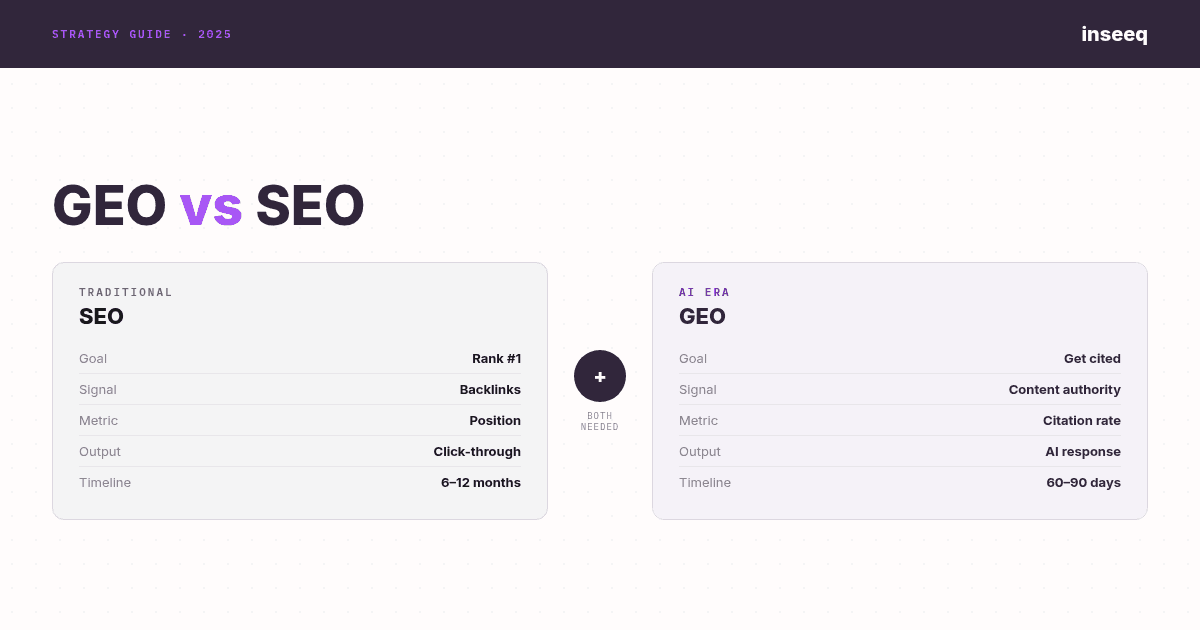
Side-by-side comparison of GEO and SEO showing differences in goal, signal, metric, output, and timeline
Two Systems, Two Different Games
Most marketers encountering GEO for the first time treat it as SEO with a new coat of paint. Different name, same playbook. That assumption is expensive.
Search engine optimization and generative engine optimization share a goal — being found when people search — but they achieve it through fundamentally different mechanisms. Understanding what actually changed is the prerequisite to building a strategy that works in both channels.
How SEO works
Google's core model rewards authority signals accumulated over time. When a user runs a query, Google's algorithm evaluates pages against that query and returns a ranked list. The primary input to that ranking is link authority: pages that earn links from trusted domains rank higher. The output is a list of clickable results the user navigates from.
SEO work, at its core, is the discipline of earning those authority signals: building backlinks, optimizing on-page factors, publishing content consistently, earning trust over time. The metric is position. Get to position 1, get the traffic.
How GEO works
When a user asks Perplexity or ChatGPT a question, the system doesn't return a list. It synthesizes an answer and, where appropriate, cites the sources it drew from. The user may never visit a third-party page at all.
The inputs that determine what gets cited are different. AI search engines parse content at query time to find the clearest, most authoritative, most directly relevant answer to a specific question. They're less interested in how many links a domain has accumulated and more interested in whether this specific piece of content is the best available answer to this specific question.
The output isn't a ranking. It's inclusion or exclusion. You're cited, or you're not.
Treating GEO as a variant of SEO means optimizing for the wrong signals. The brands winning in AI search aren't necessarily the ones with the highest domain authority. They're the ones whose content is structured to be cited.
What Carries Over from SEO to GEO
The gap between SEO and GEO isn't as wide as some coverage suggests. A meaningful portion of solid SEO work creates foundations that GEO builds on.
Technical fundamentals
Pages that aren't indexed can't be cited. Crawlability, page speed, and proper technical structure matter for both disciplines. If your site has indexing problems, technical SEO fixes benefit your AI search visibility directly. There's no separate technical layer to build for GEO.
Content quality
Both systems reward content that actually answers questions well. Thin, vague, or outdated content doesn't rank in Google and doesn't get cited in AI responses. The investment in producing substantive, accurate, well-researched content pays across both channels.
Topical authority
Google rewards topical authority: a site that covers a subject cluster comprehensively tends to rank well for queries in that cluster. AI search engines make similar assessments. A brand that has published authoritative content across a topic area sends a signal to AI systems that it's a reliable source on that subject. The strategy of building content clusters applies in both contexts.
Structured content
Well-organized content with clear headers, logical flow, and direct answers performs better in both SEO and GEO. The mechanism differs slightly (Google's crawlers vs. AI parsing engines), but the outcome is the same: structured content is easier to process, extract from, and cite.
What you've built in SEO is not wasted investment when you move to GEO. It's a foundation that the GEO layer extends, not replaces.
What's Fundamentally Different in GEO
Despite the shared foundations, several core elements of GEO diverge sharply from traditional SEO practice.
No ranking positions
SEO has a scoreboard: position 1, 2, 3. Every ranking tool in the market is built around that framework. GEO doesn't work this way. An AI response either includes your brand or it doesn't. Citation is binary.
This changes how you measure success. Instead of tracking rank positions, GEO measurement tracks citation frequency (how often you appear across a query set), query coverage (which relevant questions trigger a citation to your content), and response share (what percentage of AI responses in your space include your brand vs. competitors).
Content structured for AI parsing, not human skimming
Traditional SEO content is often optimized for human reading behavior: compelling headlines, engaging intros, narrative flow. These elements aren't irrelevant in GEO, but the primary structural requirement shifts. AI systems parse content to extract answers. Content that leads with direct answers, uses clear H2s that map to real questions, and states specific claims plainly is easier to cite than content organized around reader engagement patterns.
The difference between a sentence that gets cited and one that doesn't is often specificity and directness. "Perplexity cites sources inline with every response and draws from its own index" is extractable. "AI search platforms are increasingly important for brands to consider" is not.
Content authority, not domain authority
Domain authority is a proxy metric for how much accumulated link trust a domain has. It's a backwards-looking signal: what has this site proven over time? AI search engines care about this less. A newer domain with a genuinely excellent, specific, well-structured article can be cited over a high-DA site with superficial coverage of the same topic.
This is the most important strategic difference. It means the playing field is more level in GEO than in mature SEO niches. Brands that couldn't compete against established players on domain authority can build real AI search visibility through content quality and topical depth.
Freshness signals
Perplexity and other AI search engines explicitly favor recent content for fast-moving topics. In SEO, a well-ranking evergreen article can hold position for years with minimal updates. In GEO, content on dynamic topics needs regular refreshes to maintain citation frequency. The operational model for content management differs as a result.
The Practical Differences Side by Side
Dimension | SEO | GEO |
|---|---|---|
Primary goal | Rank in Google's results page | Get cited in AI-generated responses |
Core signal | Backlinks + domain authority | Content authority + structural clarity |
Success metric | Ranking position | Citation frequency, query coverage |
Content structure | Optimized for human reading | Optimized for AI parsing |
Competitive lever | Link building over time | Content quality and topical depth |
Timeline | 6-12 months to meaningful rankings | 60-90 days to measurable citation gains |
Output | User clicks through to site | User may never visit — citation is the outcome |
The two disciplines reinforce each other more than they conflict. Good SEO content, when structured for AI parsing, becomes good GEO content. The primary area of potential conflict is resource allocation: if your content team is spending time on link-bait content that earns backlinks but lacks depth, you're optimizing for SEO at the expense of GEO. The reallocation isn't abandoning SEO — it's producing content that earns both.
The area where they most diverge is measurement and tooling. Your existing rank tracker is not a GEO tool. Building a GEO measurement practice alongside your SEO reporting is a separate work stream, not an extension of existing dashboards.
What to Actually Prioritize
If you're a B2B brand reading this without a GEO strategy, here's the sequencing that makes sense.
Start with a baseline measurement
You cannot optimize a gap you haven't measured. Before any content work, run an AI visibility check to understand where you currently stand. Which AI platforms cite your brand? For which queries? What's your response share vs. competitors? This takes minutes and gives you a concrete starting point.
inseeq's free AI visibility checker runs this analysis across ChatGPT, Perplexity, Google AI Overviews, and Gemini and returns a structured score. Use it before making any GEO investment.
Don't abandon SEO
SEO still drives significant traffic and still feeds into some AI search models. The move isn't to reallocate your entire SEO budget to GEO. It's to layer GEO practices on top of existing content work: restructure existing articles for AI parsing, build content clusters that establish topical authority, add FAQ sections to high-traffic pages, refresh outdated content with current data.
The highest-leverage GEO moves for B2B brands
Three content actions move the needle fastest:
Build a topical cluster around your core category. A single article doesn't establish authority. A cluster of five to ten interlinked, substantive articles signals to AI systems that you're the authoritative source on this topic.
Rewrite your existing content for direct answers. Take your ten highest-traffic SEO articles and restructure them: lead each section with a direct answer to a clear question, add FAQ sections, replace vague claims with specific, citable ones.
Get cited in third-party content. AI search engines train on and index authoritative third-party sources. Getting mentioned in industry publications, research reports, and authoritative directories expands the surface area for citation.
The gap between where most B2B brands are today on AI search visibility and where they need to be is significant. The brands that measure first and build systematically will own those citations. The window to do it cheaply is open now, before competitors recognize the same opportunity.
Frequently Asked Questions
What does GEO stand for? GEO stands for Generative Engine Optimization. It's the discipline of structuring content and brand presence to appear as a cited source in responses from AI search engines like ChatGPT, Perplexity, Google AI Overviews, and Gemini.
Is GEO replacing SEO? No. GEO is an additional discipline, not a replacement. Google's ranked list model still exists and still drives significant traffic. The accurate framing is that AI search is a parallel channel growing in query volume share. Brands need presence in both channels. GEO doesn't make SEO irrelevant; it makes SEO insufficient on its own.
Do I need to choose between GEO and SEO? Not directly. Many GEO best practices — content depth, topical authority, factual specificity, structured formatting — reinforce SEO performance rather than conflicting with it. The main tension is resource allocation: content produced purely for link acquisition may not serve GEO goals. Aligning content production toward substantive, authoritative pieces that earn both links and citations is the practical resolution.
How is GEO success measured? GEO performance is measured by citation metrics: citation frequency (how often your brand appears across a defined query set), query coverage (which relevant questions trigger a citation to your content), and response share (your brand vs. competitors across AI responses in your space). These are different from SEO rank tracking and require different tooling.
Which AI platforms does GEO target? The four platforms with the most query volume right now are ChatGPT with Search, Perplexity, Google AI Overviews, and Gemini. Each uses different data sources and citation logic, so a complete GEO strategy covers all four rather than optimizing for one platform in isolation.
How is content structured differently for GEO? GEO-optimized content leads with direct answers, uses clear H2s that map to real questions, includes specific and verifiable claims, and has FAQ sections that address common follow-up queries. The goal is to make every answer extractable by an AI parsing the page. SEO content can be more narrative and engagement-focused; GEO content prioritizes parsability and factual density.
Can a new brand compete in GEO against established players? Yes, and this is one of GEO's most significant strategic opportunities. Domain authority accumulated over years is less of a determinant in GEO than in mature SEO niches. A newer brand with genuinely excellent, well-structured content on a specific topic can achieve significant AI search visibility against established competitors. The playing field is more level in GEO precisely because the primary currency is content quality, not accumulated backlink equity.
Run Your AI Visibility Check First
The most common mistake brands make with GEO is jumping to tactics before establishing a baseline. You need to know which queries you're invisible in, which platforms aren't citing you, and where competitors are winning citations before deciding where to invest.
inseeq's free AI visibility checker gives you that baseline in minutes. Check where you stand today, then build from there.
For a deeper look at what AI search visibility means and how it's measured, read our guide: What Is AI Search Visibility (And Why Google Rankings Don't Tell the Whole Story).

Hans-Peter Frank
Co-founder
How Visible Is Your Business in AI Search?
Find out in 60 seconds. Our free AI Visibility Checker scans ChatGPT, Perplexity, and Google AI Overviews for your brand.
Check Your AI Visibility