
GEO vs. SEO: What's Actually Different (And Why It Matters for Your Brand)
GEO (Generative Engine Optimization) and SEO target different systems with different signals. Here's exactly what changed and what your brand needs to do about it.
How Visible Is Your Business in AI Search?
Find out in 60 seconds. Our free AI Visibility Checker scans ChatGPT, Perplexity, and Google AI Overviews for your brand.
Check Your AI Visibility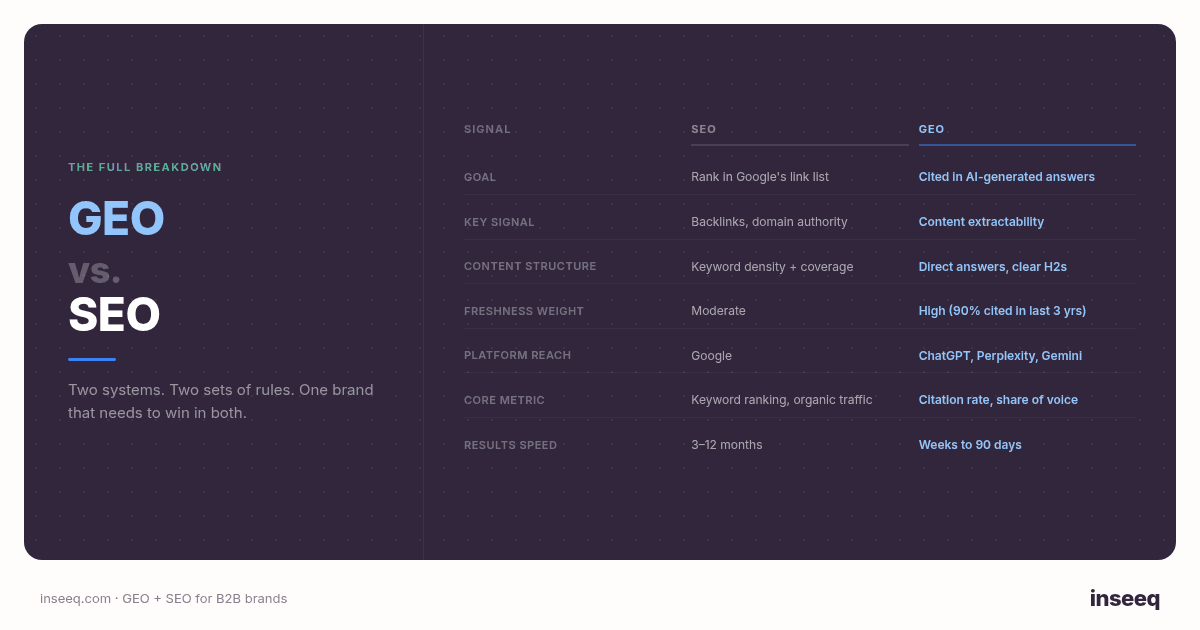
GEO vs SEO comparison table showing differences in signals, content structure, metrics and results speed across seven dimensions
Two Systems, Two Sets of Rules
There's a version of this conversation that ends badly: someone in a marketing team hears about GEO, decides it's just rebranded SEO, and goes back to building backlinks. Three years from now, their Google rankings look fine and their AI search presence is zero.
SEO (Search Engine Optimization) is the practice of optimizing web content and technical infrastructure so Google ranks your pages for relevant queries. It's been the dominant discipline in digital marketing for two decades.
GEO (Generative Engine Optimization) is the practice of structuring your content and brand presence so AI platforms — ChatGPT, Perplexity, Google AI Mode, Gemini — cite you when answering questions in your category.
Same goal: be found by people looking for what you offer. Completely different systems, signals, and success metrics.
The critical point is that these two disciplines coexist without one substituting for the other. A brand that does excellent SEO will not automatically gain AI visibility. A brand that builds strong AI citation rates will not automatically rank on Google. The overlap exists — quality content serves both — but the specific optimizations required are different, the measurement is different, and the competitive dynamics are different.
Running only SEO in 2026 is like running only TV advertising in 2010. The channel still works. It's just no longer the whole picture.
What SEO Actually Optimizes For (And Where It Stops)
SEO is built around a specific model of how search works: a user types a query, Google evaluates billions of pages, and returns a ranked list of links. The brand that gets the most qualified clicks wins.
To win that ranked list, Google weighs a set of signals that are well-understood after two decades of research:
Backlinks: Links from other websites signal that your content is worth referencing. The quantity and quality of those links feed Google's PageRank calculation.
Domain authority: The overall strength of your site's backlink profile, which gives new pages on your domain a credibility head-start.
Keyword relevance: How well your content matches the intent behind a specific query.
Technical performance: Site speed, mobile-friendliness, crawlability — the infrastructure signals that determine whether Google can index you at all.
User behavior: Click-through rates, dwell time, and pogo-sticking all feed back signals about whether users found what they were looking for.
SEO works brilliantly for a specific class of queries: transactional ("buy running shoes"), navigational ("Notion login"), and local ("accountant near me"). These are queries where the user wants to click through to a specific destination. The ranked-list model serves them perfectly.
The gap emerges at the research stage. When a B2B buyer asks "what are the best project management tools for distributed engineering teams?" they increasingly don't want a list of links to click through. They want an answer. And that answer is increasingly coming from AI systems, not Google's blue links.
According to Semrush's 2026 data, AI Overviews now appear in over 16% of all Google searches. ChatGPT has 900M+ weekly users. Perplexity, the most citation-heavy AI search platform, is growing rapidly among research-phase buyers. The research stage of the B2B buyer journey has migrated — and SEO doesn't follow it there.
What GEO Actually Optimizes For
Generative engine optimization targets a different output: a citation in a synthesized answer, not a position in a ranked list. The question GEO answers is: when an AI platform responds to a query in my category, does it cite my brand as a source?
The signals that drive AI citation are meaningfully different from SEO signals:
Content extractability is the most important. AI systems need to pull specific, accurate information from your pages to include in their synthesized answers. Content that's buried in long prose, organized around keyword density rather than direct questions, or structured in a way that doesn't parse cleanly — gets ignored. Content with clear H2s that mirror how users phrase questions, direct answers in the first sentence of each section, and structured data (tables, lists, FAQ schema) — gets extracted and cited.
Entity clarity is how consistently your brand is described across all the sources AI systems index. If your website says you're a "B2B marketing agency," your LinkedIn says "AI-native content company," and your Crunchbase listing says "MarTech startup," AI systems have conflicting signals about what you are. Consistent entity definition across owned and earned properties makes it easier for AI to accurately characterize and cite you.
Freshness matters more in AI search than in traditional SEO. Approximately 90% of AI-cited pages were published within the last three years, according to Semrush. AI models appear to weight recency more heavily than Google does — possibly because they're trained on recent data and prioritize current, accurate information over historically authoritative pages.
Multi-platform presence is a signal unique to GEO. AI models don't just index your website. They build their understanding of your brand from across the web: Reddit discussions, YouTube content, LinkedIn posts, review platforms, industry publications, press mentions. Brands with consistent, accurate representation across these platforms get cited more reliably than brands that only have a strong owned-media presence.
"Topical authority" means something different in GEO than in SEO. In SEO, topical authority is built through comprehensive keyword coverage and backlinks from relevant domains. In GEO, topical authority is whether an AI system considers your brand a reliable, extractable source on a specific subject — which is built through depth of coverage, structural clarity, and consistent multi-platform signals, not link profiles.
The Metrics Are Different Too
This is where the practical gap becomes most visible. The metrics your team tracks today are almost entirely blind to GEO performance.
SEO metrics — keyword rankings, organic traffic, CTR, domain rating, backlink count — measure performance in Google's system. They're useful, well-understood, and worth tracking. They tell you nothing about whether ChatGPT cites you.
GEO metrics are a different set:
Metric | What it measures | Why it matters |
|---|---|---|
Citation rate | How often your domain is cited when AI answers queries in your category | The core GEO metric — zero means invisible |
Share of voice | Your citations as a percentage of total category citations | The competitive metric — who dominates AI recommendations |
Sentiment | How AI characterizes your brand when it mentions you | Negative framing is a citable liability |
Competitive gap | Delta between your citation rate and your top competitors' | The urgency signal |
Crawl accessibility | Whether AI bots can access your site | A binary, fixable failure mode |
The problem: Google Analytics, Semrush, Ahrefs, and Moz don't capture these metrics by default. Standard analytics show you referral traffic from AI platforms if users click through — but most AI interactions don't result in a click. The buyer gets their answer from the AI and moves on without visiting your site.
Measuring GEO performance requires either dedicated tooling (purpose-built AI visibility trackers that run prompts against AI platforms and record citations) or a structured manual tracking process using a defined prompt set. inseeq's free AI visibility checker provides a baseline report in two minutes, covering citation coverage, competitive gap, and topical blind spots.
Where GEO and SEO Overlap (And Where They Don't)
The two disciplines share a foundation, which is why brands with strong SEO are better positioned to add GEO than brands starting from zero. But the divergences are significant.
Shared foundation:
Content quality: Both systems reward substantive, accurate, well-researched content
Technical accessibility: Both systems need to be able to crawl and index your pages
E-E-A-T (Experience, Expertise, Authoritativeness, Trustworthiness): Google's framework for content quality maps closely to what AI systems look for in citations
Named authorship and credentials: Both systems respond positively to content tied to verifiable human expertise
Where they diverge:
Backlinks are the defining currency of SEO. They matter very little for AI citation directly. A brand with 50,000 backlinks and poorly structured content will underperform a brand with 500 backlinks and excellent content extractability in AI citations.
Keyword optimization — the core of SEO content strategy — is less relevant in GEO. AI systems are semantic and contextual. They're looking for content that answers specific questions comprehensively, not content that includes a target keyword at the right density.
Content structure is far more important in GEO. SEO rewards comprehensive topic coverage. GEO rewards self-contained, directly answerable sections. A 5,000-word SEO-optimized article that meanders through a topic may perform worse in AI citations than a 1,500-word article that directly answers five specific questions in five clear sections.
Google AI Overviews vs. independent LLMs are worth distinguishing separately. AI Overviews — Google's AI-generated summaries at the top of search results — correlate more strongly with Google rankings (76% of cited sources rank in the top 10, per Ahrefs). Optimizing for AI Overviews is closer to traditional SEO. Independent LLMs like ChatGPT and Claude use entirely different signals, and the 2.1% overlap with Google's top 10 reflects how independently they operate.
How to Start Running Both in Parallel
The right starting point isn't choosing between SEO and GEO. It's understanding where you stand in both, then investing in the moves that serve both systems simultaneously.
Step 1: Baseline your AI visibility. Run inseeq's free AI visibility checker before doing anything else. The report shows your current citation rate, competitive gap, and topical blind spots. This tells you whether your GEO gap is critical or moderate — which determines how urgently to invest in closing it.
Step 2: Identify content that can serve both systems. Not all SEO content is GEO-ready, but some can be made to work for both with structural changes. Pages with strong organic traffic, comprehensive topic coverage, and genuine authority on a subject are candidates for GEO restructuring. The changes needed are specific: rewrite H2s to mirror user questions, add direct answers at the top of each section, add FAQ sections, and add comparison tables for reference data. These changes don't hurt SEO — they improve it.
Step 3: Publish fresh, topically specific content. Both systems reward freshness and specificity. Articles that directly answer the questions your buyers ask — not the keywords they type, but the questions they'd pose to an AI — build AI citation authority while also targeting long-tail SEO traffic. This is the content strategy that compounds across both channels.
Step 4: Build multi-platform presence. SEO focuses on your site and its backlink profile. GEO also requires consistent brand representation across Reddit, LinkedIn, YouTube, and industry publications. Participating in these communities and building an accurate, consistent brand narrative across them builds the multi-platform signals that AI systems use to characterize your brand.
For brands that want to run this strategy as a managed workflow rather than building it internally, inseeq's AI search visibility service handles content production, structural optimization, and distribution — with measurable AI citation improvement typically visible within 90 days. The related article on AI search visibility measurement covers the full methodology for tracking GEO performance over time.
Frequently Asked Questions
Is GEO replacing SEO? No. GEO addresses a separate distribution channel — AI-generated answers — that SEO doesn't reach. The two disciplines target different systems with different signals. Brands that run both outperform brands that treat them as alternatives. Google rankings still drive significant traffic for transactional and navigational queries. AI search is increasingly handling research-stage queries. You need presence in both.
What does GEO stand for? Generative Engine Optimization. "Generative engine" refers to AI systems that generate synthesized answers — ChatGPT, Perplexity, Google AI Mode, Gemini — as opposed to traditional search engines that return ranked lists of links.
How is GEO different from AEO (Answer Engine Optimization)? AEO and GEO are largely synonymous in practice. AEO is an older term that emerged when AI Overviews were introduced. GEO has become the more widely used term in the industry, particularly for optimization targeting independent LLMs like ChatGPT and Claude, rather than Google's integrated AI features specifically.
Do backlinks matter for GEO? Not directly. Backlinks are the primary currency of traditional SEO and have limited direct impact on AI citation rates. What matters for GEO is content extractability, entity clarity, freshness, and multi-platform brand presence. A brand with a strong backlink profile has a better SEO foundation, which provides some indirect benefit — but it doesn't translate to AI citations without the GEO-specific optimizations.
How long does it take to see results from GEO? Faster than traditional SEO. Structural content changes — rewriting headings, adding FAQ sections, fixing crawl access for AI bots — can show up in AI citations within weeks. AI models refresh their indexes more frequently than Google's ranking algorithm cycles. Brands that implement a systematic GEO strategy typically see measurable citation improvement within 60 to 90 days.
Which AI platforms should I optimize for? For most B2B brands: ChatGPT, Perplexity, and Google AI Mode. These three represent the majority of AI-driven discovery for B2B buyers. Perplexity drives the most citation-based referral traffic. ChatGPT has the largest user base. Google AI Mode matters because it sits inside the world's most-used search engine. Gemini is a secondary priority for brands with European or enterprise-focused audiences.
Can I do GEO without an agency? Yes. The core GEO practices — restructuring content, fixing robots.txt, adding FAQ sections, building third-party presence — can be implemented by any content team. The barrier is time and prioritization, not specialized knowledge. For brands that want to move faster or lack internal capacity, managed services like inseeq execute the full workflow without requiring internal resource allocation.
Where to Go From Here
The brands getting ahead in AI search right now aren't the ones with the biggest SEO budgets. They're the ones that recognized early that a new distribution channel required a new discipline — and started measuring and optimizing for it before their competitors did.
Start with your baseline. Run inseeq's free AI visibility checker and see where you actually stand in AI citations compared to your competitors. Two minutes, no signup, clear output.
Then you'll know exactly what gap you're closing and how urgently.

Hans-Peter Frank
Co-founder
How Visible Is Your Business in AI Search?
Find out in 60 seconds. Our free AI Visibility Checker scans ChatGPT, Perplexity, and Google AI Overviews for your brand.
Check Your AI Visibility