
GEO vs AEO vs SEO: What B2B Founders Actually Need in 2026
GEO, AEO, SEO — three acronyms, one decision. Here's what each actually means for B2B visibility and which one your company needs right now.
How Visible Is Your Business in AI Search?
Find out in 60 seconds. Our free AI Visibility Checker scans ChatGPT, Perplexity, and Google AI Overviews for your brand.
Check Your AI Visibility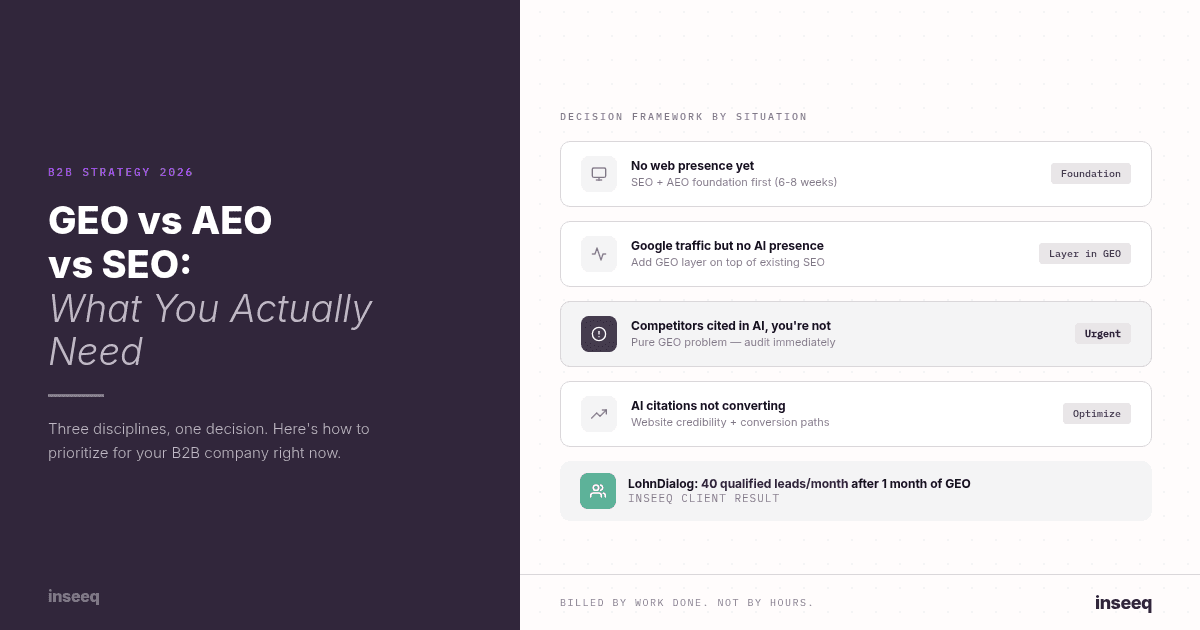
Decision framework comparing GEO vs AEO vs SEO for B2B companies in 2026
Three Acronyms, One Problem
You're trying to grow a B2B company. You've heard that you need to show up in AI search. Someone says you need SEO. Someone else says AEO. A third person is talking about GEO. They all sound confident. None of them agree.
Here's the plain version: SEO, AEO, and GEO are three distinct optimization disciplines for three distinct discovery channels. They overlap. They reinforce each other. But they're not the same, and treating them as interchangeable is how you end up with a strategy that covers nothing well.
This article cuts through the acronym noise. By the end, you'll know what each discipline actually does, how they relate to each other, and which one your B2B company needs to prioritize right now.
What SEO Actually Covers in 2026
SEO is not dead. Anyone telling you otherwise is either selling you something or hasn't looked at the traffic data.
Traditional search still drives the majority of web traffic for most B2B companies. Google processes billions of queries daily. Organic rankings remain a primary acquisition channel. The question isn't whether SEO matters. It's whether it's sufficient.
What SEO does well in 2026:
Drives consistent organic traffic for stable, high-volume keywords
Builds long-term compounding returns from domain and topical authority
Supports AI citability (Perplexity cites top-10 Google rankings 91% of the time)
Captures buyers in research mode who are actively comparing options
Where SEO falls short:
It doesn't target AI-generated answers directly
Traditional SEO metrics (domain authority, backlink count) don't translate to AI citation signals
Zero-click searches have reached 65-70% of all Google queries in early 2026, meaning rankings no longer guarantee traffic
Building meaningful organic traffic takes 3-6 months minimum in competitive B2B categories
SEO is the foundation. Everything else is built on top of it.
What AEO Is (And Isn't)
Answer Engine Optimization (AEO) is the practice of structuring content to be pulled into direct answer placements: featured snippets, Google's "People Also Ask" boxes, voice search results, and AI-generated summaries.
AEO doesn't require a separate content strategy. It's a layer applied on top of existing SEO work through:
FAQ sections with exact-match questions and concise answers
Structured data markup (FAQ schema, HowTo schema, Article schema)
Entity clarity: making it unambiguous to AI systems who you are, what you do, and what category you belong to
Concise, direct answers to specific questions within H2 sections
Featured snippet optimization: answering the target question in the first 40-60 words of a section
The key distinction between AEO and GEO: AEO focuses on being pulled into structured answer slots within existing search interfaces. GEO focuses on being cited in the synthesized responses of generative AI systems.
A piece of content can be well-optimized for AEO (strong featured snippet performance) and still have zero GEO presence (never cited by ChatGPT or Perplexity). The signals that drive each outcome are related but not identical.
Research from 2026 puts the commercial intent for "answer engine optimization agency" searches at high: founders and CMOs actively looking for an agency specifically for AI answer optimization, not just traditional SEO.
What GEO Adds on Top
Generative Engine Optimization (GEO) is the discipline of making brands visible in the citation and recommendation behavior of generative AI systems: ChatGPT, Perplexity, Google AI Overviews, Claude, Gemini.
What makes GEO distinct:
Topical authority, not just keyword targeting. AI engines don't cite the page that best matches a keyword. They cite the source they believe knows the most about a topic. Building topical authority means publishing a structured cluster of related content that establishes deep expertise, not a collection of loosely related articles.
Content freshness signals. Platforms like Perplexity weight recency heavily. A publishing cadence of 2-5 articles per week in your target topic area is standard practice for competitive GEO campaigns. It's meaningfully different from a quarterly blog post cadence.
Trusted domain signals. AI engines develop trust in domains over time based on citation history and content depth. A domain that has been consistently cited by other authoritative sources accumulates what functions like a GEO authority score.
Structured, extractable content. AI systems retrieve and summarize content differently than Google's PageRank model. Clear H2 structure, direct answers to specific questions, tables and lists for comparison data, and FAQ sections all make content more extractable.
The data makes the business case clearly: research from Semrush (June 2025) found that the average LLM visitor converts at 4.4x the rate of the average organic search visitor. The traffic volume from AI search is still smaller than Google, but the quality is measurably higher.
The Decision Framework: Which Does Your B2B Company Need?
Most B2B companies need all three, layered. The question is what to prioritize given your current situation.
If you're a B2B startup with little to no web presence: Start with SEO and AEO simultaneously. Get the technical foundation right: fast WordPress setup, proper schema markup, clear entity signals on your homepage and service pages. Publish foundational content targeting your core topics. This takes 6-8 weeks to set up properly.
If you have existing Google rankings but no AI presence: Your SEO is working but you're missing the AI layer. Add GEO on top: audit your current AI citation gaps, restructure existing content to be more extractable, build topical authority clusters around your core categories. This is the most common situation for B2B companies founded before 2024.
If competitors are showing up in ChatGPT and you're not: That's a pure GEO problem. You need a citation gap analysis, a topical authority strategy, and a content production cadence that can close the gap quickly. Speed matters here. First-mover advantage in AI citation compounds fast.
If you're getting AI citations but not converting them: The issue is usually off-page: your website doesn't support the conversion journey that AI-cited traffic expects. Website credibility, clear conversion paths, and landing page quality matter here.
Situation | Priority |
|---|---|
No web presence | SEO + AEO foundation first |
Google traffic, no AI presence | Add GEO layer |
Competitors cited, you're not | GEO urgency: audit now |
AI citations not converting | Website + conversion optimization |
How inseeq Combines All Three
inseeq's positioning as an AI-native agency means the SEO/AEO/GEO distinction isn't a product menu. It's an integrated methodology.
The typical engagement starts with an AI visibility audit: where does the client currently stand across Google, ChatGPT, Perplexity, and Google AI Overviews? That audit produces a gap map that determines which layer needs the most immediate attention.
The infrastructure layer covers WordPress website setup, schema markup, entity optimization, and internal linking structure. That handles the SEO and AEO foundations simultaneously. The content layer handles topical authority cluster design, keyword research, and citation-ready article production. That drives GEO performance.
LohnDialog is a concrete example: after one month of combined SEO/GEO work, the company was generating 40 qualified leads per month from AI search visibility in their category. The leads came in pre-sold because ChatGPT and Perplexity had already recommended the brand in response to buyer queries.
Read more: What Is a Generative Engine Optimization Agency and Do You Need One? for a deeper breakdown of what GEO agencies specifically deliver.
Frequently Asked Questions
What is the difference between AEO and SEO? SEO optimizes for traditional search engine rankings (primarily Google). AEO builds on SEO by structuring content to appear in direct answer placements: featured snippets, People Also Ask boxes, and AI-generated summaries. AEO requires structured data markup, FAQ formatting, and entity clarity that traditional SEO doesn't always prioritize.
Is AEO replacing SEO? No. AEO is a layer on top of SEO, not a replacement. Strong Google rankings still feed AI citability: Perplexity cites top-10 Google results 91% of the time. The brands winning in 2026 are running SEO, AEO, and GEO together, not choosing between them.
What is answer engine optimization? Answer engine optimization is the practice of structuring content to be pulled into direct answer placements by AI systems and search engines. This includes FAQ schema markup, concise direct answers within content sections, entity optimization, and featured snippet targeting.
Do I need an AEO agency? For most B2B companies, AEO can be layered into an existing SEO or GEO engagement rather than requiring a separate specialist. The techniques (schema markup, FAQ formatting, entity signals) are complementary to SEO and GEO work, not a standalone discipline requiring its own agency.
How does GEO differ from AEO? AEO targets structured answer slots within search interfaces (featured snippets, voice search). GEO targets the citation and recommendation behavior of generative AI platforms like ChatGPT and Perplexity. GEO requires topical authority building, high publishing cadence, and content structured for AI extraction. Schema markup alone won't get you there.
Not Sure Where to Start?
If you don't know whether you need SEO, AEO, or GEO work most urgently: start with an audit. That's the only way to know where the gap actually is.
inseeq's free Growth Audit maps your current visibility across traditional search and AI search, identifies your highest-priority gaps, and gives you a clear starting point.
Book your free Growth Audit and see exactly where you stand across every search channel that matters.
Check Your AI Visibility
How visible is your brand in AI search engines like ChatGPT, Perplexity, and Google AI Overviews? Find out in 60 seconds with our free tool.
Related Articles
→ What is Generative Engine Optimization (GEO)? The Complete 2026 Guide
→ GEO vs SEO: What's the Difference and Why You Need Both in 2026
→ What Is a Generative Engine Optimization Agency and Do You Need One?

Hans-Peter Frank
Co-founder
How Visible Is Your Business in AI Search?
Find out in 60 seconds. Our free AI Visibility Checker scans ChatGPT, Perplexity, and Google AI Overviews for your brand.
Check Your AI Visibility