
Agentic AI Is Changing How Brands Get Found. Here's What to Do About It
Agentic AI doesn't just answer questions — it takes actions on behalf of users. Here's what that means for brand discoverability and what B2B companies need to do now.
How Visible Is Your Business in AI Search?
Find out in 60 seconds. Our free AI Visibility Checker scans ChatGPT, Perplexity, and Google AI Overviews for your brand.
Check Your AI Visibility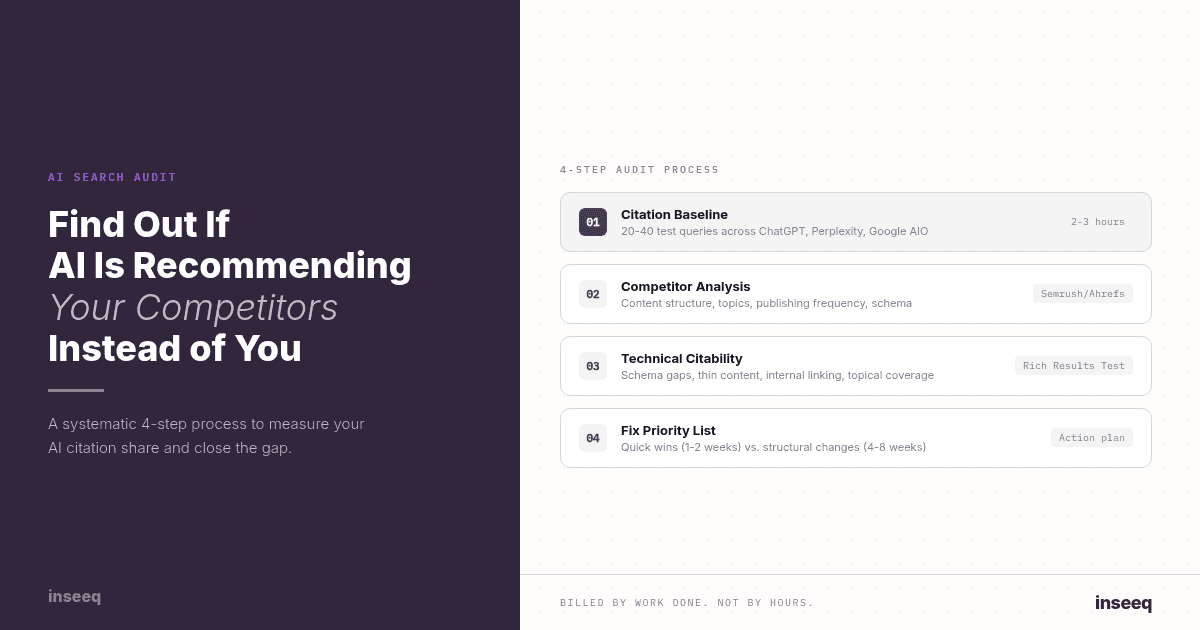
Agentic AI market data showing $10.86B market and 43.84% CAGR through 2034
The Next Wave Isn't AI Search. It's AI Action.
When a user asks Perplexity "what's the best B2B marketing agency for a seed-stage startup?", they get an answer. They click through, they read, they decide.
That's AI search. It's happening now.
The next wave is agentic AI: systems that don't just answer the question but act on it. OpenAI Operator can complete forms, book appointments, and execute multi-step workflows on a user's behalf. Google launched agentic checkout in AI Mode, where AI completes purchases directly on merchant websites. Perplexity has live shopping with instant checkout. Gemini agents execute tasks across the Google ecosystem.
Ask an AI agent "find me a B2B marketing agency for my startup and book a discovery call" and the agent researches options, evaluates fit against your criteria, navigates to a website, and submits the contact form. Without the user doing anything after the initial request.
The brands that benefit are the ones AI agents trust enough to recommend and act on. The brands that don't have AI visibility right now will be doubly invisible in the agentic era. Agents won't surface what AI search doesn't recognize.
What Agentic AI Actually Does
The distinction between conversational AI and agentic AI is meaningful.
Conversational AI takes in a query and returns an answer. The user still takes every subsequent action.
Agentic AI takes in a goal and executes a sequence of tasks to accomplish it. The AI navigates web interfaces, submits forms, interacts with APIs, and completes workflows autonomously.
The market scale of this shift is significant. The global agentic AI market was valued at $7.55 billion in 2025 and is projected to reach approximately $10.86 billion in 2026, expanding at a CAGR of 43.84% through 2034 (Fortune Business Insights). Gartner projects that 40% of enterprise applications will be integrated with task-specific AI agents by end of 2026, up from less than 5% in 2025.
In B2B specifically, the buying cycle involves discrete stages: identifying options, researching providers, shortlisting, requesting demos or proposals, and making a decision. Agentic AI can automate the first three or four of these stages on behalf of the buyer.
What this means: a B2B buyer with an agentic AI assistant can say "find me three marketing agencies that specialize in AI search visibility for SaaS startups, check their pricing, and request a free audit from the top one." The agent handles it. The only thing the buyer does is review what the agent has done and confirm.
How Agentic AI Changes Brand Discoverability
The traditional discoverability model has one step where brands can be found or lost: the buyer's search.
The emerging agentic model has two steps: the agent's AI search (does the AI know about you?), and the agent's trust evaluation (does the AI trust you enough to act?).
Most GEO work addresses the first step. The second step is less discussed but increasingly important.
Step 1: AI search recognition. Does the AI system know who you are? Can it identify your brand when answering questions about your category? This is what topical authority, schema markup, citation-ready content, and publishing cadence address.
Step 2: Agentic trust evaluation. When an AI agent is choosing between brands to act on, it applies a quality filter: is this a credible, real company? Is the service they offer clearly described and matched to the user's need? Is there enough information to evaluate fit? Does the website support the action the agent needs to take?
A brand that fails step 2 doesn't get booked, contacted, or purchased from, even if the AI knew about them in step 1.
What Your Website Needs for Agentic AI Compatibility
Agentic compatibility is an extension of AI search readiness, not a separate workstream. The same technical and content investments that improve AI citations also improve agentic trust signals, with a few additions.
Organization schema with complete entity information. An AI agent evaluating vendors reads your Organization schema first. Name, description, services, contact information, location. All of this should be present, accurate, and specific. A schema description of "we help businesses grow" is useless for agentic evaluation. "AI-native marketing agency specializing in GEO, AI search visibility, and WordPress website builds for B2B startups" is evaluable.
Structured service descriptions. Service pages need to clearly describe: what the service covers, who it's designed for, what the process looks like, what results clients have seen, and how to request it. AI agents match service descriptions to user intent criteria. Vague descriptions fail the match.
Clean, machine-navigable conversion pathways. If a user asked an AI agent to "contact inseeq about their free Growth Audit," the agent would need to find the contact page, understand the fields, and submit the form. Pages that require multiple clicks to reach, forms with unclear labels, and CAPTCHAs that block automated requests all create friction.
Consistent external entity profiles. AI agents don't rely solely on your website. They check LinkedIn, Google Business Profile, Crunchbase, and industry directories to build confidence in a vendor's legitimacy. All external profiles should use consistent brand language and be fully completed.
Content authority as trust signal. A domain with comprehensive, well-maintained content on a topic signals to AI agents that the company behind it is an active, knowledgeable operator in that space. Thin or outdated content reduces agentic trust.
Content Strategy in the Agentic Era
The content stack that supports agentic AI readiness is an extension of GEO content strategy with a few additions.
Topical authority clusters remain the foundation. Everything discussed in What Is Topical Authority and Why AI Search Cares About It More Than Google Did applies here. Comprehensive coverage of a topic area is both an AI citation signal and an agentic trust signal.
Decision-stage content for agentic matching. Agents matching vendors to user criteria need content that clearly describes specific capabilities, target customers, and outcomes. Articles like "How We Set Up AI Search Visibility for a B2B Startup in 30 Days" function as decision-stage evidence that agents can evaluate for fit.
Process documentation. Content that explains exactly how you work, the steps, the timeline, what's included, what results clients see, is highly valuable for agentic evaluation. Case studies and process walkthroughs are formats agents can evaluate against user requirements.
FAQ on service pages. The questions agents ask on behalf of users are often the same questions buyers ask: "How much does this cost?" "How long does it take?" "What do I get?" A service page FAQ that directly answers these questions reduces evaluation friction for both human visitors and AI agents.
How inseeq Prepares Clients for the Agentic Wave
inseeq's approach, AI-native from the ground up, is built to work in the current AI search environment and the emerging agentic environment simultaneously.
The WordPress builds include complete entity schema, structured service page formats, and clean conversion pathway architecture as standard elements. The content strategy includes decision-stage content and process transparency alongside topical authority clusters.
The practical outcome: inseeq clients are building AI citation authority now that will compound into agentic discoverability as that channel grows. The investment in topical authority and technical citability today is the same investment that positions brands well in the agentic era.
The market timing: agentic AI is early. Most B2B companies aren't optimizing for it yet. The brands that establish strong AI visibility and agentic trust signals in 2026 will have a structural advantage when agentic adoption accelerates in 2027.
See also: The AI Search Audit: How to Find Out If AI Is Recommending Your Competitors Instead of You.
Frequently Asked Questions
What is agentic AI? Agentic AI refers to AI systems that can execute multi-step tasks autonomously on behalf of users, not just answer questions but take actions: browsing websites, completing forms, making bookings, executing purchases. OpenAI Operator, Google's agentic checkout in AI Mode, and Perplexity's shopping assistant are current examples. For B2B, agentic AI can handle vendor research, shortlisting, and initial outreach autonomously.
How does agentic AI affect marketing? Agentic AI introduces a second filter in the B2B discovery process: not just whether the AI knows about you (AI search recognition) but whether it trusts you enough to act on a user's behalf (agentic trust evaluation). Brands that fail either filter don't get selected. This makes entity clarity, structured service descriptions, and clean conversion pathways directly relevant to lead generation.
How do I optimize for agentic AI? Build the AI search visibility foundation first: schema markup, topical authority clusters, citation-ready content structure. Then add agentic-specific elements: complete Organization schema with specific entity information, structured service page descriptions, machine-navigable conversion pathways, consistent external profiles (LinkedIn, Google Business Profile), and decision-stage content that helps agents evaluate fit against user requirements.
What is the difference between AI search and agentic AI? AI search provides information in response to queries. Agentic AI takes action in pursuit of goals. The difference for B2B marketers: AI search determines whether a buyer's research process includes your brand. Agentic AI determines whether an AI assistant completes a booking or contact request on a buyer's behalf. Both require AI visibility as a prerequisite; agentic readiness requires the additional layer of trust signals and machine-compatible conversion infrastructure.
How will AI agents change B2B buying? Gartner projects 40% of enterprise applications will be integrated with task-specific AI agents by end of 2026. In B2B buying, this means research, vendor evaluation, and initial outreach may increasingly be handled by AI agents. For B2B companies, this accelerates the case for AI visibility investment: if AI agents are shortlisting vendors autonomously, brands without AI citation authority and agentic trust signals won't make the shortlist.
Get Ahead of the Agentic Wave
Most B2B brands are still figuring out basic AI search visibility. The ones building agentic readiness now will have a structural advantage when the wave accelerates.
inseeq's free Growth Audit covers both layers: your current AI search citation status and your website's agentic readiness. You'll know where you stand and what to do first.
Book your free Growth Audit and get ahead of the agentic shift before your competitors do.

Hans-Peter Frank
Co-founder
How Visible Is Your Business in AI Search?
Find out in 60 seconds. Our free AI Visibility Checker scans ChatGPT, Perplexity, and Google AI Overviews for your brand.
Check Your AI Visibility