
Your Traffic Didn't Drop. AI Ate It.
Organic clicks are down 42% since AI Overviews expanded. Here's what's happening to your traffic, who's still growing, and what to do about it.
How Visible Is Your Business in AI Search?
Find out in 60 seconds. Our free AI Visibility Checker scans ChatGPT, Perplexity, and Google AI Overviews for your brand.
Check Your AI Visibility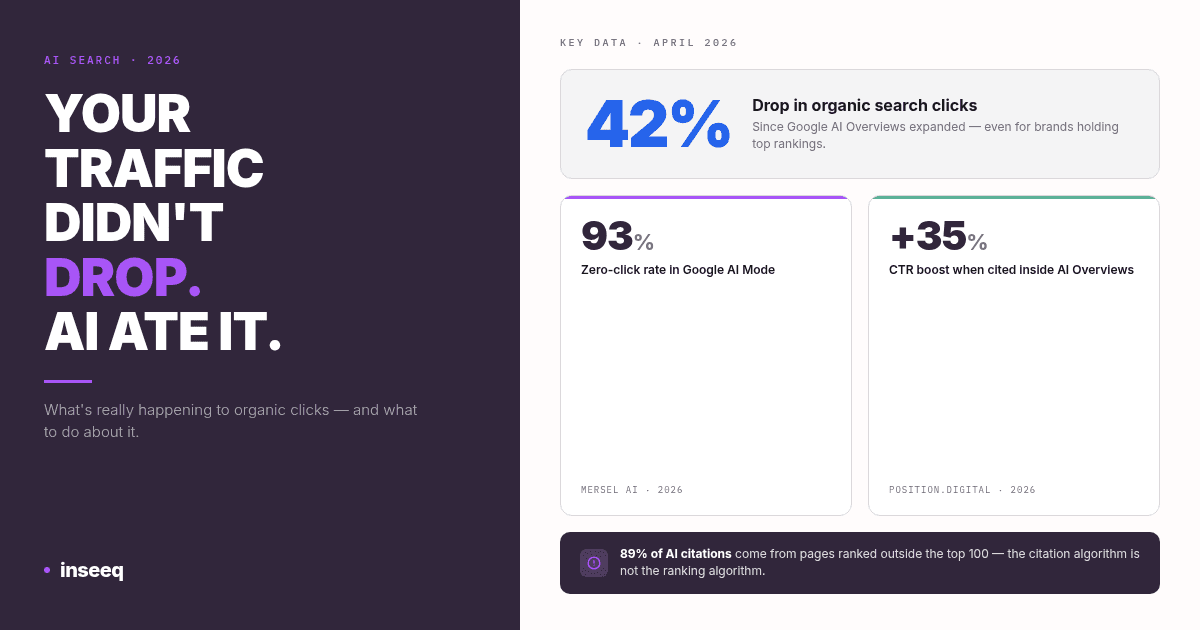
Chart showing 42% drop in organic search clicks since Google AI Overviews expanded, with key stats on zero-click rates and AI citation impact
The Numbers Nobody Wants to Say Out Loud
Your rankings are fine. Your content is solid. You haven't been hit by a penalty. And yet, somewhere in the last 12 months, your traffic quietly started shrinking.
This is happening to nearly every website right now. And it has nothing to do with anything you did wrong.
Organic search clicks are down 42% since Google AI Overviews began their full expansion. That number comes from a broad cross-industry analysis tracking click behavior before and after the rollout, and it holds up across sectors. Even more unsettling: AI Overviews now appear on 14% of all shopping queries, up 5.6x from 2.1% in November 2025. The commercial intent queries that used to send your highest-converting visitors are increasingly being answered before those visitors ever reach a result.
And here is the part most analytics dashboards are hiding from you: even queries that do not trigger an AI Overview are seeing 41% CTR declines. Users are clicking less across the board. The behavior has shifted, not just the SERP feature.
One documented example from Seer Interactive tells the story cleanly. A site saw impressions rise 27.56% year-over-year while clicks dropped 36.18% and CTR fell from 5.98% to 3.35%. Their average ranking actually improved 14.01% over the same period. More visibility, better positions, and a third fewer clicks. The traffic disappeared and the rankings had nothing to do with it.
Zero-click searches are heading toward 70% of all queries. In Google AI Mode specifically, the zero-click rate sits at 93%. Google is answering questions. Not routing traffic to the people who helped it answer them.
This is not a traffic dip. It is a structural shift in how information moves on the web.
What's Actually Happening to Your Google AI Overviews Traffic
There are four forces operating simultaneously, and most brands are only aware of one or two of them.
Force 1: AI Overviews absorbing clicks before users reach results. When an AI Overview appears, the CTR on organic results drops sharply. Seer Interactive's data puts the drop at 61% for informational queries. A query that used to send 100 visitors to your site now sends 39, because 61 of them got what they needed from the AI-generated summary at the top.
Force 2: Zero-click search becoming the default behavior. Even without an AI Overview, users are clicking less. This is partly behavioral habituation, partly the expansion of other zero-click features (featured snippets, Knowledge Panels, People Also Ask boxes), and partly the growing use of AI chat tools for research instead of Google at all. Queries that do not trigger an AI Overview are still seeing 32 to 41% CTR declines.
Force 3: Google rankings decoupling from AI citation visibility. This is the one that catches most brands off guard. Mid-2025, there was roughly 75% overlap between the pages that ranked in the top 10 on Google and the pages that got cited in AI Overviews. By early 2026, that overlap had collapsed to between 17% and 38% (BrightEdge). The algorithm that decides what gets cited is not the same algorithm that decides what ranks. A page can hold position one for a high-volume keyword and never appear in a single AI Overview. The inverse is also true: 89% of AI citations now come from pages ranked outside the top 100.
Force 4: Buyers moving their research upstream into AI conversations. This is the hardest to see in your analytics because it never shows up as lost traffic. It shows up as lost pipeline. 85% of B2B buyers now arrive at a vendor shortlist before ever speaking to a sales rep, according to Gartner. A growing share of that shortlist is being built through AI conversations, not Google searches. If your brand is not being cited when a potential buyer asks ChatGPT or Perplexity who the leading providers in your space are, you are off the list before the sales conversation ever starts.
The decline in your Google AI Overviews traffic is real. But the bigger problem is the invisible one.
The Brands That Are Still Growing
Here is what the data shows about the brands that are not shrinking.
When a brand is cited inside an AI Overview, organic CTR is 35% higher than the baseline, according to research from position.digital. Being the source Google cites does not just protect you from the traffic loss. It actively drives more traffic than you would have received from a standard top-10 ranking.
The structure of who gets cited has also flipped. BrightEdge reported a 400% increase in AI citations pulled from pages ranked at positions 21 through 30. 89% of citations now come from beyond the top 100 organic listings. The old playbook, where you built backlinks to push pages into the top 10 and then collected traffic, is not the citation playbook. The citation playbook is different.
What gets cited comes down to three things:
Content depth. AI systems extract answers from content that directly addresses a question. Short, thin pages built around keyword density do not get pulled. Long, structured, specific content that answers questions completely does. Research consistently shows that sentence count and word count correlate more strongly with AI citation than traffic volume or backlink counts.
Topical authority. Brands that get cited consistently are not citing individual strong pages. They have built comprehensive coverage across a topic. When AI systems pull from a domain repeatedly, it signals that the domain is a reliable source on that subject. One good article is not enough. A content architecture that covers a topic from multiple angles is.
Structured data and technical accessibility. AI crawlers need to be able to read your content. This means proper schema markup, an accessible llms.txt file, and confirmed access for crawlers like GPTBot and PerplexityBot. Roughly 75% of sites blocking OpenAI or Google AI bots still appear in AI citations, because those bots often use already-indexed content. But actively enabling them is a signal.
The brands growing right now are not necessarily the ones with the highest domain authority or the biggest backlink profiles. They are the ones that structured their content to be cited.
What to Stop Measuring (And What to Track Instead)
If your primary success metric is organic traffic, you are measuring a lagging indicator of a problem that already happened. Traffic reflects what your content earned weeks or months ago. By the time the decline shows up in your dashboard, the opportunity to prevent it has passed.
The metrics that actually reflect your current position in the AI search era are different.
Share of voice in AI citations. How often does your brand, your content, or your domain appear when AI systems answer questions in your space? This requires actively querying ChatGPT, Perplexity, Google AI Mode, and Gemini with the questions your buyers ask. It is manual work or it requires a tool built for it. But it tells you whether you exist in the channels where your buyers are now doing research. inseeq's free AI visibility checker lets you run this audit immediately.
Branded search lift. When you appear in AI citations, people who were not previously aware of your brand search for you directly. An increase in branded search volume is often the first measurable signal that your AI search visibility is working. It is also a signal that AI systems are driving awareness even when the session never results in a click.
AI-referred traffic in GA4. This requires setting up proper attribution. AI-referred sessions come from domains like chatgpt.com, perplexity.ai, and gemini.google.com. Tag these as a source group and track them separately. The conversion rate on AI-referred traffic tends to be significantly higher than standard organic traffic. A Series A fintech tracked in one case study saw AI-referred sessions convert at 4.4x the rate of standard organic sessions.
Assisted conversions. AI search is often an early touchpoint in a longer research cycle. A prospect might discover your brand through a Perplexity answer, then come back through direct search two weeks later. Last-click attribution misses this entirely. If you are not tracking assisted conversions, you are undervaluing every source that introduces your brand, including AI search.
Traffic and CTR are not useless. They still matter for understanding reach. But they are no longer sufficient as primary success metrics for content investment. The question is not "how many clicks did this page get?" The question is "is this page being cited where our buyers are doing research?"
Three Moves to Make This Month
The gap between brands that are adapting and brands that are not is widening fast. These are the three highest-leverage moves available right now.
1. Run your AI citation audit.
Before you change anything, you need to know where you stand. Pick 10 to 15 questions your buyers actually ask when evaluating your category. Not keywords. Questions. "What is the best [category] for [use case]?" "How do I solve [specific problem]?" "Which companies are the leaders in [space]?"
Run each question through ChatGPT, Perplexity, Google AI Mode, and Gemini. Note which brands appear, which domains get cited, and whether your brand shows up at all. This is your baseline. It tells you exactly where the gap is between your current position and the position you need to hold.
inseeq runs this audit as a structured process across all major AI platforms and delivers a scored visibility report. You can also start with the free AI visibility checker at inseeq.com.
2. Restructure your highest-value content for citation eligibility.
Take the pages that should be ranking for your most important buyer questions and audit them against the citation criteria. Does each page directly answer a specific question? Is the answer given at the top of the page, before additional context? Is the page structured with clear headers that match the questions being asked?
The structural change that makes the biggest difference is question-first formatting. Instead of writing headers like "Our Approach to [Topic]," write headers like "How does [topic] work?" or "What is [term] and why does it matter?" AI systems extract content that answers questions. Give them content that is already structured as answers.
3. Diversify off Google.
Google AI Mode and AI Overviews are one surface. ChatGPT Search, Perplexity, and Gemini are three others. Each one uses a different citation algorithm, different source weighting, and different content signals. The overlap between pages cited across all four is small. A brand that appears consistently across multiple AI platforms has built something that is difficult to displace.
This requires presence on the third-party platforms those AI systems weight heavily. Reddit threads where your category is discussed. LinkedIn content that gets indexed. Mentions in industry publications that AI systems treat as authoritative sources. Your own site is necessary but not sufficient.
The brands waiting for traffic to recover before they act are going to wait a long time. This is not a SERP volatility event that resolves in the next core update. It is a restructuring of how search works. The brands adapting now are building an advantage that compounds. The ones waiting are falling further behind every week.
Frequently Asked Questions
Is organic search dead? No. Organic search still drives significant volume and will continue to for years. What has changed is the relationship between ranking and traffic. A page can rank well and receive far fewer clicks than it would have 18 months ago because AI Overviews answer the query before the user clicks. The goal now is not just to rank but to be cited in the AI-generated answer itself.
Does ranking #1 still matter? It matters, but less than it used to, and for different reasons. A #1 ranking improves your probability of being cited in AI Overviews. But it does not guarantee citation, and pages ranked far lower are being cited at high rates when they have content depth and topical authority. Ranking is now one input into citation probability, not the primary outcome to optimize for.
How do I know if AI Overviews are affecting my traffic? Check your Google Search Console data. Filter to queries where you have historically ranked well and compare CTR trend over the past 12 months. If impressions have held steady or increased while clicks have declined, AI Overviews are almost certainly a factor. You can also search your target keywords directly in Google and observe whether an AI Overview appears.
What types of content get cited in AI Overviews? Content that directly answers a specific question, is structured with clear headers, contains specific data or evidence, and comes from a domain with topical authority in the relevant space. Long-form content with comprehensive coverage consistently outperforms short, thin pages. FAQ sections, comparison tables, and content that addresses the question in the first paragraph are all positively correlated with citation.
How long does it take to recover AI search visibility? Structured programs typically show measurable AI citation improvement within 60 to 90 days. One Series A fintech went from 2.4% to 12.9% AI visibility in 92 days with a focused GEO program. The timeline depends on how competitive your category is, how much content infrastructure you already have, and how aggressively you execute. Waiting longer to start means starting further back.

Hans-Peter Frank
Co-founder
How Visible Is Your Business in AI Search?
Find out in 60 seconds. Our free AI Visibility Checker scans ChatGPT, Perplexity, and Google AI Overviews for your brand.
Check Your AI Visibility