Your Google Rankings Are Fine. Your AI Visibility Isn't.
Ranking on page one of Google doesn't mean ChatGPT or Perplexity cite your brand. Here's the data on why, and what to do about it.
How Visible Is Your Business in AI Search?
Find out in 60 seconds. Our free AI Visibility Checker scans ChatGPT, Perplexity, and Google AI Overviews for your brand.
Check Your AI Visibility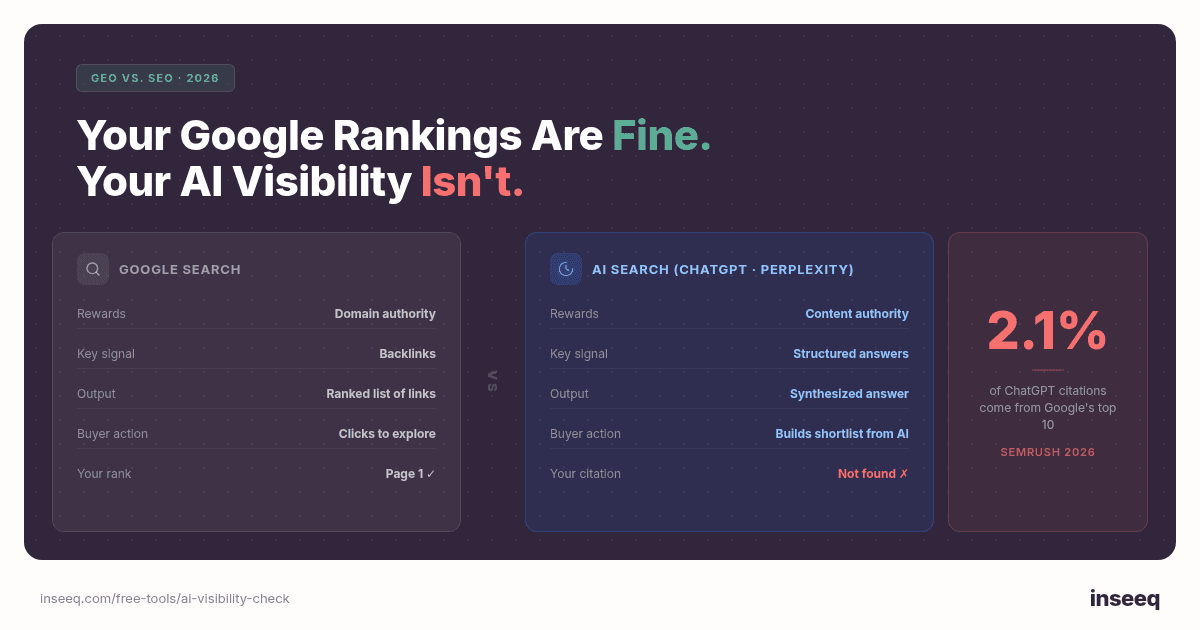
Side-by-side comparison of Google search vs AI search signals, showing only 2.1% of ChatGPT citations come from Google's top 10
Search Has Split in Two — And Most Brands Only See Half of It
Your SEO report looks healthy. Page one rankings, solid organic traffic, bounce rate down. The dashboard says things are working.
Meanwhile, your buyers are asking ChatGPT which vendors to consider in your category. They're getting a confident, synthesized answer that names three companies. Yours isn't one of them.
That's not a hypothetical. That's the current state of search for most B2B brands.
Search has split into two parallel systems. Google shows links. AI shows answers. And they barely overlap.
On Google, you compete for position. Rank 1 gets the click, rank 10 doesn't. The whole game is the list.
On AI search, there is no list. ChatGPT, Perplexity, and Google AI Mode synthesize a response from sources they've indexed as authoritative. You're either in the answer or you're not. And the criteria for getting into the answer have almost nothing to do with your Google ranking.
The blind spot is your analytics. Google Analytics shows organic traffic, sessions, and conversions from visitors who reached your site. It doesn't show you the buyers who never came because an AI told them to go somewhere else. It doesn't show you the deals that were shortlisted before a single browser ever loaded your homepage.
Most brands are optimizing hard for the half of search they can see, and have no idea what's happening in the half they can't.
The Data That Should Worry You
The numbers on AI search vs. Google search visibility are not subtle.
According to Semrush's 2026 AI visibility analysis, only 2.1% of ChatGPT citations come from pages in Google's top 10. Flip that: 97.9% of what ChatGPT recommends to users comes from sources that are not dominating traditional search rankings.
And AI search users aren't a niche audience to deprioritize. Visitors arriving from AI search platforms convert at 4.4x the rate of standard organic search visitors, according to the same research. These are high-intent buyers who've already done their research with an AI assistant and are arriving at your site ready to evaluate.
The problem: if your brand wasn't in the AI answer that shaped their research, you're not in their evaluation at all.
The compounding dynamic is what makes this urgent. A buyer searches for solutions to a problem on Perplexity. Perplexity cites three companies: your competitor, a niche player, and a category blog. Your buyer reads the synthesis, clicks through to two of those sources, builds a shortlist. Your brand, despite ranking on page one of Google for three relevant keywords, was never in the picture. The deal was shaped before your site was ever visited.
This is happening at scale, every day, across every B2B category. The only question is whether your competitors already know it.
Why the Signals Are Completely Different
Understanding why Google rank and AI citation diverge so sharply requires understanding what each system is actually trying to do.
Google's job is to rank the most authoritative, relevant pages for a given query. It uses domain authority (built through backlinks), PageRank (the link graph), and user behavior signals (click-through rates, dwell time) to decide what goes where. The system is built to surface trusted domains, not necessarily the most useful individual pages.
AI search systems have a different job. They're trying to synthesize a direct, accurate, extractable answer to a specific question. They weight content depth, structural clarity, directness of answer, and recency far more heavily than link profiles. They're not looking for the most authoritative domain. They're looking for the page that best answers this question right now.
What Google rewards | What AI search rewards |
|---|---|
High domain authority | Deep topical coverage |
Strong backlink profile | Direct, structured answers |
Keyword relevance | Content that's extractable |
Historical trust signals | Freshness (last 3 years heavily weighted) |
Click-through behavior | Schema markup and structured data |
The result: a brand that's invested five years building domain authority can be outcompeted for AI citations by a newer brand that publishes deeply structured, specific, question-answering content — even if that brand barely registers in Google's rankings.
This isn't a theoretical risk. inseeq sees this regularly when running AI visibility audits: clients with strong Google presence and zero AI citation, consistently outcompeted in AI answers by competitors they don't even consider serious threats in traditional search.
The divergence is structural. The two systems use different inputs. You can't optimize for one and assume the other follows.
What This Looks Like in Your Pipeline
The impact of zero AI visibility doesn't show up in your current metrics. That's precisely what makes it dangerous.
Here's the buyer journey that's becoming standard in B2B:
A procurement lead has a problem. They open Perplexity and ask: "What are the best [your category] solutions for [their use case]?" The AI returns a synthesized response naming four vendors, summarizing each, and citing sources. Your brand doesn't appear.
The buyer clicks through to the two or three sources the AI cited. They skim. They open a couple of demo request pages. They forward a summary to their manager. A shortlist forms — without your company on it.
Two weeks later, they run a Google search to cross-check one of the shortlisted vendors. This is where your page-one ranking is visible. But you're being evaluated against brands that were already in the consideration set. You're not entering the race — you're arriving after the qualifying round.
This is the invisible loss. It doesn't appear in your CRM as a lost deal. It doesn't show up as a bounce or an abandoned cart. It just never enters your funnel at all.
The competitive threat is compounding. Brands that already understand AI search are actively investing in GEO strategies. They're restructuring content for extractability, publishing fresh topical coverage, building third-party mentions in places AI systems crawl. Every week that gap widens, the harder it becomes to catch up.
The question isn't whether AI search visibility matters. It's whether your competitors figure it out before you do.
How to Find Out Where You Actually Stand
The first step is measurement. You can't fix a gap you haven't quantified.
inseeq's free AI visibility tool runs your domain against the major AI platforms and returns a scored report in under two minutes. No signup required. The report shows citation coverage across ChatGPT, Perplexity, and Google AI Mode, a competitive gap analysis, and the topical blind spots driving your invisibility.
What the gap between your Google rank and your AI citation rate reveals: whether you have a content structure problem, a crawl access problem, or a content authority gap. Each has a different fix, and the checker diagnoses which applies.
The three metrics to baseline first:
Citation rate: Are you appearing in AI answers at all, or zero? Zero is a structural problem, not a volume problem.
Competitive share of voice: What percentage of AI citations in your category go to you versus your top three competitors?
Topical coverage: Which subject areas in your niche return AI citations for competitors but not for you?
Once you have those three numbers, you know what you're dealing with. Without them, you're guessing.
For B2B brands that want to go deeper, the What Is AI Search Visibility — And How Do You Measure It? guide covers the full measurement methodology, including how to track these metrics monthly without dedicated tooling.
The Fix Is Not More SEO
When brands discover they have zero AI visibility, the instinctive response is to double down on SEO. More content, more backlinks, more keyword optimization. This is the wrong move.
The signals that drive AI citation are fundamentally different from the signals that drive Google rankings. Adding more content that's structured the same way as your current content, published through the same process, will produce the same AI citation result: nothing.
The actual fixes:
Structural content changes are the highest-leverage intervention. Rewrite your most authoritative pages so every H2 mirrors a question your buyers actually ask. Lead each section with a direct answer in the first sentence. Add comparison tables and FAQ sections with genuine buyer questions. Break long prose into short, topically focused paragraphs. These changes can show up in AI citations within weeks — AI models update their indexes faster than Google's ranking cycles.
Updating existing content outperforms creating new articles for most brands. Approximately 90% of AI-cited pages were published in the last three years. Your best-performing pages from 2021 or 2022 may be invisible to AI systems regardless of their quality — because recency is a stronger signal in AI search than in traditional SEO. Refreshing those pages with current data, new statistics, and updated examples is a faster path to AI citation than publishing net-new articles.
Distribution beyond your own domain is essential. AI models don't build their understanding of your brand solely from your website. They index third-party mentions across publications, Reddit communities, LinkedIn, review platforms, and industry blogs. Accurate, consistent mentions of your brand in places AI systems crawl regularly shape how AI characterizes you — independent of what's on your own pages. Getting your brand accurately discussed in those contexts compounds over time.
inseeq's AI search visibility service executes this full stack — content restructuring, freshness updates, and third-party distribution — as a managed workflow. Clients like project b. saw +300% organic traffic within 90 days, driven by AI citation gains alongside traditional SEO momentum.
Frequently Asked Questions
Can I rank #1 on Google and have zero AI visibility? Yes. This is one of the most common patterns inseeq sees when auditing B2B brands. Google and AI search systems use different signals to decide what to surface. Strong Google rankings do not transfer to AI citations. The two need to be measured and optimized separately.
Is AI search traffic significant enough to worry about? Visitors from AI search platforms convert at 4.4x the rate of standard organic search visitors, according to Semrush's 2026 data. ChatGPT alone has 900M+ weekly users. The volume is significant and growing — AI search platforms are projected to match traditional search traffic value by 2027 and surpass it after that. The brands building AI visibility now are establishing advantages that will be difficult to close later.
How quickly can AI visibility improve after making changes? Faster than traditional SEO. Structural changes — rewriting headings, adding FAQ sections, fixing robots.txt to allow AI crawlers — can show up in AI citations within weeks. AI models refresh their indexes more frequently than Google's ranking algorithm cycles. Brands that implement these changes systematically typically see measurable citation improvement within 60 to 90 days.
What's the difference between GEO and SEO? SEO (Search Engine Optimization) optimizes for keyword rankings in Google's ranked list. GEO (Generative Engine Optimization) optimizes for citations in AI-generated answers. The methodology, success metrics, and content requirements are different. GEO is not a rebrand of SEO — it's a separate discipline that addresses a separate distribution channel.
Do I need to stop doing SEO to focus on AI visibility? No. A strong SEO foundation supports AI visibility because authoritative, well-structured content tends to perform better in both systems. The point is that SEO alone is no longer sufficient. Both need to be tracked and optimized. Brands that treat them as separate, complementary disciplines outperform brands that assume one covers the other.
Where should I start if I've never tracked AI visibility before? Start with a baseline measurement. Run inseeq's free AI visibility checker to see your current citation rate, competitive gap, and topical blind spots. That data tells you whether you have a critical gap to close or a moderate one to monitor. Without a baseline, you have no way to prioritize or measure progress.
Which platforms matter most for AI search visibility? For most B2B brands: ChatGPT, Perplexity, and Google AI Mode. These three represent the majority of AI-driven discovery for B2B buyers. Perplexity is particularly important because it's heavily citation-based and drives meaningful referral traffic. ChatGPT matters for volume. Google AI Mode matters because it sits inside the world's largest search engine.
Start With the Data
Your SEO reports don't show you what AI is saying about your brand. Your rank tracker doesn't tell you which buyers ChatGPT already sent to your competitors. And by the time the revenue impact shows up in your numbers, the competitive gap is already wide.
The fix starts with knowing where you actually stand. Run inseeq's free AI visibility tool now — two minutes, no signup, clear output. Citation rate, competitive gap, topical blind spots.
Then you'll know whether your AI visibility problem is something to monitor or something to fix immediately.
For most B2B brands who run the check, it's the latter.

Hans-Peter Frank
Co-founder
How Visible Is Your Business in AI Search?
Find out in 60 seconds. Our free AI Visibility Checker scans ChatGPT, Perplexity, and Google AI Overviews for your brand.
Check Your AI Visibility