
Your AI Content Tool Just Became a Legal Liability
The EU AI Act's Article 50 mandates labeling of AI-generated content from August 2026. Here is what marketing teams need to know and which workflows are already compliant.
How Visible Is Your Business in AI Search?
Find out in 60 seconds. Our free AI Visibility Checker scans ChatGPT, Perplexity, and Google AI Overviews for your brand.
Check Your AI Visibility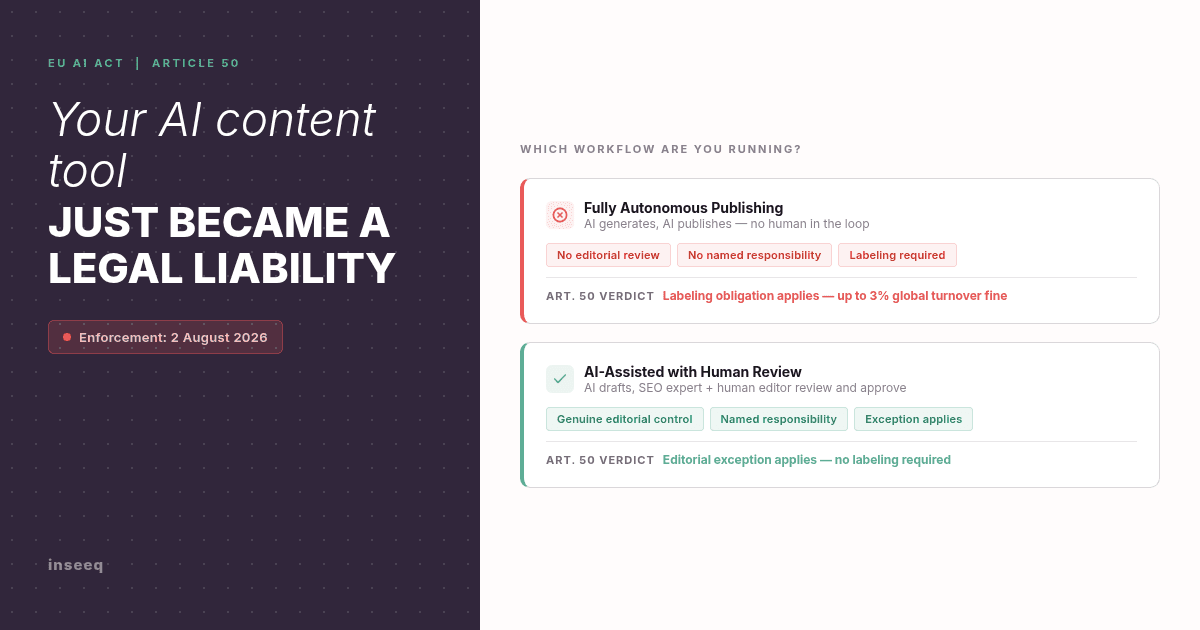
Comparison of autonomous AI publishing vs. human-reviewed AI-assisted workflow under EU AI Act Article 50, with enforcement deadline of 2 August 2026
The Rule Nobody in Marketing Is Talking About
You've been using AI to help write content. So has your agency. So has almost every marketing team with a functioning budget and a publishing cadence to maintain. The tools got good, the output got fast, and the question of legality seemed like something for lawyers at big enterprises to worry about.
That changed on 1 August 2023, when Regulation (EU) 2024/1689 entered into force. The specific provision that affects content marketers, Article 50, becomes enforceable on 2 August 2026. That is the date the labeling requirements for AI-generated content kick in.
Most marketing teams haven't read it. Most AI content tools aren't talking about it. And a few of those tools are actively marketing workflows that would place their customers in direct violation of it.
Here's what Article 50 actually says.
Any deployer (meaning any business that uses an AI system to generate content) must disclose that the content is AI-generated when that content could be mistaken for something created by a human. This covers text, images, video, and audio. It doesn't just apply to deepfakes and synthetic news. It applies to blog posts, product descriptions, social media captions, and marketing copy. Anything published to inform the public or influence decisions is in scope.
The regulation is also extra-territorial. You don't have to be based in the EU. If your content targets EU users (published in German, priced in euros, or distributed to an audience in member states), the rules apply to you. A US-based SaaS company auto-publishing AI blog posts that rank on Google.de is covered.
Non-compliance carries penalties of up to €15 million or 3% of global annual turnover, whichever is higher.
Three months is not a long runway.
What Has to Be Labeled, and What Does Not
Article 50 targets content that "could be mistaken for human-made." That's the operative phrase, and it covers more than most people assume.
Content that falls under the labeling requirement:
Blog posts and long-form articles generated by AI without meaningful human editing
Photorealistic AI-generated images that depict real or plausible-looking people, places, or events
AI voiceovers that imitate a human speaker
AI-generated video content, including edited footage where AI substantially altered the original
Social media posts generated by AI, particularly those touching on matters of public interest
Content that is explicitly exempt:
Artistic and satirical content: provided it's clearly presented as such and doesn't deceive the audience about real events or real people
AI as an assistive tool only: grammar correction, spell-check, translation, formatting suggestions. If the human writes the content and AI refines it, the content is human-created
Non-public content: internal documents, private communications, B2B reports that aren't published to the public
The boundary between "AI-assisted" and "AI-generated" isn't perfectly defined in the regulation. The European Commission's second draft Code of Practice on Marking and Labelling of AI-generated content, published in early 2026, points toward a substance test: who created the core ideas and structure? If a human did and AI helped with execution, the human editorial model applies. If AI generated the substance and a human only lightly formatted it, the labeling obligation likely applies.
Note that the labeling isn't just a visible disclaimer. The regulation also requires machine-readable markers for images, audio, and video. These are embedded metadata, watermarks, or cryptographic signatures that allow platforms and detection tools to identify AI origin. Visible labels alone may not satisfy the technical requirements for synthetic media.
The Editorial Review Exception: The Four Words That Change Everything
Article 50(4) contains an exception that most coverage has underreported. Here it is in relevant part:
"This obligation shall not apply where... the AI-generated content has undergone a process of human review or editorial control and where a natural or legal person holds editorial responsibility for the publication."
Four words carry the weight: human review, editorial responsibility.
If a human reviews the content before publication (and genuinely reviews it, not just clicks "approve" on an auto-generated draft) and a named person or company holds editorial accountability for what gets published, the labeling requirement does not apply.
This is not a loophole. It's a deliberate design choice. The EU legislators were drawing a distinction between AI that replaces human judgment and AI that supports it. When a human makes the editorial call, the content is, in the eyes of the regulation, editorially human. The AI is a tool, not the author.
What the exception does not cover:
Cursory review: the Commission's draft Code of Practice explicitly distinguishes between "genuine editorial control" and a superficial check before hitting publish. A process where a human skims 800 words in 45 seconds and clicks approve is unlikely to satisfy the exception
Review without accountability: the exception requires that a specific natural or legal person holds editorial responsibility. Anonymous publishing pipelines, or pipelines where no one can be named as responsible for the content, don't qualify
Automated review: AI reviewing AI output doesn't count. The human must be a human
For marketing agencies and content teams, the practical implication is clear: build and document the human review process. Who reviewed it? What did they check? When? As Kennedys Law notes in its analysis of the Code of Practice, organisations should maintain a reviewer's role description and contact details alongside each piece of published content, particularly for public-interest text.
Fully Autonomous Publishing Is Now a Compliance Risk
Some of the fastest-growing AI content tools on the market are built around a single promise: publish content without human involvement.
Outrank, one of the better-known platforms in this category, describes its product as: "Our AI system then goes on autopilot, automatically generating one high-quality article every day." Its homepage markets "30 articles per month without any human involvement." The platform auto-publishes directly to WordPress, Webflow, Shopify, and a range of other CMS platforms. The human is taken out of the loop by design. That's the product.
Under Article 50 of the EU AI Act, that workflow has a problem.
If the content targets EU users (and for any company with European traffic, it almost certainly does), the articles published through a fully autonomous pipeline are AI-generated content published without human editorial review. The labeling exception doesn't apply. Every article would, technically, require disclosure as AI-generated content.
This isn't a hypothetical risk. It's the direct reading of the statute.
One third-party review of Outrank put it bluntly: "The tool's core promise of publishing 30 articles per month without any human involvement is also its core risk." That was written before the August 2026 enforcement date entered the conversation. The risk is now regulatory, not just qualitative.
The tools themselves are not violating the regulation. They're software. The companies and individuals using them are the deployers under the AI Act. The liability sits with you, not with the platform. At $99/month, Outrank doesn't come with legal indemnity. The fine for non-compliance does not come with a refund from your content tool vendor.
AI-Assisted vs. AI-Autonomous: The Distinction That Matters
The EU AI Act effectively codifies something that high-quality content operations already understood: the value of human judgment in the publishing process isn't just editorial. It's now legal.
Here's how the two workflows compare under the regulation:
Autonomous workflow (e.g., Outrank-style auto-publish):
AI researches and generates article
AI optimizes for SEO
AI publishes directly to CMS
No human review, no editorial accountability
Result under Article 50: content is AI-generated, no human editorial exception applies, labeling required.
AI-assisted workflow (human-in-the-loop):
AI researches keyword landscape and drafts article
Human SEO expert reviews for accuracy, quality, and strategic fit
Human editor checks tone, facts, and brand alignment
Human approves and publishes
Named person holds editorial responsibility
Result under Article 50: content has undergone genuine human review by a named editor, editorial exception applies, no labeling required.
The quality difference between these workflows is already well-documented. As Herbert Smith Freehills Kramer's analysis of Article 50 makes clear, the exception requires "genuine human review" where a natural person assumes editorial responsibility. A rubber-stamp process doesn't cut it.
AI models miss context, hallucinate facts, produce generic structures, and can't make strategic calls about what your brand should and shouldn't say. Those limitations are widely known. The legal difference is newer, but equally significant. Building a content operation around autonomous AI output isn't just a quality risk anymore. From August 2026, for any business with EU reach, it's a compliance risk with seven-figure penalty exposure.
How inseeq Keeps You Compliant
inseeq was built as an AI-assisted model from the start. Not because of the EU AI Act, but because the quality bar required it.
Every article inseeq produces follows a structured review workflow: AI handles research, drafting, and SEO optimization. A professional SEO expert reviews keyword strategy, search intent alignment, and content structure. A human editor then reviews the full content for accuracy, tone, factual claims, and brand fit before anything goes live. A named person holds editorial responsibility for every piece that gets published.
That workflow isn't a compliance workaround. It's what good content production looks like. The EU AI Act's editorial exception happens to describe exactly the process that separates defensible content from commodity output.
The result: inseeq clients publish AI-assisted content at a cadence of 2 to 5 articles per week, at a fraction of traditional agency cost, without the labeling obligation, and without the quality ceiling that comes from removing humans from the process entirely.
For companies publishing to EU audiences after August 2026, the question isn't just "is our content good?" It's "can we prove a human reviewed and approved this?" With inseeq, the answer is yes, and there's a documented workflow to back it up.
Frequently Asked Questions
Does the EU AI Act apply to my company if we're not based in Europe?
Yes. Article 2 of the regulation applies to any deployer whose AI-generated content "is made available in the Union." If your content targets EU users (published in European languages, indexed on European search results, distributed to an EU audience) the regulation applies regardless of where your company is incorporated. A US or UK company auto-publishing AI content that reaches German readers is covered.
Does every blog post generated with AI tools require a label?
Not necessarily. The key test is whether the content "could be mistaken for human-made." AI-generated content that has undergone genuine human review by a named editor with editorial accountability is exempt under Article 50(4). The labeling obligation applies primarily to content published without meaningful human involvement, or where AI generated the substance and a human only lightly formatted it.
What counts as "genuine" human review?
The Commission's draft Code of Practice points toward substantive editorial control, not a cursory check before publishing. Genuine review means a human assessed the content's accuracy, quality, and appropriateness, and would be willing to be named as the person responsible for it. Rubber-stamping auto-generated output without reading it carefully is unlikely to satisfy the exception. EU AI Compass summarises this well: the exception requires "genuine editorial control, not a cursory glance before hitting publish."
Does this apply to social media posts?
For AI-generated social media content that touches on matters of public interest, yes. The regulation specifically targets content that could mislead audiences about its origin. Straightforward product announcements may fall below the threshold. Opinion-forming or informational content on public topics falls within scope. For safety, any social content generated primarily by AI without human editing should be treated as requiring disclosure.
What about images and visuals? Do they need labeling too?
Yes, and the requirements are more technical. AI-generated images that could be mistaken for real photographs (particularly those depicting real or plausible people, places, or events) require both a visible disclosure and machine-readable markers such as metadata, watermarks, or C2PA cryptographic signatures. Visible "AI-generated" labels alone may not satisfy the technical standard for synthetic visuals.
We use AI to help with grammar and light editing. Does that count?
No. The regulation distinguishes between AI as a creative tool and AI as an assistive tool for formatting, grammar, translation, or light editing. If a human wrote the core content and AI helped polish it, the content is human-created and the labeling requirement doesn't apply.
What are the actual penalties for non-compliance?
Article 99 of the EU AI Act sets penalties for violations of the transparency obligations at up to €7.5 million or 1% of global annual turnover for smaller infractions, with the broader framework allowing up to €15 million or 3% of global annual turnover for more serious violations. No enforcement fines had been issued as of early 2026, but the August 2026 applicability date is when national supervisory authorities gain full enforcement powers.
The Clock Is Running
August 2026 is close enough to plan for and far enough away that most marketing teams haven't started.
The companies that will be exposed are those running fully autonomous publishing pipelines: content going from AI prompt to live website without a human making the editorial call. The tools that sell that workflow are selling it on volume and convenience. They're not selling compliance.
inseeq works differently. AI drafts, a professional SEO expert reviews, a human editor approves, and you publish with confidence. That's not a response to regulation. It's what professional content production requires. The EU AI Act just made it the legal standard too.
If you're publishing AI-assisted content to a European audience and aren't sure where your workflow stands, start with a free AI visibility check. Or book a free Growth Audit to review your current content setup and make sure it's built to last past August 2026.

Hans-Peter Frank
Co-founder
How Visible Is Your Business in AI Search?
Find out in 60 seconds. Our free AI Visibility Checker scans ChatGPT, Perplexity, and Google AI Overviews for your brand.
Check Your AI Visibility