What Is AI Search Visibility — And How Do You Measure It?
AI search visibility is how often your brand gets cited by ChatGPT, Perplexity, and Google AI. Learn what it means, why it matters, and how to measure it.
How Visible Is Your Business in AI Search?
Find out in 60 seconds. Our free AI Visibility Checker scans ChatGPT, Perplexity, and Google AI Overviews for your brand.
Check Your AI Visibility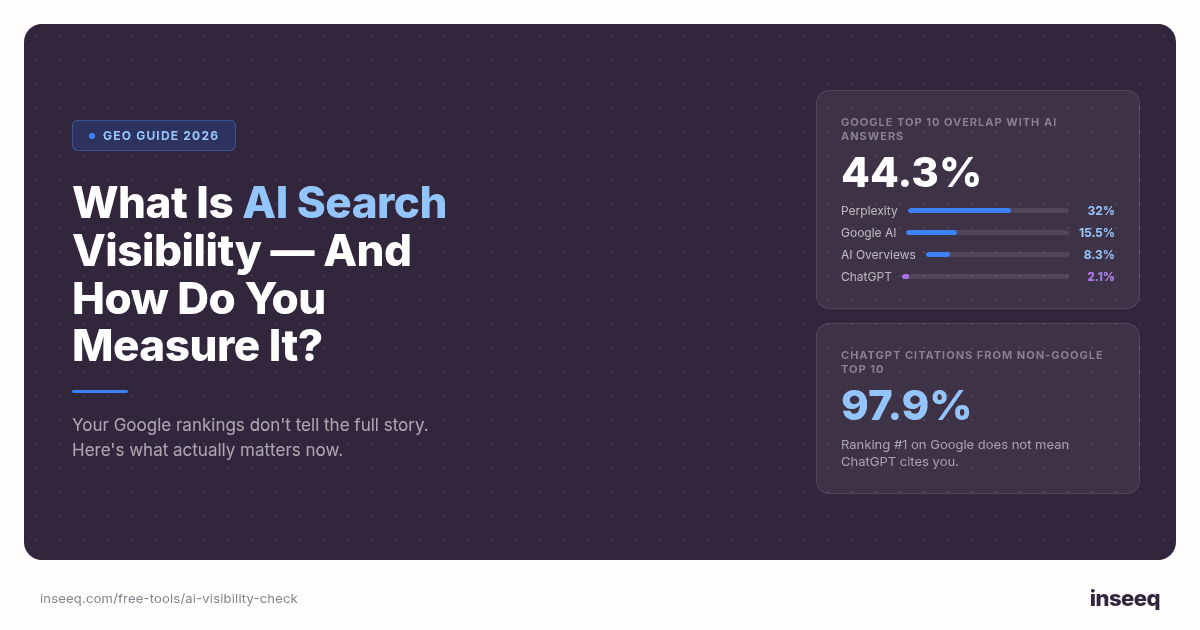
Chart showing AI search visibility overlap between Google top 10 rankings and AI platform citations — ChatGPT only 2.1%, Perplexity 32%
What AI Search Visibility Actually Means
You ask ChatGPT which project management tool is best for remote teams. It answers confidently, naming three options, explaining the tradeoffs, and linking to a couple of sources. Your product isn't mentioned. Your competitor's is.
That's the AI search visibility problem in a single scenario.
AI search visibility is how often your brand appears in the answers generated by AI-powered platforms like ChatGPT, Perplexity, Google AI Overviews, and Gemini. Not as a blue link in a ranked list. As a named source, a cited authority, a recommended solution.
It takes two forms:
Mentions: Your brand is named in an AI-generated response without a direct link to your site. The AI knows you exist and references you as relevant.
Citations: Your brand is named and linked. The AI is using your content as a source and signaling that to the user.
Both matter. Citations drive referral traffic. Mentions build brand presence in a context where no click happens at all. And increasingly, no click is exactly what happens: users get their answer from the AI and move on.
This is the structural shift that makes AI search visibility different from everything that came before. Traditional SEO operates on a ranked list. Position 1 gets the most clicks, position 10 gets almost none. There's a gradient.
AI search doesn't work that way. There's no ranked list. There's a synthesized answer. You're either in it or you're not. You're cited or you're invisible.
The funnel has also collapsed. Where traditional search created multiple touchpoints across awareness, consideration, and decision stages, AI search compresses this into two moments: educational (the AI explains something) and transactional (the user clicks to buy or book). If your brand isn't showing up in the educational answers, you're not in the consideration set when users reach the transactional moment.
Why Your Google Rankings Don't Tell the Whole Story
This is the finding that surprises most B2B marketers when they first see it: only 44.3% of pages that rank in Google's top 10 for a given query also appear in AI-generated answers for that same query.
Less than half.
The overlap varies by platform. According to Semrush's 2026 AI Visibility analysis, the breakdown looks like this:
Platform | Overlap with Google Top 10 |
|---|---|
Perplexity | 32% |
Google AI Mode | 15.5% |
Google AI Overviews | 8.3% |
ChatGPT | 2.1% |
ChatGPT cites pages from Google's top 10 only 2.1% of the time. Which means 97.9% of ChatGPT citations come from sources that aren't dominating Google rankings.
Why? Because AI systems and search engines use fundamentally different signals to decide what's worth surfacing.
Google weights domain authority, backlink profiles, PageRank, and click-through behavior. AI models weight content depth, topical specificity, structural clarity, and how well a piece actually answers the question being asked. These systems are looking for content they can extract and cite, not content that competes for a ranking position.
The practical consequence: a competitor with a weaker Google presence but better-structured, more topically authoritative content can be getting cited constantly by ChatGPT while you rank in the top three on Google and get zero AI citations.
That's not a hypothetical. It's what inseeq sees regularly when running AI visibility audits for B2B companies. Strong SEO performance and zero AI search visibility are entirely compatible failure modes.
The risk isn't just missed traffic. It's that AI systems are increasingly shaping the narrative in your market. When a prospect asks ChatGPT or Perplexity who the leading providers are in your space, the AI's answer doesn't pull from your website. It pulls from sources it has indexed as authoritative. If those sources mention your competitors and not you, the AI is actively working against you in every buyer's research process.
The Metrics That Actually Matter for AI Visibility
Measuring AI search visibility requires different metrics from traditional SEO. Keyword rankings don't exist here. There's no position 1 to track.
The four metrics that actually matter:
Citation rate How often does your brand get cited when AI systems answer queries relevant to your category? This is the core metric. It's measured by running a defined set of prompts across your target AI platforms and tracking how frequently your domain appears as a cited source. A citation rate of zero means you are producing content that AI systems do not consider worth referencing.
Share of voice Within the AI-generated answers relevant to your industry, what percentage of citations goes to your brand versus competitors? If your category generates 100 AI citations per week and you appear in 3, your share of voice is 3%. Your nearest competitor appearing in 22 has a 7x advantage in AI search presence.
Sentiment Not just whether you're mentioned, but how. AI systems summarize and characterize brands. "Company X is known for competitive pricing but mixed customer support reviews" is a citation that may work against you. Tracking sentiment across mentions gives you insight into how AI is positioning your brand in buyers' minds before they ever visit your site.
Competitive gap The delta between your AI visibility and your top competitors', measured across the same prompt set. This is the most actionable metric early on. It tells you whether you're invisible in absolute terms or just behind the right competitor on specific topics.
Manual tracking across these four metrics is possible but time-consuming. The standard approach is to define 20 to 30 prompts representing the questions your buyers actually ask, run them weekly across ChatGPT, Perplexity, and Google AI Mode, and record results in a shared spreadsheet. It takes roughly two to three hours per week to maintain.
Purpose-built tools automate this. Options range from free spot-check tools to platforms running continuous tracking across hundreds of prompts. The right level of tooling depends on how much of your pipeline is at risk if AI search visibility is zero.
How to Check Your AI Search Visibility Right Now
You don't need a subscription to get a baseline reading. Here's how to do it manually in under 30 minutes, and where to go if you want a proper measurement.
Manual method
Open ChatGPT, Perplexity, and Google AI Mode (if available). Run these prompt types and record what you find:
"What are the best [your product category] tools for [your target use case]?"
"Who are the leading [your industry] companies?"
"What do experts recommend for [the main problem your product solves]?"
"Compare [your brand] vs. [your main competitor]"
For each response, note whether your brand is mentioned, whether it's cited with a link, what's said about it, and which competitors appear instead. Five to six prompts across three platforms gives you a workable picture of your current AI search presence.
What you'll likely find: you appear in some prompts and not others. Your competitor appears more consistently. The AI describes you less specifically than you'd like.
Free checker
inseeq's free AI visibility checker runs this analysis automatically and returns a scored report: which AI platforms cite you, which queries trigger your brand, where competitors are outperforming you, and what content gaps are driving the invisibility.
It takes about two minutes to run and gives you the baseline data you need before deciding how much effort to put into AI search optimization.
What to look for
Three things to evaluate in the results:
Citation coverage: Are you appearing in any AI answers at all, or zero? Zero is a content structure problem more than a content volume problem.
Topical gaps: Which categories of queries return citations for competitors but not for you? These are your priority targets.
Sentiment framing: When you are mentioned, is the characterization accurate and favorable? Negative or vague AI characterizations are fixable with targeted content.
Why Most Brands Are Invisible to AI Search (And How to Fix It)
The most common assumption when a brand discovers it has zero AI search visibility: "We need more content."
Usually wrong. The problem isn't content volume. It's content structure and content authority.
Content authority vs. domain authority
Domain authority (the SEO metric measuring the strength of your backlink profile) has very limited predictive value for AI citation. What AI systems respond to is content authority: depth of topical coverage, directness of answers, specificity of claims, and structural clarity.
A 3,000-word article that comprehensively answers a specific question in a well-organized format is more likely to get cited by ChatGPT than ten 600-word articles on vaguely related topics. AI systems are looking for sources they can extract from, not sources with high PageRank.
Structural factors
The structural elements that improve AI citability are well-documented:
Use clear H2 and H3 headings that mirror how users phrase questions
Answer questions directly, in the first paragraph of each section
Use tables for comparisons and reference data, since AI systems extract structured data efficiently
Include specific, verifiable statistics with source citations
Keep paragraphs short and on a single topic
These aren't just SEO best practices. They're how you make content that AI systems can parse, extract, and cite without confusion.
Freshness signals
According to Semrush's analysis, approximately 90% of AI-cited pages were published within the last three years. AI systems appear to weight recency more heavily than traditional search engines. If your most authoritative content is five years old, it may be invisible to AI systems regardless of its quality.
Refreshing existing content with current data, updated statistics, and new sections is a lower-effort path to improved AI visibility than producing entirely new articles.
Earning mentions across the web
AI models don't just index your site. They index the entire web, including Reddit threads, industry publications, review platforms, and LinkedIn posts. Brand mentions in trusted third-party contexts carry significant weight.
Getting your brand discussed accurately in places AI systems regularly crawl: industry publications, comparison sites, Reddit communities in your niche, and guest articles on authoritative domains. These mentions shape how AI models characterize your brand even before a user visits your site.
This is why inseeq's approach to AI search visibility combines content production with broader distribution. A well-structured article on your own domain plus consistent mentions in external sources compounds faster than either strategy alone.
For a deeper look at how to audit and fix AI visibility gaps systematically, see the AI Search Audit: How to Find Out If AI Is Recommending Your Competitors Instead of You.
Frequently Asked Questions
What is AI search visibility? AI search visibility is how often and how prominently your brand appears in the answers generated by AI-powered platforms like ChatGPT, Perplexity, and Google AI Mode. It is measured through citations (links to your site in AI responses) and mentions (references to your brand without a link).
Is AI search visibility the same as SEO? No. Traditional SEO optimizes for ranked positions in a list of links. AI search visibility optimizes for citations in synthesized answers. The signals AI systems use to decide what to cite (content depth, structural clarity, topical authority) are meaningfully different from the signals Google uses to rank pages (backlink profiles, PageRank, click behavior). Strong SEO performance does not guarantee AI visibility.
Which AI platforms should I track my visibility on? The three highest-priority platforms for most B2B brands are ChatGPT, Perplexity, and Google AI Mode. If your audience skews European, also track Google AI Overviews. If your category has significant research-phase traffic, Perplexity is particularly important, since it is heavily citation-based and drives referral clicks at a meaningful rate.
How do I improve my AI search visibility? The most effective interventions are: restructuring existing content with question-based headings and direct answers, refreshing older articles with current data, earning third-party mentions on publications and platforms AI systems frequently crawl, and producing content that specifically targets the questions your buyers ask during research. Volume alone does not improve AI visibility; structure and authority do.
Can I measure AI search visibility for free? Yes. inseeq's free AI visibility checker provides a scored report of your brand's AI search presence across major platforms, including citation coverage, competitor comparison, and content gap identification. It runs in under two minutes.
How often should I check my AI search visibility? Monthly tracking is sufficient for most B2B brands getting started. Weekly tracking makes sense if you're actively executing an AI search optimization strategy and need to measure the impact of specific content changes. The core set of prompts you track should remain consistent over time so results are comparable.
Why does my brand appear in some AI answers but not others? AI citation is topic-specific. Your brand may have strong content authority in one part of your category and none in another. The prompts that return citations for you and the ones that don't map directly to the topical gaps in your content strategy. A structured AI visibility audit identifies exactly which topics you're invisible on and what it would take to close those gaps.
What to Do Next
Your Google analytics don't show you whether AI is recommending your competitors. Your ranking tracker doesn't tell you what ChatGPT says about your brand when a buyer asks. And by the time you notice the traffic decline, the narrative has already shifted.
The first step is measurement. Run inseeq's free AI visibility check and get a scored baseline. It takes two minutes and gives you the data to decide whether AI search visibility is a gap worth closing now or later.
For most B2B brands who run it, the answer is clear.

Hans-Peter Frank
Co-founder
How Visible Is Your Business in AI Search?
Find out in 60 seconds. Our free AI Visibility Checker scans ChatGPT, Perplexity, and Google AI Overviews for your brand.
Check Your AI Visibility