The 30 Million Citation Study: Why Reddit Outranks You in AI Search
Peec AI analyzed 30 million citations across ChatGPT, Gemini, Perplexity and AI Overviews. Reddit is #1. Here's what B2B brands need to do about it.
How Visible Is Your Business in AI Search?
Find out in 60 seconds. Our free AI Visibility Checker scans ChatGPT, Perplexity, and Google AI Overviews for your brand.
Check Your AI Visibility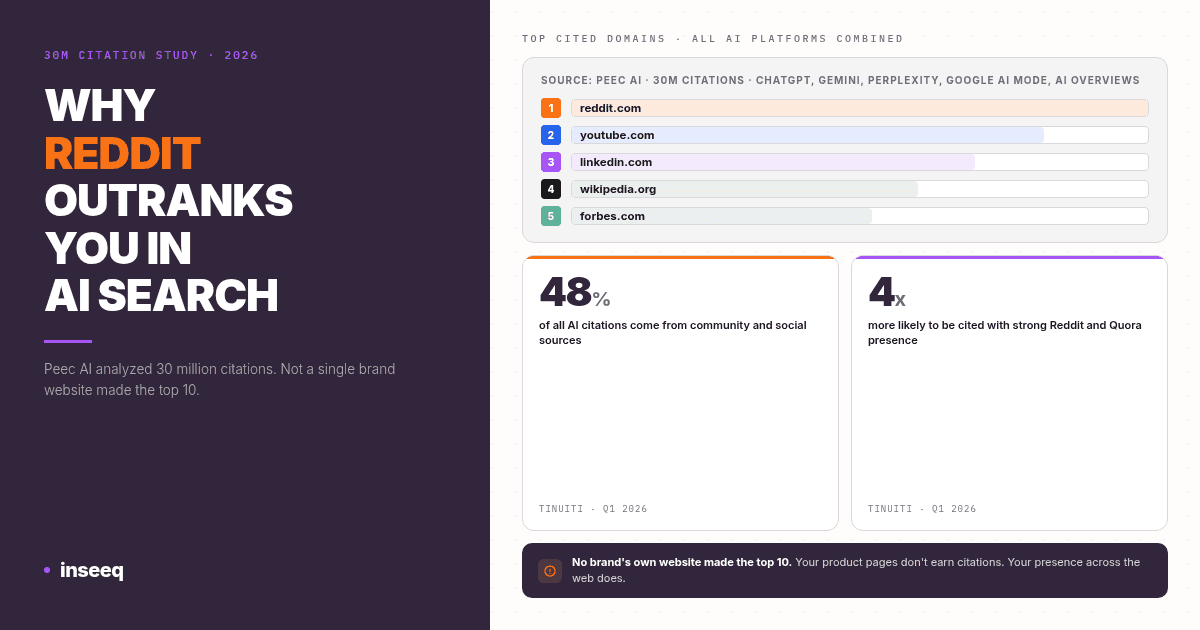
Bar chart showing top AI-cited domains from 30 million citation study: Reddit, YouTube, LinkedIn, Wikipedia, Forbes — with stats showing 48% community citation share and 4x citation boost for brands with Reddit presence
What the Study Found
Peec AI pulled 30 million direct citations from across ChatGPT, Google AI Mode, Gemini, Perplexity, and AI Overviews. Then they ranked the domains by how often each one got cited when AI systems answered questions.
Here is the top 10:
Reddit
YouTube
LinkedIn
Wikipedia
Forbes
G2
Yelp
Facebook
Medium
TechRadar
Look at that list carefully. Not a single brand's own website made it. The sources AI systems trust most are community platforms, video, professional networks, reference databases, and editorial publications. Your carefully crafted product pages, your blog, your about us section — none of it makes the global top 10.
This is not a minor finding. It is a structural description of how AI systems have decided to evaluate credibility. The web has been training these models for years. What the models learned is that real people discussing real experiences on Reddit, that expert practitioners writing on LinkedIn, that independent reviewers publishing on G2 — these sources are more trustworthy signals than what a brand publishes about itself.
Social and community sources now account for 48% of all AI citations. Owned domains and editorial sources account for the remaining 52%. Half of all AI citations come from platforms most B2B brands treat as secondary marketing channels at best.
The implications for content strategy are not incremental. They are structural.
Why Reddit Wins (And What It Actually Signals)
Reddit's dominance across every major AI platform is not accidental. It reflects something specific about how AI systems are trained to evaluate source reliability.
Reddit threads contain first-person accounts from people with direct experience. They contain problem-solution structures that map cleanly to the questions AI systems are trying to answer. They contain authentic language that matches how real people phrase queries. And they contain multiple perspectives on the same topic, which allows AI systems to triangulate what is actually true versus what a single source claims.
Brands with a significant presence in relevant Reddit discussions and on Quora are approximately four times more likely to be cited in AI responses than brands that exist only on their own sites, according to Tinuiti's Q1 2026 research. That is not a marginal advantage. It is a structural one.
There is also a financial dimension. Google signed a $60 million annual licensing deal with Reddit that directly reinforces Reddit's citation signals across Google's AI surfaces. Reddit content is not just organically preferred — it is commercially embedded in how Google's AI products source information.
The risk here is real in the other direction too. When Reddit sued Perplexity in October 2025 over unauthorized content use, Perplexity's Reddit citation share dropped 86% in the immediate aftermath. Citation signals from community platforms are powerful but can be volatile. A multi-platform presence distributes that risk.
The takeaway is not that brands need to go post on Reddit. It is that authentic community presence, where real people discuss your brand or your category in real contexts, is now citation infrastructure. It needs to be treated strategically, not left to chance.
The Platform-by-Platform Breakdown
One of the most important findings in the 30 million citation study is how differently each AI platform sources its answers. There is no single AI citation strategy. Each platform rewards different content types, different domains, and different signals.
ChatGPT leans editorial and reference-driven. Its top cited domains include Wikipedia, Forbes, TechRadar, and LinkedIn. When ChatGPT answers a question, it reaches for authoritative editorial sources and professional content. Reddit features here, but its weight is lower than on other platforms. ChatGPT cited Reddit in roughly 5% of responses in January 2026.
Perplexity shows the strongest B2B commercial behavior. G2 appears prominently in its citation mix alongside LinkedIn, Reddit, YouTube, and Wikipedia. For software categories and recommendation queries specifically, Perplexity pulls heavily from review platforms. If your brand is not represented on G2, it is likely invisible to Perplexity for commercial intent queries.
Google AI Mode and AI Overviews favor social and platform content. YouTube, Facebook, Yelp, and Reddit all feature prominently. Reddit accounts for roughly 44% of Google AI's social citations. Google's financial relationship with Reddit reinforces this pattern. For local and product categories, Yelp carries meaningful weight.
Gemini sits between the others, drawing on Reddit, YouTube, Wikipedia, and long-form editorial material. Its citation behavior is more balanced across content types than the other platforms.
The practical implication: a brand optimizing only for ChatGPT misses most of the citation surface area on Perplexity, Google AI Mode, and Gemini. Each platform requires its own presence strategy. Monitoring only one platform gives a profoundly incomplete picture of your actual AI search visibility.
What This Means for B2B Brands
Most B2B brands have put their content investment in the wrong place, measured by where AI citations actually come from.
The owned website is necessary. It accounts for roughly 52% of citations and provides the factual core that AI systems reference when describing your product, your positioning, and your category. But 52% is not the whole game. The other 48% is earned entirely on platforms that most B2B marketing teams treat as secondary.
LinkedIn is now the number one AI citation source for professional and B2B queries, according to a SEMrush analysis of 325,000 prompts. LinkedIn native articles in the 500 to 2,000 word range account for more than half of all LinkedIn AI citations. Individual profile content outperforms company page content for citations on most platforms. A founder or senior practitioner publishing specific, data-backed insights on LinkedIn is building citation infrastructure that a company blog post cannot replicate.
YouTube is the second most-cited domain overall. The citation mechanism here is transcripts and descriptions, not the video itself. AI systems cannot watch video. What they can read is the auto-generated or submitted transcript, the description, and the metadata. A YouTube video with a clean transcript covering a topic your buyers research is a citation asset. Most B2B companies have not treated their YouTube presence this way.
G2 is Perplexity's top B2B source. If your software product has sparse or outdated reviews on G2, Perplexity is effectively blind to your brand for the commercial intent queries where buyers are closest to a decision. The same logic applies to Capterra, Trustpilot, and category-specific review platforms.
Reddit and Quora presence matters for exploratory and comparison queries. A potential buyer asking "what is the best tool for [use case]?" is getting their answer shaped by Reddit threads discussing that exact question. If your brand is not mentioned in those discussions, in an authentic and helpful way, it is absent from that moment in the buyer journey.
Building a Five-Layer Citation Strategy
The research points to a clear operating model for brands that want to be consistently cited across AI platforms. It has five layers, and all five are necessary.
Layer 1: Owned factual core. Your website needs clean, structured, comprehensive content about your product, category, and the problems you solve. This is where AI systems anchor their understanding of your brand. Schema markup, an accessible llms.txt file, and clear topical coverage across your core use cases are the baseline requirements. Without this, the other layers have nothing to amplify.
Layer 2: Expert distribution on LinkedIn. Individual practitioners at your company, founders, senior leaders, subject matter experts, should be publishing native LinkedIn articles and posts on the topics your brand owns. Not promotional content. Specific, data-backed, insight-driven content that treats LinkedIn as a publication, not a megaphone. This content gets indexed, gets cited, and builds topical authority that company pages alone cannot generate.
Layer 3: Demonstrative media with clean transcripts. YouTube videos covering your category, your use cases, and your methodology need clean transcripts. If you are not actively submitting or editing transcripts for your YouTube content, you are leaving citation surface area on the table. Webinar recordings, product walkthroughs, and expert interviews all qualify. The transcript is the asset.
Layer 4: Third-party validation. G2, Capterra, Trustpilot, and relevant category review platforms are not just sales tools. They are AI citation infrastructure. An active review profile with specific, detailed customer reviews gives AI systems the third-party validation signals they weight heavily for commercial intent queries. Proactively collecting reviews from customers and keeping your profiles current directly improves your AI citation probability for buyer-stage queries.
Layer 5: Consistent entity claims. AI systems build their understanding of a brand by aggregating signals from across the web. If your brand description, positioning, and key claims are inconsistent across your website, LinkedIn, G2, press mentions, and other sources, the AI systems cannot form a coherent picture. Consistency in how you describe your brand, your category, and your differentiation across every platform reinforces citation probability everywhere.
inseeq audits citation coverage across all five layers and builds the content programs that close the gaps. For brands starting from scratch on their AI visibility, the free AI visibility checker shows immediately where you stand and which platforms represent the biggest gaps.
Frequently Asked Questions
Does my brand need a Reddit account to get cited? Not necessarily. The most effective path to Reddit citation is authentic participation in relevant discussions, which can come from individual team members and founders rather than a branded account. Branded Reddit accounts that post promotional content tend to be downvoted and flagged, which actively hurts rather than helps. The goal is genuine presence in conversations where your category is discussed — answering questions helpfully, contributing to threads, and being referenced as a credible source over time.
How do I know which platforms AI uses to cite brands in my category? The fastest way is to run the queries your buyers actually use across ChatGPT, Perplexity, Google AI Mode, and Gemini, and observe which domains get cited in the responses. Note which platforms cite which types of sources for your category. B2B software categories will likely see heavy G2 and LinkedIn citation via Perplexity. Consumer categories will see more Reddit and YouTube. Category-specific patterns diverge meaningfully from the global top 10.
Is LinkedIn really more important than my own blog for AI visibility? For B2B queries specifically, LinkedIn content is often cited more frequently than equivalent content on a brand's own website. This is because LinkedIn carries stronger domain authority signals and because individual-authored expert content is weighted differently than brand-published content. The answer is not to deprioritize your blog — owned content still accounts for 52% of citations — but to treat LinkedIn publication as a parallel priority, not an afterthought.
How quickly can third-party citations start showing up in AI answers? Third-party content, particularly on high-authority domains like LinkedIn and Reddit, can start appearing in AI citations within days of publication, since these platforms are crawled frequently. Review platform content typically takes longer because it requires accumulating enough reviews to register as meaningful. The key variable is content depth and specificity. A generic LinkedIn post earns nothing. A specific, well-structured LinkedIn article on a topic your buyers research can start getting cited within a week.
What's the biggest mistake B2B brands make with AI citation strategy? Treating it as an SEO extension rather than a distinct discipline. The instinct is to optimize existing pages for keywords and assume that ranking well will translate to AI citations. The 30 million citation study shows this assumption is wrong. Citation is driven by content depth, platform distribution, third-party validation, and entity consistency — not keyword density or backlink counts. The brands that are already winning in AI search built a presence across the citation landscape, not just on their own site.

Hans-Peter Frank
Co-founder
How Visible Is Your Business in AI Search?
Find out in 60 seconds. Our free AI Visibility Checker scans ChatGPT, Perplexity, and Google AI Overviews for your brand.
Check Your AI Visibility