
How We Built a Content Engine That Runs 95% on AI
A behind-the-scenes breakdown of how inseeq built a content production system that runs 95% on AI — the tools, the workflow, the tradeoffs, and the results.
How Visible Is Your Business in AI Search?
Find out in 60 seconds. Our free AI Visibility Checker scans ChatGPT, Perplexity, and Google AI Overviews for your brand.
Check Your AI Visibility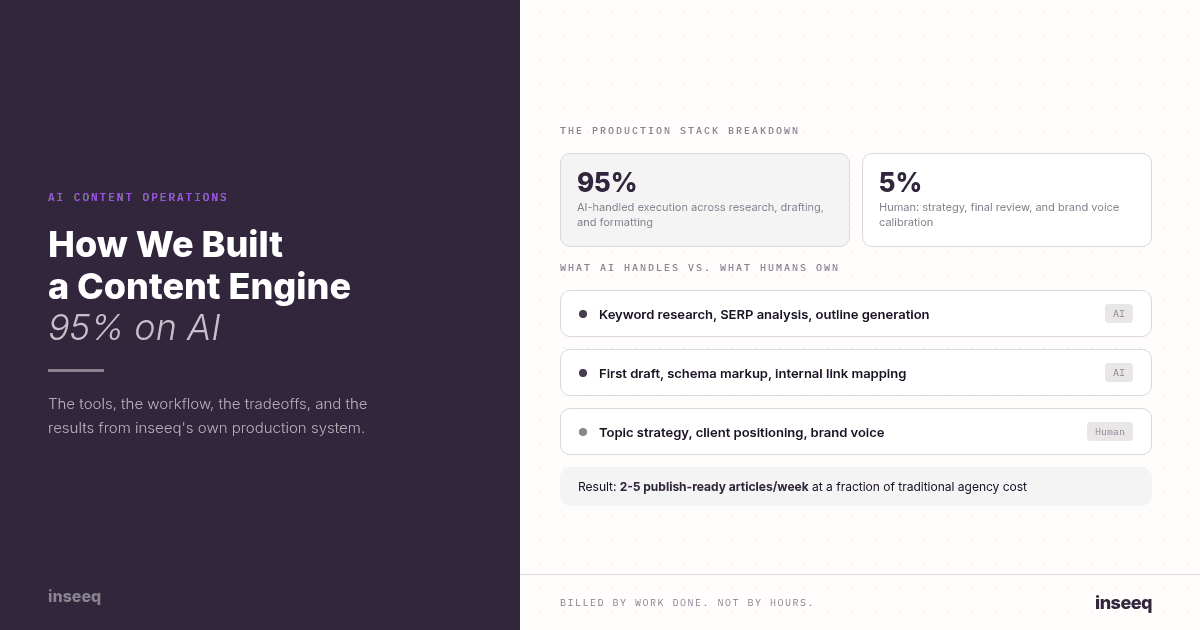
AI vs human content production split showing 95% AI and 5% human roles in inseeq's content engine
Most agencies talk about AI. We built our entire operation around it.
This is the actual breakdown of how inseeq runs a content production system where 95% of execution is handled by AI. Not a case study with the edges smoothed off. The real workflow, the real tradeoffs, and the real numbers.
Why We Did It
The traditional content agency model is economically broken. You hire writers, editors, strategists, account managers. You bill by the hour. Margins erode. Quality is inconsistent. Output is slow.
We didn't want to build that. We wanted to build something closer to software than a service firm — where output scales without headcount, and quality is a function of systems, not individual performance.
The goal wasn't to cut costs (though we did). The goal was to build something structurally different. A content engine that could publish 2-5 articles per week for multiple clients at 36-60 EUR per article, with consistent quality, and results visible in month one.
That's not possible with a human-first model. So we built an AI-first one.
What 95% AI Actually Means
People hear "95% AI" and imagine a fully automated pipeline spitting out garbage. That's not what this is.
95% refers to execution volume. AI handles:
Keyword research and topic clustering
Competitive content analysis
Outline generation
First-draft writing (full articles, 1500-3000 words)
Meta descriptions, SEO titles, slug suggestions
Internal linking recommendations
Featured image generation
WordPress publishing
The 5% that's human is the part that determines whether any of the above is worth anything:
Topic strategy and prioritization
Editorial judgment on every draft
Quality control before anything goes live
Client communication and feedback loops
Positioning decisions
The human-in-the-loop isn't a compromise. It's the product. Remove it and you get AI slop. Keep it and you get a content operation that actually moves metrics.
The Stack
We're not using one tool. The engine is a pipeline of specialized systems, each handling a specific job.
Keyword and topic research flows through search intent analysis and AI query modeling. We're not just asking "what does Google rank?" but "what does Perplexity cite, what does ChatGPT reference, what does Gemini surface?" GEO (Generative Engine Optimization) requires a different input signal than traditional SEO.
Outlines are generated with competitor structure analysis built in. The AI reads the top-performing content for a given keyword and drafts an outline that covers the topic more completely, not just differently.
Drafting happens in structured sections. Not one long prompt. Each section is generated with its own context window, then assembled. This produces more consistent output than end-to-end generation.
Images are generated programmatically. Featured images are rendered from HTML/CSS templates, not DALL-E wildcards. This enforces brand consistency at scale.
Publishing is automated end-to-end. From final approval to WordPress live, no human touches a keyboard.
The Tradeoffs We Made
Building this honestly required making some hard calls.
Speed vs. depth. AI first drafts are fast. They're also sometimes shallow. The editorial layer exists specifically to catch this. We added time back into the process at the review stage, not the generation stage.
Consistency vs. creativity. A templated system produces predictable output. That's mostly a feature, occasionally a constraint. For commodity content (listicles, how-tos, comparison pages), it's perfect. For brand-voice-forward content, the human edit is heavier.
Scale vs. client specificity. The more we systematize, the harder it is to accommodate one-off requests. We solved this by being selective about clients. The engine works best for clients with a clear brief, a defined audience, and a topic cluster we can own.
None of these are dealbreakers. They're design decisions. The system is optimized for what most B2B companies actually need: consistent, high-quality content at a volume and cost that moves the needle.
What the Numbers Look Like
inseeq client project b. went from baseline traffic to +300% within 90 days. LohnDialog was generating 40 qualified leads per month after one month of collaboration.
Those aren't outliers. They're what happens when you publish consistently, optimize for AI search visibility, and let the engine run.
For context on what this costs: 36-60 EUR per article. Traditional agencies charge 300-1000+ EUR for the same output, with longer turnaround times and no guarantee on results.
We back the model with a money-back guarantee after month one. If the results aren't there, you don't pay. That's a commitment no traditional agency makes because their model doesn't support it. Ours does.
What We'd Build Differently
A few things we'd change if we were starting over:
Start with the editorial layer, not the AI layer. We built the generation pipeline first and bolted on quality control later. The better sequence is to define your editorial standards first, then design the AI to produce output that meets them.
Invest in feedback loops earlier. The engine gets smarter when it learns from what didn't work. We built our feedback loop six months in. It should have been month one.
Treat GEO as a first-class metric from day one. We started with Google rankings as the primary success metric and added AI search visibility tracking later. These are different signals. A piece can rank well on Google and be invisible in AI search — and increasingly, the AI search miss is the more expensive one.
The Honest Summary
95% AI doesn't mean 95% automated. It means 95% of the execution work is handled by AI so the human effort can be concentrated where it actually matters: strategy, judgment, and results.
The content engine isn't magic. It's a system. And like any system, the output quality is a function of the inputs and the people maintaining it.
If you're a B2B company publishing fewer than two articles a month, you're not building content authority. You're producing content artifacts. The engine is what turns output into outcomes.
See how your brand currently performs in AI search. Get your free AI visibility report.

Hans-Peter Frank
Co-founder
How Visible Is Your Business in AI Search?
Find out in 60 seconds. Our free AI Visibility Checker scans ChatGPT, Perplexity, and Google AI Overviews for your brand.
Check Your AI Visibility