
How to Get Your Brand Cited by ChatGPT, Perplexity, and Google AI
Most brands are invisible to ChatGPT, Perplexity, and Google AI. Here's the tactical playbook for getting your brand cited in AI-generated responses.
How Visible Is Your Business in AI Search?
Find out in 60 seconds. Our free AI Visibility Checker scans ChatGPT, Perplexity, and Google AI Overviews for your brand.
Check Your AI Visibility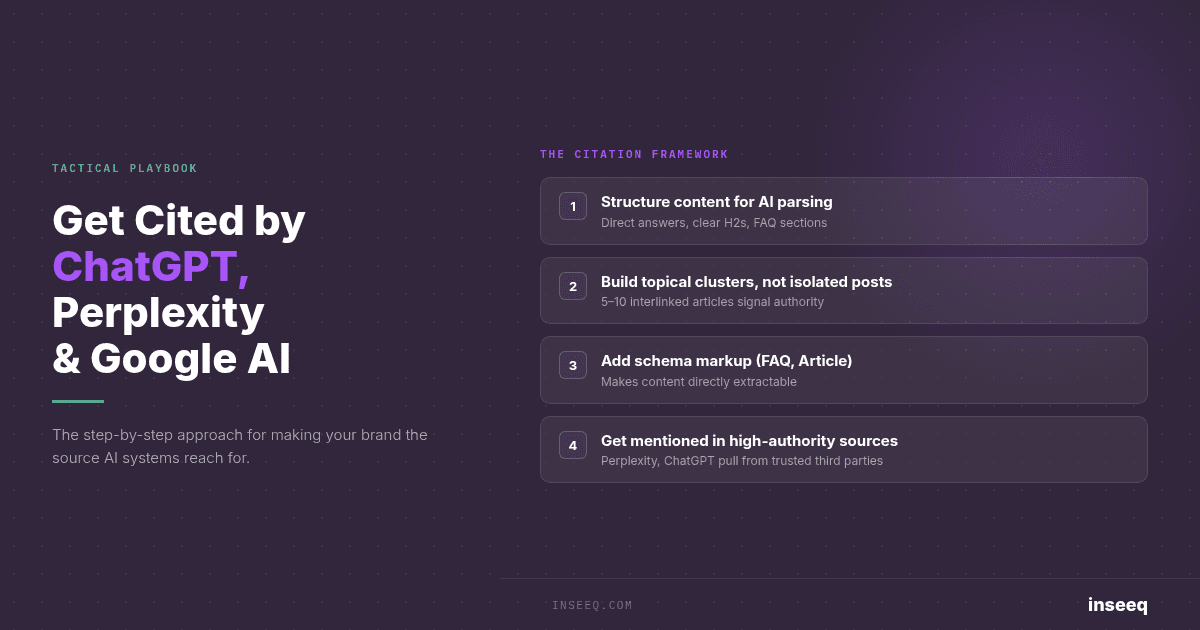
Four-step citation framework for getting your brand cited by ChatGPT, Perplexity, and Google AI search engines
Why Most Brands Are Invisible to AI Search
Type your brand name into ChatGPT and ask it to recommend solutions in your category. Note who gets mentioned. For most B2B brands, the response names two or three competitors and nothing else.
This isn't a ranking problem. It's a structural problem. The brands getting cited aren't necessarily the biggest or most established. They're the ones whose content is organized in a way that AI search engines can extract, trust, and cite.
AI search engines operate on a citation model. When a user asks a question, the system synthesizes an answer from sources it considers authoritative and relevant, then references those sources explicitly. The output isn't a list of links. It's a response that may or may not include your brand, depending on whether your content meets the criteria for citation.
Getting cited is not a passive outcome of good SEO work. It requires deliberate structuring of content and brand presence for the way AI systems actually evaluate and select sources. The playbook for that is different enough from traditional SEO that it warrants a separate strategy, even if the two share some foundations.
How Each Platform Decides What to Cite
The major AI search platforms don't all use the same sources or apply the same logic. Understanding each one matters because a complete AI visibility strategy needs to cover all of them.
ChatGPT with Search
ChatGPT's search functionality draws primarily from Microsoft's Bing index, supplemented by OpenAI's own training data. For queries that trigger a web search, it retrieves and synthesizes current results from pages Bing has indexed. This means Bing crawlability is a prerequisite: if Bing hasn't indexed your content, ChatGPT's search feature can't find it. Beyond indexing, ChatGPT weights authority signals from Bing's index, including backlink profiles, content quality, and page structure.
Perplexity
Perplexity operates its own crawler and explicitly cites every source it uses in a response. This makes it the most transparent AI search engine for tracking citations. Perplexity indexes content independently of Google and weights recency heavily for dynamic topics. It also tends to favor content that answers questions directly and specifically, making structural clarity particularly important for Perplexity visibility.
Google AI Overviews
AI Overviews appear at the top of standard Google search results and synthesize answers before any ranked links. They draw from Google's index and apply Google's E-E-A-T (Experience, Expertise, Authoritativeness, Trustworthiness) signals to evaluate sources. This makes traditional SEO signals — backlink authority, domain trust, structured data — more relevant for AI Overviews than for Perplexity or ChatGPT. If your content ranks well in Google, it has a higher baseline probability of appearing in AI Overviews.
Gemini
Google's Gemini is integrated across Google Search, Workspace, and Android. Its source selection draws on the Google ecosystem, meaning Google index signals, Knowledge Graph data, and structured data markup all feed into what Gemini references. Schema markup and clear factual claims matter more for Gemini than for other platforms.
What they have in common
Despite using different data sources and citation logic, all four platforms converge on the same underlying requirements: content must directly answer relevant questions, claims must be specific and verifiable, and the source must be consistently authoritative on the topic. These shared requirements are where to focus the content foundation work.
The Content Foundation for AI Citations
Tactics only work on top of a content foundation that meets baseline citation requirements. Four structural elements determine whether your content gets extracted and cited.
Step 1: Write for direct answers, not narrative engagement
Traditional content marketing often builds to the answer: engage the reader, establish context, then deliver the payload. AI search engines don't read articles the way humans do. They parse content looking for direct answers to specific questions. Content that buries the answer in narrative context is harder to cite than content that states the answer clearly in the first sentence of a section.
The practical change: every H2 section should open with a direct statement of the answer to the implicit question in that heading. If your H2 is "How does Perplexity select sources?", the first sentence of that section should answer that question directly, not build up to answering it.
Step 2: Build topical clusters, not isolated articles
A single well-written article is a weak signal. A cluster of five to ten interlinked, substantive articles covering a topic from multiple angles sends a strong signal: this source covers this subject comprehensively. AI systems develop a model of which sources are authoritative on which topics over time. Topical depth is more influential than individual article quality.
For a B2B SaaS company, this means publishing not just a product page and a blog post, but a cluster of articles that covers the problem space from every angle: definition articles, comparison articles, tactical guides, case studies, FAQ-focused pieces. Each article links to the others. The cluster, not the individual article, builds the citation authority.
Step 3: Add FAQ sections that map to real questions
FAQ sections are high-value citation targets for AI search engines. A question-and-answer format maps directly to the way AI responses are structured. When an AI system is synthesizing a response to a specific question, a FAQ entry that addresses that exact question in two to four clear sentences is easy to extract and cite.
Every substantive article should include a FAQ section with five to seven questions drawn from the real questions people ask (available via People Also Ask data, keyword research, and manual AI searches). Write concise, direct answers. Don't pad FAQ responses.
Step 4: Include verifiable, specific claims with sources
AI systems favor citable facts over vague assertions. The difference between getting cited and being ignored often comes down to whether a piece of content contains something worth extracting. Vague claims like "AI search is growing rapidly" provide nothing citable. Specific claims with sources do.
Include data points: industry research, survey results, specific numbers with attribution. Cite external sources with links. When you make a claim, make it in a form that an AI can extract and include in a response: "According to [source], [specific number] [specific fact]."
Technical and Structural Signals That Drive Citations
Beyond content quality, several technical elements affect whether AI systems can find, parse, and trust your pages.
Schema markup
Structured data markup in JSON-LD format helps AI systems understand what your content is and what it contains. The schema types most relevant for GEO are:
FAQ schema: marks up question-and-answer pairs on your page, making them directly extractable
Article schema: signals publication date, author, and content type — freshness and authorship signals matter for Perplexity and Gemini
HowTo schema: for step-by-step instructional content, helps AI systems extract procedures cleanly
These schema types don't guarantee citation, but they reduce friction for AI systems trying to extract structured information from your page.
Clear heading hierarchy
A consistent H1 > H2 > H3 heading structure where each heading maps to a real question is the baseline structural requirement. H2 headings should be phrased as questions or clear topic statements. H3 subheadings break those topics into specific aspects. AI parsers use heading structure as a navigation system to find relevant answers within a page.
Internal linking within topic clusters
Internal links between articles in the same topical cluster reinforce the signal that a site covers a topic comprehensively. They also help AI crawlers discover related content. Every article in a cluster should link to at least two to three others in the same cluster using descriptive anchor text.
Page speed and crawlability
Slow-loading pages and crawl errors are disqualifying factors for citation. If an AI crawler can't reliably access your content, it won't be indexed as a source. Standard technical SEO hygiene — clean sitemaps, no broken links, fast load times, mobile rendering — is the entry requirement for AI visibility, not a differentiator.
Off-Page Signals: Getting Mentioned Where AI Pays Attention
Content on your own site is one signal. The other is being mentioned in third-party content that AI systems treat as authoritative.
Publications AI systems index
Search Engine Land, TechCrunch, G2, Capterra, Product Hunt, and major industry publications are sources that AI search engines weight heavily. Getting your brand, tool, or methodology mentioned in articles on these publications creates citation surface area that AI systems draw on. A mention in a Search Engine Land article carries more AI citation weight than five articles on a low-authority blog.
Tool directories and roundups
"Best [category] tools" roundup articles are high-citation-probability content. When someone asks Perplexity "what's the best [tool category]?", the response often draws from these roundups. Being listed on G2, Capterra, Product Hunt, and in authoritative roundup articles dramatically increases the probability of citation in category queries.
Thought leadership that generates citable mentions
Original research, proprietary data, and frameworks that other publications reference are citation multipliers. When your data gets cited in other articles, those articles become vectors for your brand being cited in AI responses. A survey report with specific findings that other writers quote is worth more for AI visibility than a dozen generic blog posts.
Wikipedia-adjacent authority
AI training data is heavily influenced by Wikipedia and other authoritative reference sources. While getting a Wikipedia page for your brand requires meeting notability standards, being cited in Wikipedia articles related to your space, or having your methodology referenced in educational and reference content, amplifies AI visibility significantly.
Measure Before You Optimize
Every tactic above works better when you know your starting point. Without a baseline, you're optimizing blind — investing in content areas where you might already have citations and ignoring the gaps where you have none.
Before building any content or chasing any placements, run an AI visibility check across the major platforms. Know: which queries cite you, which don't, which platforms include you, and who your competitors are being cited against.
inseeq's free AI visibility checker runs this analysis across ChatGPT, Perplexity, Google AI Overviews, and Gemini in minutes. The output is a structured score showing where you have citations and where the gaps are. Use that as the prioritization input for everything else.
Once you have a baseline, the approach is straightforward: build content in the gaps, fix structural issues in existing content, and track citation frequency over time as the work compounds.
Frequently Asked Questions
How does ChatGPT decide which sources to cite? ChatGPT's search functionality draws from Microsoft's Bing index. It selects sources based on relevance to the query, authority signals in the Bing index (including backlinks and content quality), and how directly the content answers the user's question. For ChatGPT to cite you, your content needs to be indexed by Bing and structured to answer the relevant question clearly.
Does Perplexity use Google's index? No. Perplexity operates its own crawler and builds its index independently. This means Perplexity indexing is separate from Google indexing. A page that ranks well in Google is not automatically indexed or cited by Perplexity. You need to ensure your site is crawlable and that your content meets Perplexity's quality and relevance signals, which weight recency and direct answers heavily.
How long does it take to start appearing in AI search results? Timelines vary by competitive intensity, starting content quality, and platform. Brands with existing content authority in their space typically see measurable citation gains within 60 to 90 days of targeted GEO work. Building from scratch in a competitive category takes three to six months of consistent execution. The fastest wins usually come from restructuring existing high-traffic content for AI parsing, which can show results faster than publishing new articles.
Do I need schema markup to be cited by AI? Schema markup is not a strict requirement, but it reduces friction significantly. FAQ schema and Article schema make your content easier for AI parsers to extract and trust. For Google AI Overviews specifically, schema markup correlates with higher citation rates because it aligns with E-E-A-T signals that Google AI weighs. It's a high-leverage, low-effort implementation that's worth doing before optimizing anything else.
What type of content gets cited most in AI responses? Content that gets cited most often shares four characteristics: it answers a specific question directly and clearly, it includes verifiable, specific claims with sources, it's structured with clear headings that map to real questions, and it comes from a source that has covered the topic consistently across multiple pieces of content. FAQ-formatted content, data-heavy articles with citations, and in-depth comparison pieces tend to perform best.
Is there a difference between being cited in AI Overviews vs. ChatGPT? Yes. AI Overviews draw from Google's index and apply Google's authority signals, so content that ranks well in Google has a higher baseline probability of appearing in AI Overviews. ChatGPT uses Bing's index with its own authority logic, which is correlated with but not identical to Google's. Perplexity uses an independent index. A complete AI visibility strategy targets all three separately rather than assuming that performing well in one guarantees performance in others.
How do I track whether my brand is being cited by AI search engines? Manual tracking means running representative queries across ChatGPT, Perplexity, and Google and recording whether your brand appears. This is practical for initial baseline checks but doesn't scale. Dedicated AI visibility tools, including inseeq's free AI visibility checker, run systematic query sets across multiple platforms and return structured citation data. For ongoing monitoring, scheduled checks across a defined query set give you trend data over time.
Start With Your Baseline Score
Getting cited by ChatGPT, Perplexity, and Google AI is not a mystery. The content that gets cited is direct, specific, well-structured, and comes from sources that have demonstrated topical authority over time. The technical barriers are low. The operational requirement is consistent execution.
The first step is knowing where you stand. Check your current AI visibility across the major platforms with inseeq's free AI visibility checker. It takes two minutes and gives you the baseline every other tactic depends on.
For more on the underlying mechanics, read What Is AI Search Visibility (And Why Google Rankings Don't Tell the Whole Story) and GEO vs SEO: What's Different and What Actually Matters for Your Brand.

Hans-Peter Frank
Co-founder
How Visible Is Your Business in AI Search?
Find out in 60 seconds. Our free AI Visibility Checker scans ChatGPT, Perplexity, and Google AI Overviews for your brand.
Check Your AI Visibility