
How to Get Cited by Perplexity AI (And Why Your ChatGPT Strategy Won't Cut It)
Perplexity cites sources differently than ChatGPT. Here's the exact content strategy B2B brands need to start showing up in Perplexity answers.
How Visible Is Your Business in AI Search?
Find out in 60 seconds. Our free AI Visibility Checker scans ChatGPT, Perplexity, and Google AI Overviews for your brand.
Check Your AI Visibility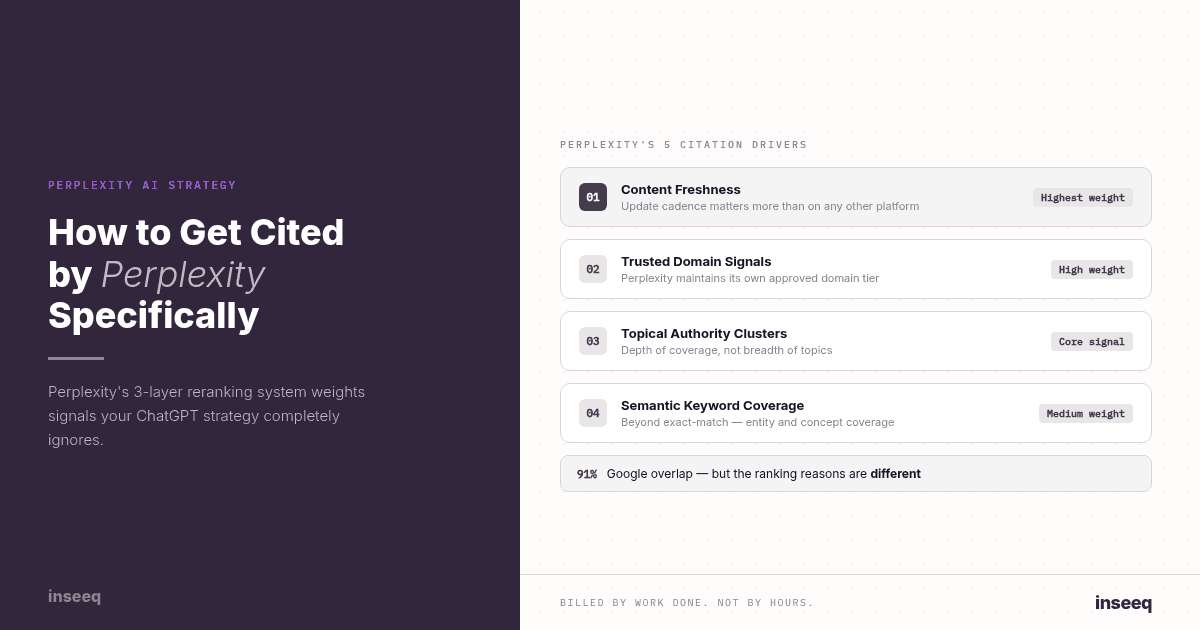
Perplexity AI citation factors including freshness, trusted domains, and topical authority
Perplexity Has a Different Citation Engine — and Most Brands Are Ignoring It
You optimized for ChatGPT. You followed the GEO playbook: structured content, topical authority, clean markup. Your brand shows up in ChatGPT answers. Good. Now open Perplexity and search for something in your space. Count how many times your site gets cited.
For most B2B brands, that number is zero.
Not because your content is bad. Because Perplexity runs on a fundamentally different retrieval architecture than ChatGPT. The tactics that got you cited in one system don't automatically transfer to the other. And Perplexity is growing fast: the platform hit 15 million daily active users in early 2026, up from around 10 million mid-2025, with query volume growing roughly 300% year-over-year according to Perplexity's own published data.
The brands building Perplexity AI SEO strategies now are positioning themselves in a channel that competitors haven't figured out yet. That window won't stay open long.
Here's what's actually different, and what to do about it.
How Perplexity Actually Decides What to Cite
ChatGPT answers questions from its training data. It synthesizes what it learned during training and generates a response. Your content influences that only if it was included in the training corpus, which you have limited control over.
Perplexity works the opposite way. Every query triggers a live web search. Perplexity retrieves a candidate set of pages, runs them through a reranking model, and then synthesizes an answer from the highest-scoring sources. The citations in the response are the sources that cleared the reranker's quality threshold.
This matters because it means Perplexity AI optimization is closer to technical SEO than it is to the brand-presence work that drives ChatGPT visibility. Your pages need to be crawlable, fast, semantically clear, and surfaced by the underlying search layer before the reranker even sees them.
The three-layer process looks like this:
Layer | What Happens | What You Control |
|---|---|---|
Initial retrieval | Perplexity's search index pulls candidate pages | Crawlability, indexing, keyword relevance |
Reranking | Quality model scores each page for citation-worthiness | Content depth, authority signals, freshness |
Synthesis | Answer is generated from top-ranked sources | Structured answers, quotable claims |
Perplexity's reranker weighs signals differently than a standard search algorithm. Based on research from Princeton's 2024 GEO study and Perplexity's published best practices, the factors with the highest citation lift are: content freshness, presence of statistics and quotable claims, domain authority signals, and structured answer formatting. User engagement signals, such as how often users click a cited source, feed back into the reranker over time.
The key difference from perplexity AI optimization vs. optimizing for ChatGPT: Perplexity can be influenced right now, with content you publish today. ChatGPT's training data has a cutoff. Perplexity's index doesn't.
The 5 Factors That Drive Perplexity Citations in 2026
1. Content Freshness
Perplexity heavily weights recency because its value proposition is real-time answers. A page last updated in 2023 will lose to a well-structured page updated this quarter, even if the older page has more backlinks.
What this means in practice:
Publish and update dates should be visible and accurate, not just in metadata but on the page itself
Refresh high-value articles quarterly at minimum, not just to change the date but to add new data and remove outdated claims
Pages targeting time-sensitive queries ("best X in 2026") need active maintenance to stay cited
2. Trusted Domain Signals
Perplexity's retrieval layer uses domain-level trust signals to filter its candidate set. Domains with stronger authority profiles are more likely to make it into the initial candidate pool that the reranker evaluates.
This means the backlink-building work you do for Google SEO directly feeds perplexity AI SEO performance. They're not separate strategies. The difference is that Perplexity also weighs signals Google doesn't: Wikipedia citations, mentions on platforms like Reddit and Quora, and presence on established news and industry publications.
Actions that build trusted domain status for Perplexity:
Earn editorial mentions on high-authority industry publications, not just any backlinks
If your company is notable enough, a Wikipedia presence (or citation as a source on existing pages) meaningfully lifts citation rates
Get your data and research cited by other sites, so multiple pages reference your content rather than you being an isolated source
3. Topical Authority Clusters
Perplexity cites sources it perceives as genuine subject-matter authorities, not sites that happened to write one good article on a topic.
The American Kennel Club gets cited for dog-related queries not because of any single piece of content but because their entire domain signals deep, consistent expertise on that subject. The same principle applies to B2B content. If inseeq publishes 10 well-structured articles on AI search visibility and GEO, its pages are far more likely to be cited for those queries than if it had published one article and moved on.
This is why the internal linking strategy from your existing GEO article matters: it tells Perplexity's reranker that these pages are part of a coherent topical cluster, not isolated pieces.
Content clusters worth building for B2B brands:
A pillar page on your core topic, with depth (2,000+ words)
Supporting articles targeting related queries and secondary keywords
Cross-links between all cluster pieces using natural anchor text
Consistent update cadence across the cluster, not just the pillar
4. Semantic Keyword Coverage
Perplexity's underlying language model understands topical relationships between keywords. A page that only targets the exact phrase "perplexity AI SEO" but doesn't cover related concepts like citation optimization, reranking, or AI search visibility will be outcompeted by a page that covers the full semantic neighborhood of the topic.
Secondary keywords to weave into a Perplexity-focused article:
Perplexity AI ranking
Perplexity AI optimization
AI search visibility
Optimize for Perplexity AI
Perplexity citation strategy
The goal is coverage, not stuffing. Each secondary keyword should appear naturally in a section where it genuinely fits the content.
5. Meta Titles and Descriptions as Citation Anchors
Perplexity's synthesis layer often pulls from meta descriptions when constructing its response, particularly for definitional and comparison queries. A well-written meta description that directly answers the question being searched is significantly more likely to be quoted inline.
The rule: your meta description should read like the opening sentence of a great answer, not like a marketing pitch. Compare:
Bad: "Learn how inseeq helps B2B brands get more AI visibility."
Good: "Perplexity cites sources differently than ChatGPT. Here's the exact content strategy B2B brands need to start showing up in Perplexity answers."
The second version answers a question directly. It's quotable. The first is promotional and adds nothing to a synthesized response.
What Your Existing GEO Strategy Gets Wrong for Perplexity
Most GEO frameworks were designed with ChatGPT in mind. That's not a criticism: ChatGPT is the largest AI search product by volume. But the strategies diverge at a fundamental level, and applying a ChatGPT-first playbook to Perplexity leaves real citations on the table.
The three most common mistakes:
Mistake 1: Treating content as static. ChatGPT's training data was fixed at a cutoff date. Once your content was indexed in that training run, it contributed to your brand's presence regardless of whether you updated it. Perplexity re-crawls continuously. Content that hasn't been refreshed signals low investment in accuracy, which the reranker penalizes. The brands getting consistent Perplexity citations treat their key articles like live documents, not published artifacts.
Mistake 2: Ignoring engagement signals. Perplexity tracks which cited sources users actually click through to. Pages that get cited but not clicked gradually lose citation share to pages that drive clicks. This means your page titles need to work as headlines: specific, benefit-clear, and accurate enough that a user trusts them before clicking. A vague title like "AI Search Guide" will underperform "How Perplexity Decides What to Cite (And How to Be One of Its Sources)."
Mistake 3: Building authority in the wrong places. ChatGPT's training data included massive amounts of content from the open web, Reddit, Wikipedia, and forum discussions. Brand mentions in those places feed ChatGPT brand recognition. Perplexity has a Reddit search mode and draws heavily from Wikipedia for definitional queries, but for B2B informational queries, it primarily cites authoritative trade publications, research papers, and high-domain-authority websites. The guest post on a DA 20 blog that might help your ChatGPT presence doesn't move the needle for Perplexity. The byline in a DA 70 industry publication does.
A Perplexity Citation Playbook for B2B Brands
Follow these steps in order. The first two are diagnostic; the rest are operational.
Step 1: Audit your current Perplexity visibility. Open Perplexity and run 20 to 30 queries your target customers actually use. Document which pages get cited, which competitors appear, and where you're absent. This is your baseline. Do this manually, weekly. There's no automated tool that fully replaces it yet, though tracking "perplexity.ai" as a referral source in Google Analytics gives you a partial signal.
Step 2: Map your content against the query list. For every query where a competitor is cited and you're not, identify whether you have a page that should be ranking. Three scenarios:
You have a relevant page that isn't being cited: audit it against the 5 factors above
You have no relevant page: add it to your content calendar as a priority
A competitor has a fundamentally stronger page: decide whether to build a better version or target a different angle
Step 3: Refresh your highest-potential existing content first. New articles take time to build authority. Your existing content already has some domain signal. Pick the 3 to 5 articles most likely to get cited for high-value queries and run them through the following checklist:
Updated date is accurate and visible
Page loads in under 3 seconds
Meta description directly answers the target query
Content includes specific statistics with source citations
At least one comparison table or structured list
FAQ section addressing 5 to 7 PAA questions
Internal links to at least 2 related articles on your site
Step 4: Build content clusters, not standalone articles. Identify your 2 to 3 most important topic areas and plan a cluster: one pillar article targeting the primary keyword, 4 to 6 supporting articles targeting related queries, and cross-links between all of them. inseeq's approach to this is documented in the AI content infrastructure guide.
Step 5: Get cited by sources Perplexity already trusts. Identify 5 to 10 high-authority publications in your space that Perplexity regularly cites for your target queries (you'll see them in your audit from Step 1). Prioritize getting your data, research, or expert commentary featured on those sites. A single mention on a source Perplexity already treats as authoritative is worth more than 20 mentions on sites outside its trusted set.
Step 6: Track and iterate. Re-run your query audit monthly. Compare your citation rate to the previous month. Look for patterns: which content types are getting cited, which competitors are losing ground, which queries are showing opportunity. Adjust your content calendar based on what the data shows, not on gut feel.
Frequently Asked Questions
How is Perplexity SEO different from regular SEO? Traditional SEO optimizes for ranking positions in a list of links. Perplexity AI SEO optimizes for being cited as a source in a synthesized answer. The underlying content quality requirements overlap significantly (depth, authority, accuracy), but the specific signals differ: Perplexity weights freshness, structured answers, and quotability more than Google weights them in organic rankings.
Is Perplexity SEO different from regular SEO? Yes, in meaningful ways. Standard SEO is primarily about earning ranking positions. Perplexity citation optimization is about earning selection as a source in a synthesized answer. The same high-quality content tends to perform in both contexts, but Perplexity's additional weighting of freshness, statistics, and direct-answer formatting means you need to optimize specifically for citation, not just for ranking.
How do I track if Perplexity is citing my content? Two methods. First, manual testing: run your target queries in Perplexity weekly and note which sources appear. Second, referral tracking: in Google Analytics 4, look for "perplexity.ai" under Acquisition, then Traffic Acquisition. Perplexity sends trackable referral traffic when users click through to cited sources, which is a meaningful advantage over ChatGPT where traffic attribution is much harder.
How often should I update content for Perplexity? At minimum, quarterly for your most important articles. Monthly is better if you're actively competing for high-value citations. The update doesn't need to be a complete rewrite: adding recent statistics, correcting outdated figures, and adding a new FAQ entry or section counts as a meaningful refresh.
Does social engagement affect Perplexity citations? Indirectly. Social signals don't directly feed Perplexity's retrieval algorithm the way they might influence certain Google ranking factors. But content that performs well on social tends to earn more backlinks and editorial mentions, which do feed trusted domain signals. Perplexity's Reddit search mode also means content that gets genuine engagement on Reddit surfaces for relevant queries in that mode specifically.
See Where Your Brand Stands in AI Search
Most B2B brands don't know their current Perplexity citation rate. They're not showing up in the answers their buyers are reading, and they have no system to fix it.
inseeq runs AI visibility audits that map exactly which queries you're being cited for across Perplexity, ChatGPT, and Google AI Overviews, and where competitors are eating your lunch. From there, we build the content and technical infrastructure to close the gap.
See how your brand performs in AI search. The audit is free. The results are specific.

Hans-Peter Frank
Co-founder
How Visible Is Your Business in AI Search?
Find out in 60 seconds. Our free AI Visibility Checker scans ChatGPT, Perplexity, and Google AI Overviews for your brand.
Check Your AI Visibility