
Google Finally Wrote the AI Search Playbook. Here's What It Actually Says.
Google published its first official guide to optimizing for AI search. Here's what it actually confirms, what it debunks, and what it still won't tell you.
How Visible Is Your Business in AI Search?
Find out in 60 seconds. Our free AI Visibility Checker scans ChatGPT, Perplexity, and Google AI Overviews for your brand.
Check Your AI Visibility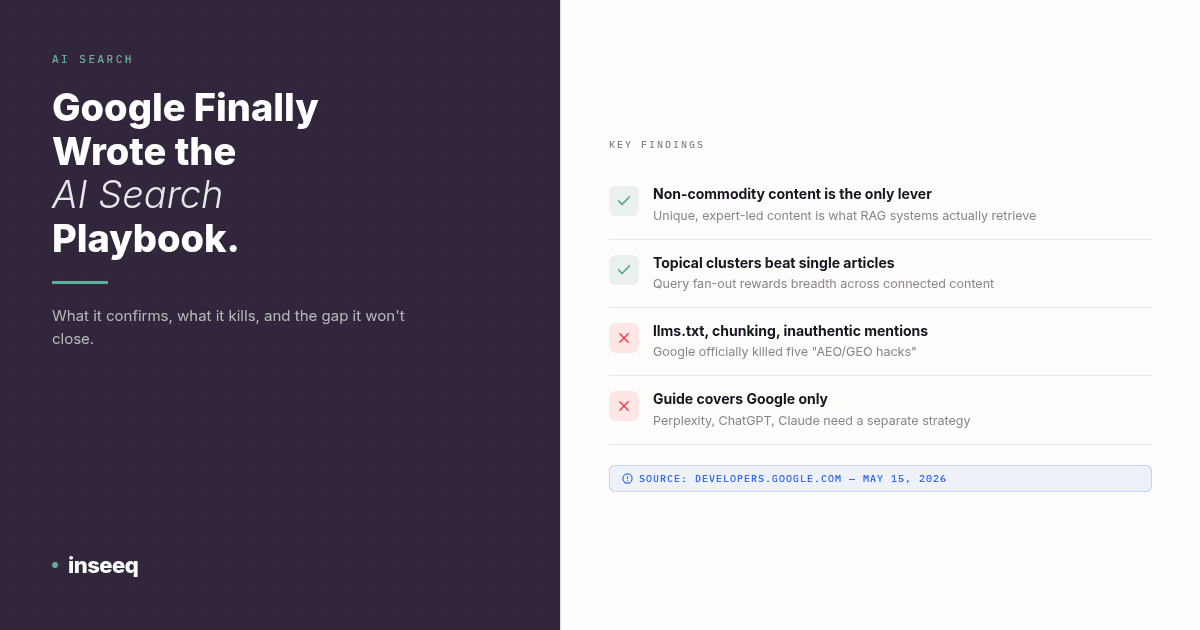
Featured image showing key findings from Google's first official AI search optimization guide, including confirmed best practices and debunked AEO/GEO hacks
Google Just Validated Everything GEO Practitioners Have Been Saying
For years, practitioners building content strategies around AI search visibility operated on educated inference. You studied how RAG systems retrieve sources. You tested what made Perplexity cite one page over another. You built structured, expert-led content and measured citation rates because no authoritative guide existed.
That changed on May 15, 2026.
Google published its first official guide to optimizing for generative AI features in Google Search — covering AI Overviews and AI Mode. The document is titled "Optimizing your website for generative AI features on Google Search" and it is the clearest signal Google has ever sent about what matters for AI search visibility.
The verdict: everything serious GEO practitioners have been doing is correct. And a long list of "AEO hacks" circulating the internet are a waste of time.
Here is what the guide actually says, what it means in practice, and the critical gap it leaves unaddressed.
The Three Things Google's Guide Confirms About AI Search
1. Non-Commodity Content Is the Only Thing That Compounds
Google's language on this point is unusually direct. The guide explicitly distinguishes between commodity content ("7 Tips for First-Time Homebuyers" — based on common knowledge, no unique insight) and non-commodity content ("Why We Waived the Inspection & Saved Money: A Look Inside the Sewer Line" — unique expert or experiential perspective).
Their framing: commodity content "could originate from anyone" and "typically adds little unique insight." Non-commodity content "provides unique expert or experienced takes that go beyond common knowledge."
This is not a soft preference. It is how Google's AI systems decide what to cite. Retrieval-augmented generation (RAG), the core mechanism behind AI Overviews, surfaces pages from the index and uses them to generate responses. Pages that offer nothing beyond what the model already knows provide no retrieval value. They get skipped.
The practical implication: if your content is a repackaged version of what already exists in the SERP, it will not be cited. Not because of a ranking penalty. Because AI systems genuinely do not need it.
2. Technical Crawlability Is the Floor, Not a Differentiator
Google confirms that to appear in AI search features, pages must be indexed and eligible to appear in search with a snippet. No index access, no AI visibility. This is table stakes.
The guide reinforces existing technical SEO best practices: crawlable content, semantic HTML (for accessibility and parsability), JavaScript handled correctly, good page experience, reduced duplicate content. None of this is new. All of it still matters.
One notable addition: Google mentions that AI systems may access content through browser agents that analyze visual renderings, DOM structure, and accessibility trees. This is a forward-looking signal. Agentic AI that can "browse" your site like a user is already in play. Sites that are poorly structured for screen readers or have content buried in inaccessible JavaScript are quietly failing a readability test that is about to matter more.
3. The Retrieval Mechanism Rewards Breadth, Not Just Depth
Google's explanation of "query fan-out" is worth reading carefully. When a user asks "how to fix a lawn full of weeds," Google's AI generates a set of concurrent, related queries: "best herbicides for lawns," "remove weeds without chemicals," "how to prevent weeds in lawn." Each of these fetches additional results to build the final response.
The implication for content strategy: topical authority across a cluster of related queries gives you more entry points into AI-generated responses than any single highly optimized page does. A content engine that builds connected, cross-linked coverage on a topic consistently outperforms a one-off article targeting a single keyword.
This is how inseeq has structured its clients' content from the start. The topical authority framework was not built for traditional SEO. It was built for the citation model AI search uses.
Five "AEO/GEO Hacks" Google Explicitly Killed
This is the section of the guide that deserves the most attention. Google named and dismissed a specific list of tactics that have been circulating as AI search optimization advice. If you or your agency has been doing any of these, stop now.
1. llms.txt Files and Special AI Markup
Google states clearly: "You don't need to create new machine readable files, AI text files, markup, or Markdown to appear in generative AI search."
llms.txt has been sold as the robots.txt for AI systems. The theory is that AI crawlers read it to understand your site structure. Google does not use it as a special signal. They can discover and crawl many file types — having an llms.txt does not earn you preferential treatment.
Note: this guidance is specific to Google's AI systems. Whether llms.txt is useful for other AI platforms is a separate question. But for Google's AI Overviews and AI Mode, it is not a factor.
2. "Chunking" Content for AI Parsability
Some practitioners have been breaking content into small, digestible pieces under the theory that AI systems retrieve in chunks and smaller units are easier to extract.
Google's response: their systems "are able to understand the nuance of multiple topics on a page and show the relevant piece to users." There is no ideal page length. Build pages for your audience, not for AI parsing logic.
3. Rewriting Content in AI-Friendly Syntax
The idea that AI systems need content written in a specific way to understand it is wrong. Google's AI "can understand synonyms and general meanings of what someone is seeking, in order to connect them with content that might not use the same precise words."
You do not need to write in a robotic question-and-answer format. You do not need to use exact keyword phrases throughout. You need to write clearly for humans. That is the instruction.
4. Seeking Inauthentic "Mentions"
There is an entire category of AI search tactics built around getting your brand mentioned across forums, review sites, and social platforms, under the theory that AI systems use mentions as a signal of authority.
Google confirms they can show what is being said about products across the web — but they are also clear that "seeking inauthentic mentions isn't as helpful as it might seem." Core ranking systems prioritize high-quality content. Spam detection systems filter the rest. Manufacturing mentions to game AI search is the same losing strategy as manufacturing links to game traditional SEO.
5. Overfocusing on Structured Data for AI
Structured data (schema markup) is not required for AI search and there is "no special schema.org markup you need to add." Google recommends continuing to use structured data as part of overall SEO strategy because it helps with rich results. But it is not an AI search lever on its own.
What Google Still Won't Tell You
The guide is well-written, honest, and more specific than anything Google has published before on this topic. But it has a scope problem.
It covers Google's AI features. Not ChatGPT. Not Perplexity. Not Claude. Not Gemini's standalone interface.
When your buyers search on Perplexity, the citation logic is different. Perplexity weights recency, source diversity, and structured answer formats in ways Google's systems do not. When ChatGPT search surfaces your brand, it is pulling from its own index and its own retrieval pipeline. When Claude cites a source, it has been trained on a dataset with different coverage patterns.
Google validating its own best practices does not give you cross-platform AI search visibility. That requires a different analysis.
The second gap: the guide says almost nothing about brand entity recognition. AI systems do not just retrieve documents. They build a model of what brands exist, what they do, and whether they are trustworthy sources. Building that entity layer — consistent brand mentions, structured data about your organization, a coherent knowledge graph footprint — is the work that makes citation possible at scale. Google's guide touches on local and ecommerce entity management (Merchant Center, Google Business Profiles) but says nothing about it for B2B brands.
This is not an oversight. It is the competitive edge that separates brands getting cited from brands getting ignored.
You can check where your brand currently stands across AI systems with inseeq's free AI visibility checker. It shows you exactly which platforms cite you, for which queries, and where the gaps are.
What This Means for Your Content Strategy Right Now
Google's guide is an invitation to stop overthinking AI search optimization and start executing the fundamentals. Three actions that follow directly from it:
Audit your existing content for commodity status. Go through your top 20 pages. For each one, ask: does this contain a perspective, data point, or experiential insight that could not have been written by someone who simply read the top 10 results? If the answer is no for most of them, you have a commodity content problem. AI systems will not cite pages they do not need.
Build topical clusters, not one-off articles. Query fan-out means AI systems pull from multiple sources to build a single response. A content engine that covers a topic from multiple angles, with internal cross-links connecting related pieces, gives your brand more citation surface area than a single high-ranking article. If you are publishing one article per month, you are not building a cluster. You are building a collection of unrelated pages.
Stop chasing AI-specific "hacks" and invest in content authority. The tactics Google debunked (llms.txt, chunking, inauthentic mentions, structured data as an AI lever) all share a common flaw. They try to hack the signal rather than build the underlying asset. The underlying asset is content that humans find useful, experts validate, and AI systems can use as a reliable source. There is no shortcut to that.
If you are not sure where to start, an AI visibility audit identifies the specific gaps between your current content and what AI systems need to cite your brand consistently.
Frequently Asked Questions
Does traditional SEO still matter for AI search visibility?
Yes. Google's guide confirms that its AI features are built on the same core ranking and quality systems as traditional search. Pages must be indexed and eligible to appear with a snippet. Foundational SEO — crawlability, page experience, technical structure — is the prerequisite for AI visibility, not an alternative to it.
What is the difference between AEO and GEO?
Answer Engine Optimization (AEO) is typically used to describe optimization for any AI-powered answer surface, including voice assistants and AI chatbots. Generative Engine Optimization (GEO) is more specific to large language model-based search systems that generate responses by citing sources. In practice, the terms are often used interchangeably, but GEO is the more precise framing for platforms like Google AI Overviews, Perplexity, and ChatGPT search.
Do I need to create an llms.txt file for my website?
No. Google has confirmed that llms.txt files are not used as a special signal for AI search visibility on its platforms. You do not need one to appear in AI Overviews or AI Mode.
How does Google decide which pages to cite in AI Overviews?
Google uses retrieval-augmented generation (RAG), which surfaces relevant pages from the index and uses their content to construct responses. The primary signals are the same as for standard search: content quality, authority, relevance, and technical accessibility. Pages with unique, expert-led, non-commodity content have the highest retrieval value.
Does structured data help with AI search?
Not directly. Google's guide states there is no special schema markup required for AI search features. Structured data is still recommended as part of overall SEO strategy for rich results, but it is not a distinct AI search lever.
What is query fan-out and why does it matter?
Query fan-out is the process by which Google's AI generates a set of related sub-queries to gather more information when answering a user's question. It means a single user query can trigger retrieval from multiple pages across multiple topics. Brands with topical coverage across a content cluster have more chances to be cited in any given AI-generated response than brands with a single high-ranking article.
How is Google AI search different from Perplexity or ChatGPT?
Google's AI features (AI Overviews, AI Mode) are grounded in Google's own index and ranking systems. Perplexity and ChatGPT have their own retrieval pipelines, different indexing priorities, and different source weighting logic. Appearing in Google's AI features does not guarantee visibility on other platforms. Cross-platform AI search visibility requires a separate, platform-aware content strategy.
Start with What AI Systems Can Actually See
Google's guide confirms the direction serious practitioners have been building toward: high-quality, expert-led, technically accessible content that covers topics with depth and specificity. That is the foundation.
What it does not cover is how to get cited across the full AI search landscape — Perplexity, ChatGPT, Claude, Gemini, and the AI agents that are increasingly making purchase and vendor decisions on behalf of buyers.
That is the gap inseeq is built to close. If you want to know exactly where your brand stands across all major AI platforms today, run a free AI visibility check. It takes two minutes and shows you which systems cite you, which ignore you, and what the path to visibility looks like.
For a deeper review of your full content strategy, book a free Growth Audit and see what AI search results are saying about your brand.

Hans-Peter Frank
Co-founder
How Visible Is Your Business in AI Search?
Find out in 60 seconds. Our free AI Visibility Checker scans ChatGPT, Perplexity, and Google AI Overviews for your brand.
Check Your AI Visibility