ChatGPT Just Opened Its Ad Platform. Organic Visibility Has a New Enemy.
ChatGPT ads hit $100M revenue in 6 weeks. Self-serve access launches this month. Here's what it means for brands relying on organic AI citation.
Ready for AI Search Optimization?
Get a personalized roadmap to make your brand visible in AI search results. Free growth audit with actionable insights.
Get Your Free Growth Audit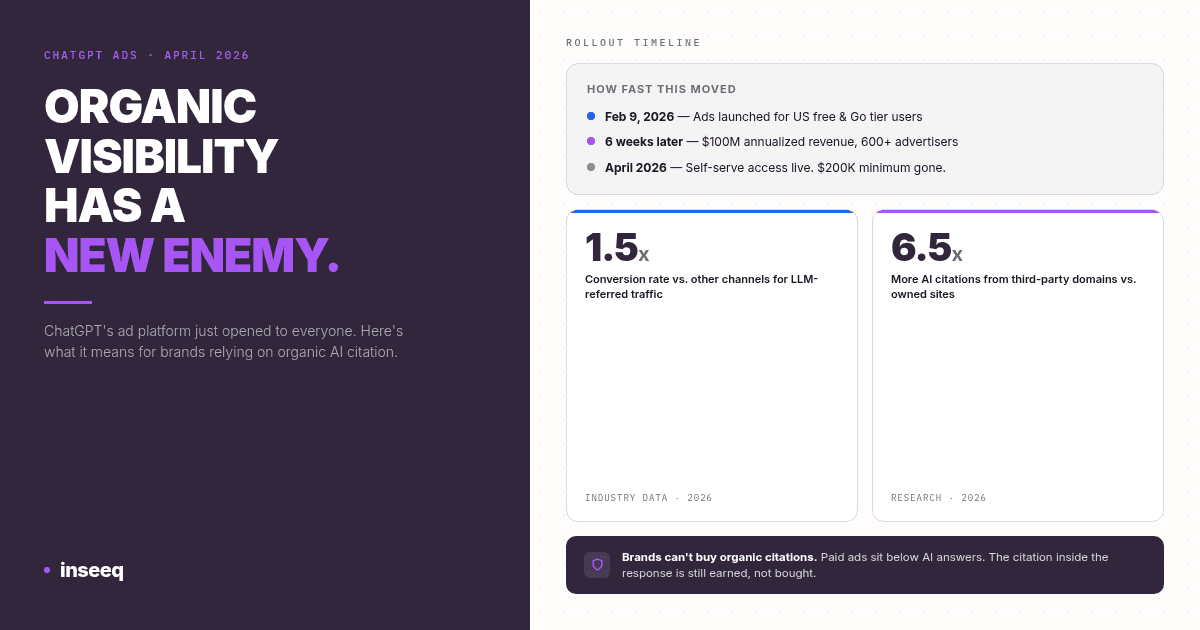
Timeline showing ChatGPT ads rollout from February 2026 to self-serve launch in April, with stats on LLM conversion rates and third-party AI citation rates
What Actually Happened (And When)
For the past two years, getting cited in ChatGPT was purely an organic game. You either structured your content to be referenced in AI answers, or you didn't show up at all. No amount of budget could change that.
That changed on February 9, 2026.
OpenAI began testing ads inside ChatGPT for US users on the free and Go tiers. Six weeks later, the program had crossed $100 million in annualized revenue with 600+ advertisers. By late March, OpenAI expanded access to Canada, Australia, and New Zealand. And this month, self-serve tools are launching, removing the $200,000 minimum commitment that kept the channel out of reach for most brands.
The numbers tell the story of how fast this moved. ChatGPT draws 72.9 million unique US visitors per month. Roughly 85% of free and Go tier users are now eligible to see ads. The channel went from zero paid inventory to a nine-figure annualized run rate before most marketing teams even had a briefing on it.
For context on the speed: Google Ads took years to reach its first $100 million. Facebook Ads took about 18 months. ChatGPT ads did it in six weeks. The demand was clearly there, waiting for supply.
This is not a future consideration. It is a live channel with real competition and a structural shift in how AI interfaces monetize attention. Every brand that has been treating ChatGPT as a purely organic channel needs to update that assumption now.
How ChatGPT Ads Work (And How They Don't)
Before adjusting strategy, it helps to understand exactly what ChatGPT ads are and what they are not.
Ads appear below AI-generated responses, clearly labeled as sponsored content. They are visually separated from the answer itself. OpenAI has been explicit: brands cannot buy their way into the organic response. The citation that appears inside the AI answer is determined by content quality and authority signals, not by ad spend. Paid and organic operate on parallel tracks.
The current ad format functions similarly to a display unit sitting beneath search results, visible but not integrated into the answer itself. Users who want the information get it from the AI response. The ad is a secondary visibility layer.
The performance metrics reflect this dynamic. Early CTR data puts ChatGPT ads at 0.91% to 1.3%, compared to Google's 6.4% to 29.2% across formats. The click rate is lower. But the conversion quality is meaningfully higher. Traffic referred from LLM platforms converts at approximately 1.5 times the rate of other channels, because users arriving from AI conversations tend to be further along in their research and more specific in their intent.
Think about who is using ChatGPT to research a purchase or evaluate a vendor: they are not browsing passively. They have a specific question and are actively building a decision. That intent level is significantly higher than someone scrolling a feed or performing a broad Google search. The lower CTR reflects a different user behavior, not lower commercial value.
The channel is early, and the benchmarks will shift. But the fundamental structure is clear: ads buy secondary visibility, organic citations buy primary visibility, and you cannot substitute one for the other.
The Threat to Brands Relying on Organic Visibility
Here is the competitive dynamic that matters most.
Before February 2026, the only way to show up in ChatGPT was through organic citation. That meant the brands investing in AI-visible content had an uncontested advantage. Competitors without that investment simply did not exist in the channel.
That advantage still exists, but it is no longer uncontested.
Competitors who ignored organic AI visibility can now buy a presence in the same interface where your citations live. They cannot buy the organic placement inside the answer. But they can buy the space immediately below it, visible to the same user at the same moment. The interface that was previously a pure meritocracy of content quality now has a paid layer running alongside it.
The early-mover dynamics on the paid side are significant. CPMs are low right now. Competition is thin. The brands registering for self-serve access in April are getting in before the market normalizes and costs rise. This is the same pattern that played out in Google Ads circa 2002, Facebook Ads circa 2012, and LinkedIn Ads circa 2016. The brands that showed up early when inventory was cheap built structural advantages that later entrants paid multiples to compete with.
There is also a consolidation risk. If your competitors are running ChatGPT ads and you are not, they appear twice in the user's session: once in the paid placement and potentially again in organic citations if they have done the content work. A brand with both organic citations and paid presence in the same AI interface has a significant share-of-voice advantage over a brand that has neither.
The window to enter cheaply is measured in weeks, not months. OpenAI is not slowing the rollout.
Why Organic Citation Still Wins (If You Have It)
The placement hierarchy in ChatGPT matters. Organic citations are embedded in the response body itself, the part users read first, trust most, and engage with directly as part of the answer. Paid ads sit below the response, labeled, and secondary to the answer the user came for.
This distinction has real implications for how each placement functions. A brand cited inside a ChatGPT response is being recommended as a source of authority on the topic. A brand in a paid ad is being served an impression alongside an answer. The trust signals are different, the engagement patterns are different, and the downstream conversion behavior reflects that.
Research consistently shows that third-party citations carry more weight with buyers than paid placements. Being the source ChatGPT references is closer to editorial endorsement than advertising. You cannot replicate that with ad spend.
But organic citation only wins if you have it. A brand with neither organic citations nor paid presence in ChatGPT has no position in the channel at all. A brand with only paid ads has secondary visibility but no authority signal. A brand with strong organic citations and early paid presence has both layers working together, which is where the compounding advantage lives.
The brands that spent the last 12 to 18 months building citation-first content strategies are now entering the paid era with a foundation that amplifies whatever they spend. The brands that did neither are starting from scratch in a channel that is no longer free to enter.
This is also why the instinct to shift budget from organic content investment to paid ChatGPT ads is exactly backwards. The organic work creates the authority signal. The paid work creates additional visibility alongside it. Without the first, the second is just ad spend with no reinforcement.
What to Do Right Now
The window for building organic authority before paid competition fully normalizes is still open, but it is narrowing. These are the three moves with the highest leverage right now.
1. Deepen your organic citation footprint before the paid market gets crowded.
Every piece of content your brand publishes that earns an organic citation in ChatGPT, Perplexity, or Google AI Mode is inventory that competitors cannot buy away from you. The time to build that inventory is before the paid market drives up competition and attention in the channel.
This means auditing where your brand currently gets cited, identifying the high-intent prompts where you should appear but don't, and closing those gaps with structured, authoritative content. inseeq runs this audit as a systematic process and builds the content program to close the gaps. The free AI visibility checker at inseeq.com gives you an immediate baseline on where you stand today.
2. Register for self-serve ChatGPT ad access now.
OpenAI is opening self-serve access this month. Brands that register early get access to the lowest CPMs, the most optimization data, and the most favorable inventory before competition scales. You do not need to commit large budgets to benefit from being in the market early.
Even a small early-stage presence gives you performance data that informs how to compete as the channel matures. Brands without that data will be making expensive decisions blind when costs normalize. The cost of being early is low. The cost of being late is not.
3. Build your third-party platform presence.
Research shows third-party domains are cited 6.5 times more often in AI responses than brand-owned domains alone. Reddit threads, LinkedIn articles, industry publications, and category-specific review platforms are the infrastructure that AI systems pull from most heavily.
A brand with comprehensive owned-site content but no third-party footprint is invisible in many of the contexts where buyers actually research. Building presence on the platforms AI systems trust most is the highest-leverage organic move available right now. It compounds over time in ways that ad spend alone cannot replicate, and it creates citation infrastructure that is genuinely difficult for competitors to displace.
The brands that own AI search in 2027 are the ones making these moves today, not the ones waiting for the channel to feel mature before committing.
Frequently Asked Questions
Can ChatGPT ads put my brand inside the AI answer? No. Paid ads in ChatGPT appear below the AI-generated response, clearly labeled as sponsored content. OpenAI has confirmed that the organic response and paid placements are entirely separate systems. Ad spend does not influence which brands get cited inside the answer itself. That is determined by content quality, authority signals, and how well your content is structured for AI extraction. The only path to organic citation is content that AI systems recognize as authoritative and relevant.
How much do ChatGPT ads cost? Early CTR data sits between 0.91% and 1.3%, with CPMs that are currently low relative to more established channels. The self-serve platform launching this month removes the $200,000 minimum that applied during the closed beta. Specific CPM rates are still evolving as the ad market develops, but the general principle holds: the earlier you enter, the cheaper the inventory. Brands that establish a presence now will have benchmarking data and optimization history that late entrants have to buy without.
Will ChatGPT ads replace SEO? No. They target different placements entirely. ChatGPT ads buy secondary visibility below AI responses. Organic citation, whether in ChatGPT, Google AI Overviews, or Perplexity, comes from content quality and authority, not budget. Both matter and both serve different functions. The brands with the strongest long-term position will invest in both rather than treating them as alternatives.
Should I pause my organic AI strategy to focus on ads? The opposite move makes more sense. Organic citation is the higher-trust placement and the foundation that makes paid presence more effective. Brands with strong organic citations that also run paid ads benefit from both layers reinforcing each other simultaneously. Pausing organic investment to redirect budget to paid ads results in secondary-only visibility with no authority signal in the channel, which undermines the performance of the ads themselves.
How do I know if my competitors are running ChatGPT ads? Search ChatGPT directly using the prompts your buyers actually use when evaluating options in your category. If you see clearly labeled sponsored content from competitors appearing below AI responses, they are already in the channel. Monitoring this regularly gives you real-time competitive intelligence. You can track which brands are investing, how frequently they appear, and whether their paid presence aligns with or gaps their organic citation coverage.

Hans-Peter Frank
Co-founder
Ready for AI Search Optimization?
Get a personalized roadmap to make your brand visible in AI search results. Free growth audit with actionable insights.
Get Your Free Growth Audit